Using an 800,000-year-old tooth, researchers unlock the secrets of Israel’s ancient elephant haven
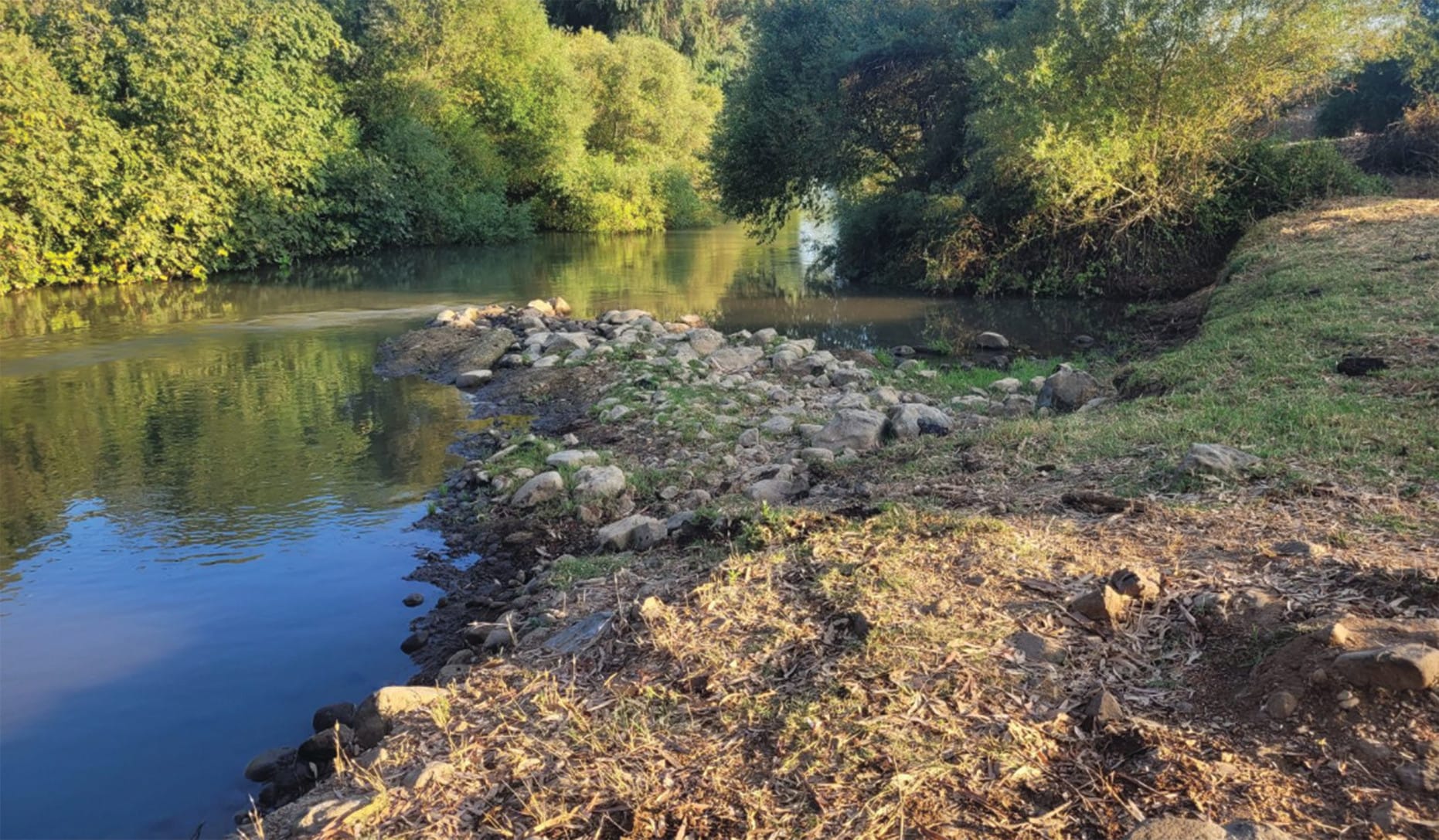
Long before modern history, the Hula Valley’s Gesher Benot Ya’aqov was as close to a Garden of Eden as the ancient world could offer. The site at the “Daughters of Jacob Bridge” is so even today.
Nearly 800,000 years ago, during the Middle Pleistocene Era, giant straight-tusked elephants, hippos, and rhinoceroses roamed a lush sanctuary of woodlands, wetlands, and waterways.
Living alongside these massive creatures were the region’s earliest humans – hominin toolmakers who left behind a remarkable record of survival along the Levantine corridor.
Nestled in northern Israel, the Hula Valley has long served as a vital bridge between Africa and Eurasia. Today, remarkable finds –including a well-preserved ancient elephant tooth and basalt handaxes – provide evidence of giant elephants and early toolmakers that together made the Hula Valley their home.
Saber-tooth tigers, rhinoceroses, hippopotami, giant wild cattle deer, gazelles, wild boars, freshwater turtles, lizards, and snakes shared the lush landscape of woodlands, wetlands, and waterways during the Middle Pleistocene Era that began some 780,000 years ago. But among the most impressive creatures were giant elephants alongside hominids – the Hula Valley’s most ancient humans.

Today, elephants, or other large animals, are kept in Ramat Gan’s Safari or Jerusalem’s Biblical Zoo, but the area remains verdant and bountiful, according to archaeologists from Tel-Hai University of Kiryat Shmona in the Galilee and colleagues at the University of Haifa and Tel Aviv University.
They found a remarkably preserved elephant tooth and tusk fragments at the prehistoric site in northern Israel, where early humans made stone tools – basalt handaxes and cleavers that were hallmark tools of the Acheulian tradition, one of the earliest and most widespread stone-tool technologies in human history.
The resource-rich environment that helped sustain both large mammals and early humans along the Levantine land bridge connecting Africa and Eurasia remains.
After studying the area for more than three decades, the archaeologists have just published their latest findings in Quaternary Science Reviews under the title “Elephant dental remains from the Acheulian site at North Bridge Acheulian-Gesher Benot Ya’aqov: hominin behavior and environmental implications.”
The study was led by University of Haifa doctoral student Hannah Farrell, at the site and excavated by Prof. Gonen Sharon of Tel-Hai. The team included Cheryl Makarewicz (isotope studies) and Nimrod Marom (archaeozoology) from the University of Haifa, along with Minji Jin and Dafna Langgut (pollen studies) from Tel Aviv University.
The research focuses on a giant elephant molar and tusk fragments discovered alongside Acheulian stone tools at Gesher Benot Ya’aqov’s northern locality located in the valley in northern Israel. The remains belonged to Palaeoloxodon antiquus, the straight-tusked elephant, one of the largest land mammals of the Pleistocene.
Rather than studying the elephant alone, researchers said they used the tooth as a biological archive to reconstruct the broader ecosystem shared by large mammals and early human toolmakers. “We applied high-resolution CT scanning of the tusk and molar recovered from the site,” Sharon noted.
The valley has abundant water, emanating from the Hermon Mountain range (mostly as melted snow), feeding underground springs and accounting for much of the abundant water. Today, the Jordan River with its three main tributaries – the Dan, the Banias and the Hatzbani – is the primary water body of the valley. From as early as the Lower Paleolithic, humans have opted to occupy the Hula Valley.
Today, the bridge is located south of the Hula Valley, probably due to the presence of high basalt there. A stone bridge was built by the Mamluks (an Arabic word that literally means “one who is owned” or “slave”) sometime in the 13th century that was replaced in 1934 by a modern bridge further south during the draining of Lake Hula.
The existing bridge was built almost two decades ago and now forms part of Israeli Highway 91, straddling the boundary between the Galilee and the Golan Heights.
Alongside the broad exposure of archaeological bearing sediments, there are uniquely well-preserved ancient flora specimens – wood, bark, seeds and fruits that provide exclusive data on the environment of the area during the Pleistocene Era and the behavior and diet of early humans in this landscape, Sharon told The Jerusalem Post in an interview. “Understanding how humans and animals responded to environmental change hundreds of thousands of years ago helps us better understand the forces that shaped our species.”
Using CT scanning, 3D reconstruction, microscopic wear analysis, isotope geochemistry, and pollen studies – each field being the expertise of a variety of experts – the team found evidence for a long-lasting landscape of woodlands, grasslands, marshes, rivers, and shallow-water habitats.
Carbon isotope values suggest the elephant lived in a consistently well-watered environment, while pollen recovered from sediments revealed abundant wetland vegetation, including reeds, sedges, willow, tamarisk, and aquatic plants.
Wildlife and human groups both moved via the Levantine Corridor land bridge. “We didn’t actually find human bones because we excavated just 100 square meters, so we would have needed a lot of luck to find them,” he explained. “But we have found tens of thousands of animal bones and tools at the site.”
Conditions for wildlife to survive
The availability of water, vegetation, and animal resources shaped where humans and wildlife could survive, Sharon added. “The wetlands, rivers, and woodlands helped sustain life along one of the world’s earliest migration corridors, offering a rare opportunity to understand the ecological conditions that supported both animals and human populations in that era.
Sharon, who heads the Tel-Hai Prehistory Laboratory, is also curator of the Upper Galilee Museum of Prehistory at Kibbutz Ma’ayan Baruch. He earned his three degrees in archaeology from the Hebrew University of Jerusalem and lives at Kibbutz Lehavot Habashan just 15 minutes away from the archeological site.
Asked what the single most important discovery that you could not have made without this particular elephant tooth and that the stone tools, other animal bones or sediments alone could not, he said: “The elephant helped us reconstruct the environment; we didn’t find any human skeletons. We found one elephant’s tooth, out of eight altogether that grow in its jaws, but this is what we do. Quite impressive.
“They eat leaves and other vegetarian food, and this wears down their teeth. When all are worn out, they die of hunger.” The teams were able to establish that both the tooth and the stone tools made by humans were contemporaneous, because they came from the same layer. Humans imported the animal tooth to the site.”
They knew that the environment could support a population of elephants, each of which consumed more than a hundred kilos of food per day. “We have collected bones there from the other animals – wild cows. Boars, bears, and birds. We know that the tooth we found belonged to an elephant species weighing about 10 tons.
“The largest in the Safari Zoo – born in 1974 and named Yossi – is only 6.5 to seven tons. The ancient humans were involved in very sophisticated activities, making stone tools and using nuts, wood, and animals. The ancient elephants couldn’t have been easy to hunt and eat. They apparently killed them with spears.”
The site endured seven or eight ice ages, but even if it got colder in the Hula Valley, the inhabitants survived. Europe was covered by destructive ice, but here, the climate didn’t bother the people and environment much even if the temperature dropped by five degrees.”
The latest findings were a pilot study. “We will study more elephants and animals and combine all the evidence. Dozens of people forming many teams – each with expertise on pollen, seeds, frogs, elephants, fish, isotopes, and much more – worked together since 1989. I joined in 1995. I suppose we have 700 or 800 more years to keep us busy,” Sharon joked.
KioskNews shows a cleaned-up reading view extracted from the publisher’s page — the original always lives on their site, not ours.