Japan seeks bigger role in Southeast Asia’s security landscape
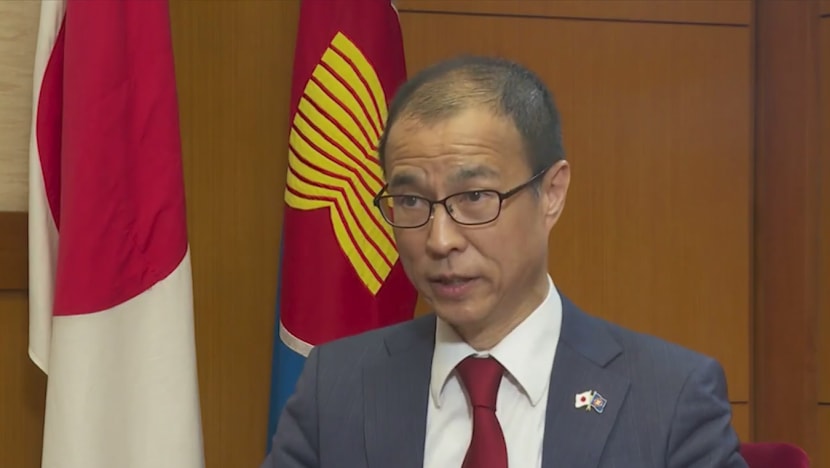
JAKARTA: Japan has pledged to remain transparent and open to dialogue as it expands defence cooperation with Southeast Asian nations, amid concerns that Tokyo’s easing of longstanding restrictions on weapons exports could fuel an arms race in the region.
In April, Japan announced a major overhaul of its rules governing overseas weapons sales, paving the way for shipments of warships, missiles and other military equipment.
Japan’s Ambassador to the Association of Southeast Asian Nations (ASEAN), Koji Yonetani, said Tokyo’s approach to regional security remains guided by its longstanding principles.
“Japan's post-war trajectory as a peace-loving nation remains absolutely unchanged. Our dedication to the rule of law, transparency, and respect for sovereignty is steadfast,” he told CNA in an interview in Jakarta on Nov 6 ahead of the ASEAN summit in Manila.
The 11-nation ASEAN bloc will open its final leaders' summit of the year in Manila on Sunday (Nov 15).
Yonetani said Japan’s framework for transferring defence equipment “operates under rigorous safeguards” and is aimed at bolstering regional security by building up its partners’ capabilities.
He cited remarks by Japan’s Defence Minister Shinjiro Koizumi at a recent ASEAN Defence Ministers’ Meeting-Plus (ADMM-Plus) in Cebu, during which Koizumi stressed the importance of dialogue and offered to explain Japan’s defence policy changes to other countries.
SOUTH CHINA SEA TENSIONS
Japan is also stepping up maritime security cooperation with Southeast Asian nations amid continuing tensions in the South China Sea.
“Japan remains deeply concerned about the situation and unilateral attempts, particularly to change the status quo by force or coercion in the South China Sea,” Yonetani said.
“Japan strongly opposes such attempts.”
He added that Tokyo had consistently expressed concerns over dangerous actions that jeopardise freedom of navigation and overflight.
Japan has expanded its maritime security cooperation through the Official Development Assistance (ODA) and Official Security Assistance (OSA) programmes. This includes providing patrol vessels, strengthening coast guard capabilities, and improving coordination with regional maritime and defence authorities.
Yonetani said these efforts were guided by Japan’s belief that a “free and open maritime order based on the rule of law benefits all nations”.
FUKUDA DOCTRINE: 50 YEARS ON
Japan’s growing security role comes as it prepares to mark the 50th anniversary of the Fukuda Doctrine next year.
Introduced in 1977 by then prime minister Takeo Fukuda, the doctrine laid the foundation for Tokyo’s modern relationship with Southeast Asia, emphasising peace, mutual trust and cooperation.
Yonetani said the doctrine has become increasingly relevant amid growing global uncertainty and strategic rivalry between China and the United States.
“Fundamentally, our posture has not changed. It's constant,” he said.
“One of the pillars of Fukuda doctrine is Japan's determination never to become a military power that threatens other countries, but to contribute as a stabilising force for global peace and prosperity.”
He said that mutual trust and respect had become even more important today.
“No country in today's uncertain world can address unpredictable shocks alone. Trust is an indispensable foundation for building resilience together,” he said.
Over the past five decades, Japan’s relationship with ASEAN has expanded beyond economic cooperation to include political, security and socio-cultural ties.
Yonetani said more than 90 per cent of the 130 cooperation initiatives outlined at the 2023 summit commemorating 50 years of ASEAN-Japan friendship and cooperation had either been implemented or are in progress.
DEEPENING REGIONAL COOPERATION
Japan is also looking to strengthen cooperation through the Quad, a grouping comprising Japan, the US, Australia and India.
Asked about a possible Quad meeting on the sidelines of the upcoming ASEAN summit, Yonetani declined to comment on specific arrangements.
However, he noted that the grouping’s foreign ministers had met three times this year, in May, July and October.
“This demonstrates our steady cooperation among the nations, and the core objective of Quad is to deliver practical and tangible benefits to the region to sustain peace, stability and prosperity by reinforcing a free and open Indo-Pacific,” he said.
Beyond security, Japan is also seeking to deepen cooperation with ASEAN in disaster management, drawing on its experience in responding to national disasters.
Japan launched its National Disaster Management Agency on Nov 2 to strengthen preparedness for major calamities, including a potential megaquake along its Pacific coast or an eruption of Mount Fuji.
The agency has more than 350 staff who will oversee disaster preparedness, emergency response and reconstruction efforts.
Yonetani said the new agency would strengthen the country’s domestic response capabilities while creating opportunities to share expertise and improve disaster preparedness with ASEAN partners.
KioskNews shows a cleaned-up reading view extracted from the publisher’s page — the original always lives on their site, not ours.