Celebrate longer life and harness the opportunities that come with it: Indranee
SINGAPORE – Under the right circumstances, living longer can be a national advantage, said Minister in the Prime Minister’s Office Indranee Rajah.
“The fact that Singaporeans are living longer is one of our greatest national achievements,” she said, and it is a reflection of decades of progress in healthcare, education, housing, public health and economic development.
“A super-aged society is one with more people who possess decades of accumulated experience, knowledge, and social capital. These are people who have spent years building careers, raising families, mentoring others, and contributing to their communities, who can continue doing so for as long as they remain healthy and active.”
A society is described as super-aged when at least 21% of its population is aged 65 and above. Singapore reached this milestone in 2026.
The life expectancy at birth for Singapore residents in 2025 was 83.9 years, among the world’s highest.
Indranee, who is also Second Minister for Finance and National Development, said Singapore should celebrate this increase in longevity and harness it well.
“Now that we have crossed that threshold and a super-aged society is no longer just something we talk about but is in fact a reality, we need to continue asking the tough questions: what must be true for this longevity to become an advantage rather than a strain?”
The advantage is not automatic, she said.
“It depends on whether the extra years lived are spent in good health, and on whether we prepare seniors for this early enough.”
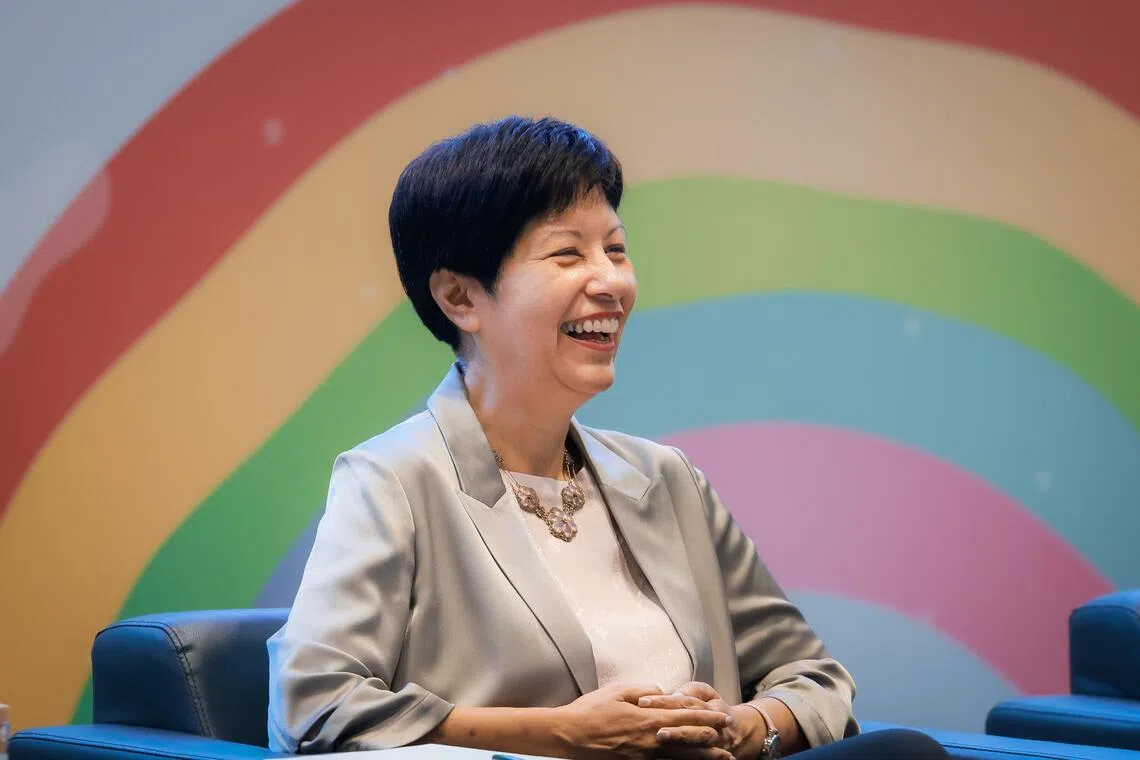
Minister in the Prime Minister’s Office Indranee Rajah said living well is important when it comes to ageing.
ST PHOTO: GAVIN FOO
The gap between life expectancy and healthy life expectancy in Singapore is about 11 years, with over a decade spent in poor health.
She was delivering her keynote address at the Singapore Management University (SMU), where she launched an annual symposium by the Centre for Research on Successful Ageing (ROSA) on Oct 20.
She suggested three areas to building a “longevity society”, where people can lead long, healthy and active lives.
First, Singapore is building the foundations for healthy and active longevity through preventive health and accessible long-term care.
To unlock the benefits of longevity, additional years must be years lived in good health. To this end, Singapore has shifted from treating illness to promoting well-being through preventive care, stronger community-based support and meaningful social connections, she said.
Through the national preventative healthcare initiative Healthier SG, residents are encouraged to take proactive steps to manage their health, prevent chronic disease and adopt healthier lifestyles before serious health problems develop.
For healthier seniors, the Government continues to expand Active Ageing Centres, which provide opportunities for social participation, lifelong learning, exercise and volunteerism.
It has also expanded Community Health Posts so that residents can access health screening, health monitoring and chronic disease support closer to home.
As for seniors with care needs, Singapore is broadening the range of community and home-based options available, including initiatives such as Community Care Apartments, Shared Stay-in Senior Caregiving Services and enhanced Home Personal Care.
Secondly, Singapore is creating neighbourhoods and built environments that are age-friendly. This involves finding ways to make neighbourhoods more accessible, inclusive and supportive of ageing in place.
To adapt the built environment to make everyday living safer and more convenient for seniors, there are programmes like the Enhancement for Active Seniors (EASE) which helps seniors move around their homes more safely through features such as grab bars, ramps and slip resistant flooring.
There is also the Silver Upgrading Programme, which helps seniors age-in-place more comfortably with amenities like therapeutic gardens and barrier-free access ramps.
Road crossings and pedestrian infrastructure are also redesigned to make roads safer and more convenient for seniors, as part of the Friendly Streets initiative.
Singapore is also piloting a more integrated approach through Age Well Neighbourhoods, where healthcare services, active ageing programmes, homebased services and age-friendly infrastructure are integrated as part of a connected neighbourhood ecosystem.
Third, the Republic needs to strengthen resilience across the course of life so that Singaporeans are better prepared for longer lives, Indranee said, adding that preparing for longevity must start much earlier in life.
The Government recognises this need for earlier planning, and has been taking steps to support Singaporeans across health, financial and skills resilience, she noted.
She added during a panel discussion that the Government has introduced the cohort system, where different support is given to the Pioneer and Merdeka Generations when needed. This is on top of other schemes like the national health insurance scheme MediShield Life.
To build skills resilience, initiatives such as the SkillsFuture MidCareer Credit and SkillsFuture Mid-Career Training Allowance support Singaporeans aged 40 and above in upskilling and reskilling.
Indranee, who chairs the inter-agency Marriage and Parenthood Reset Workgroup to help Singaporeans as they navigate marriage and parenthood, noted that retirees can help with backfilling as people are making use of the increased childcare leave to take care of their children or family.
The Government is looking into the fractionalisation of work, where the work is broken into smaller pieces and time periods.
“Retirees would be very suitable because they may not necessarily want to work for all of the time,” she said, adding that the Manpower Ministry is doing a study on this.
Longevity also creates new economic opportunities, she pointed out, citing a recent report by SMU and social enterprise and longevity consultancy Ageing Asia. It estimated that across 14 Asia-Pacific markets, there will be 733 million people aged 60 and above, holding US$7.1 trillion in savings.
This means opportunities for new products, services and business models that support longer and healthier lives.
Indranee told some 200 members of the audience that living well is important when it comes to ageing.
Stay healthy, stay connected and engaged, whether it is learning online or meeting people, she said. Finding purpose or doing something useful are key.
“What’s important is to know that in your retirement, you can still make a difference, and you can because there is so much that seniors can contribute.”
KioskNews shows a cleaned-up reading view extracted from the publisher’s page — the original always lives on their site, not ours.