Warm ski season a warning of bleak future for Australia’s snow tourism: ‘So this is our new normal’
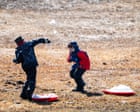
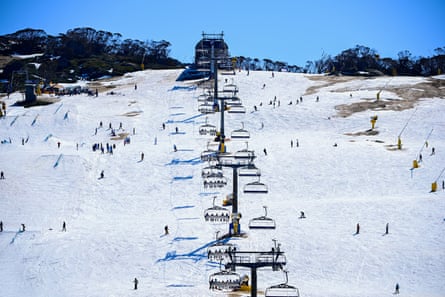
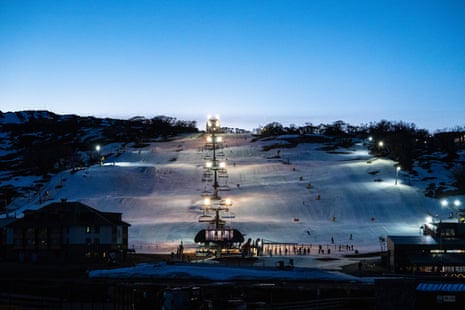
On a weekday morning in early September, Perisher is beautiful. Too beautiful. The snow guns have just laid down a blanket of fresh powder when the lifts open at 8.30am, the front valley glistening as the sun rises over the Snowy Mountains.
By noon, temperatures are hovering at a balmy 13C, bare patches of earth beginning to dot the mountainside. Skiers bedecked in layers of synthetic membranes abandon their coats, heading down the slopes in T-shirts.
-
People ski on human-made snow at Perisher Blue Ski Resort.
That’s spring skiing in Australia, after one of the warmest, snowless winters on record.
It wasn’t always like this. Early September has generally been a golden time on the slopes, the crowds a bit thinner, the weather calmer and the snow still deep. But the industry surrounding the New South Wales snowfields is reeling after an exceptionally short season. The vibe on the mountain itself is good, with skiers and snowboarders descending with excited gusto, ready to flit down human-made, but still frozen, flakes.
-
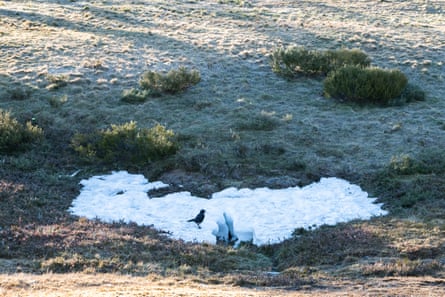
Above: A crow walks through one of the last patches of natural snow at Smiggin Holes, part of Perisher.
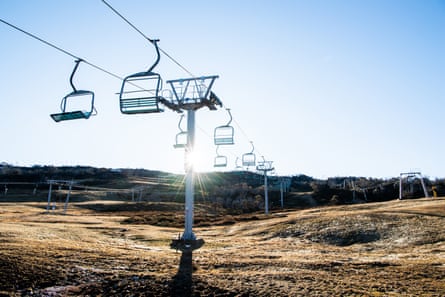
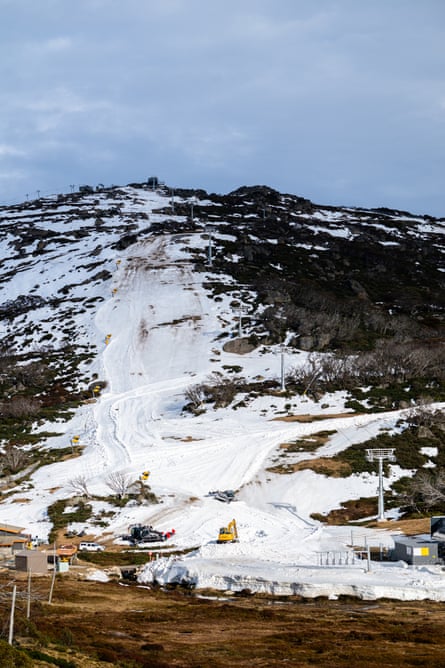
Below: Ski lift infrastructure, inactive due to a lack of natural snow.
Yet the alpine region is changing, with scientists, adventurers and the workers who buttress the ski fields all feeling it. There is still optimism and a good time to be had, but an undercurrent sense that things are not quite right.
The seasonal workers
Winter has not been kind to the legion of workers who staff the rental shops that pepper Jindabyne. The village sits at the base of Kosciuszko national park, about 30 minutes from both Perisher and Thredbo.
Maggie Hume has worked for 10 years in the ski hire business, mostly at Perisher, before this year’s season at Jindy Snow, just off the road into Jindabyne.
“I’d say everyone’s feeling a little … defeated is probably not the right word, but just with the seasons getting less and less, everyone’s feeling a little bit like, ‘Oh, so this is what our new normal is,’” she says.
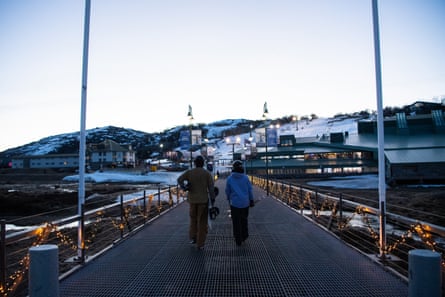
-
The Perisher Centre at Perisher Blue Ski Resort.
Two families have been through to rent gear so far that day, with a few others returning theirs after the weekend. Shifts, Hume says, are “dropping off like flies”. But visitors have largely been happy, “despite the conditions”.
Genevieve Langford is on hold to Centrelink behind the counter at Snow City, another rental shop, when I walk in to rent the legally mandated chains for a car that will almost certainly have no snow to drive over. Management decided last week to close the shop a month early.
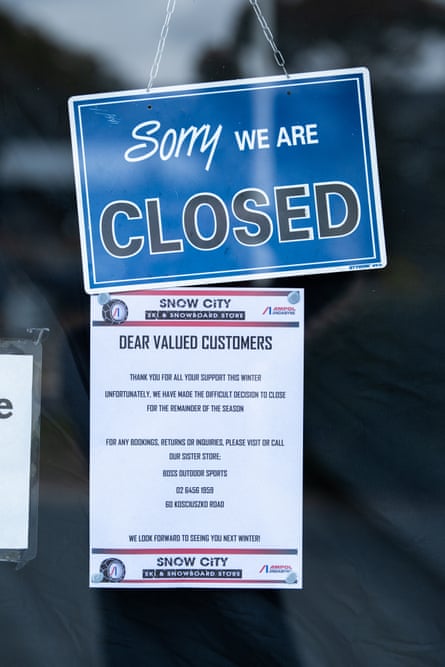
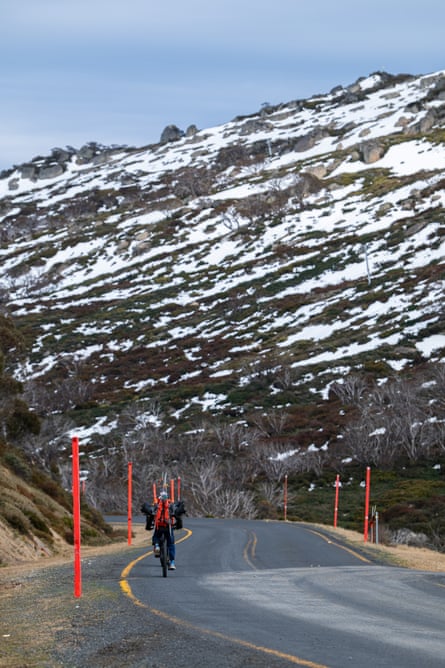
-
Left: A sign in the window of Snow City Ski Hire in Jindabyne explains why they have closed early in the ski season.
Right: A cyclist carrying backcountry skis rides up Kosciuszko Rd towards Charlotte Pass from Perisher.
“If it was five degrees colder, we would have had an epic season,” Langford says. But when it did snow, rain soon followed.
Langford says many tourists have come through and 90% said they had “such a good time”.
“The majority of people that come through here are only beginners,” she says. “You want Friday Flat [at Thredbo], you want the beginner areas … It’s slushy, but I would take slush over ice.
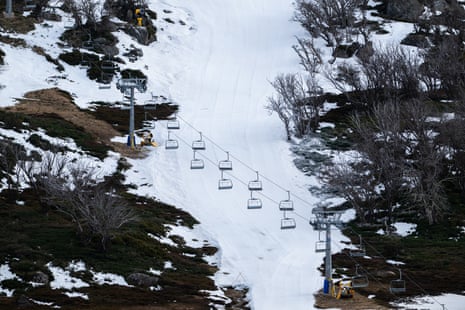
-
Many of the ski lifts are idle at Perisher.
“It’d be good if it lasted a bit longer, but we take what we can get.”
The springtime skiers
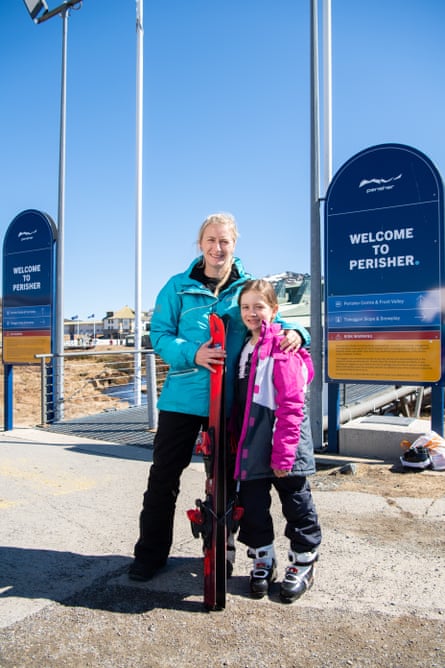
Carley Aherns is at Perisher with her seven-year-old daughter, Skylah, for her first day of skiing. Her family has rented a ski-in, ski-out apartment at Smiggins Hotel. But there is no snow to ski out to.
“A bit disappointing,” she says. “To be honest, we were talking about going down more regularly. But because of the fact that the weather at the moment is just so sporadic, I would be disappointed if I was a pass holder this year.”
Demi Goddard is in the Perisher parking lot with a mountain bike and a pair of skis, set to cycle 8km then hike up the slopes near Charlotte’s Pass.
-
Left: Carley Aherns and daughter Skylah at the entrance to Perisher Blue Ski Resort.
Right: The slopes at Perisher. One ski business owner has described the conditions as ‘shithouse’.
“It’s still been fun,” she says. “Everyone’s had a super positive attitude … Everyone’s keen to get out and ski whatever snow they can find.”
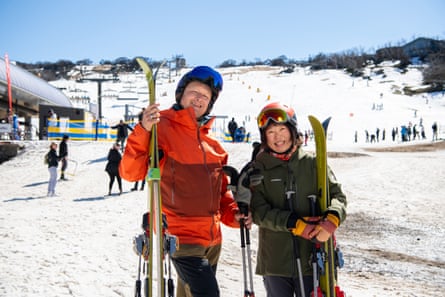
Glen Clark has chased what’s left of the snow to Perisher. He runs his own backcountry ski business at Mount Hotham in Victoria. But last week the resort there closed a month early. He says it has not been a good season.
-
Glen Clark and partner Masumi Ueda leave the slopes after some runs on the human-made snow.
“I think shithouse is the technical term,” Clark says. His business has broken even but that’s it. The state of the climate and its impact on the snowpack in NSW and Victoria has left him with “big worries”.
“If I was doing it just to make a living and nothing else, I would’ve packed up and pissed off,” he says. “The reality is … nothing less than net zero is going to start to turn things around. There’s no two ways about it.”
The climate scientist and the winter campaigner
Ruby Olsson, a social scientist at the advocacy group Protect Our Winters, has been in Canberra appealing to politicians about the state of Australian winters.
“Everyone was feeling pretty grim about the ski season,” she says. “About what that might mean for the snow in Australia. Not just for the ski industry, but for the regional communities that it supports.”
-
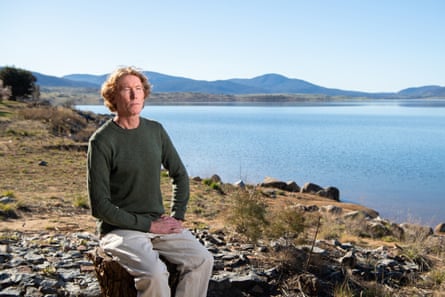
Climate risk scientist Stuart Browning sits by Lake Jindabyne.
An industry group estimated this year that the ski fields contribute about $5.7bn to the economy, compared with about $9bn from the Great Barrier Reef.
The federal government has invested $3.9bn in reef protection since 2015, alongside more than $1bn from the Queensland state government. But no such package exists for the alpine region.
Stuart Browning, a climate risk scientist based in Jindabyne, says some snow lovers don’t want to believe it, but the data coming out of the Alps is not good.
“I look at the data all the time and there’s no good stories for the Australian snow industry,” says Browning, an avid snowboarder himself. “We all hope for good seasons, but the reality is that the snowpack is declining.”
-
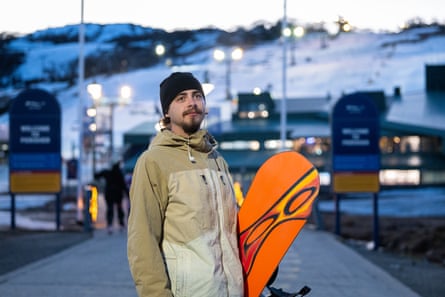
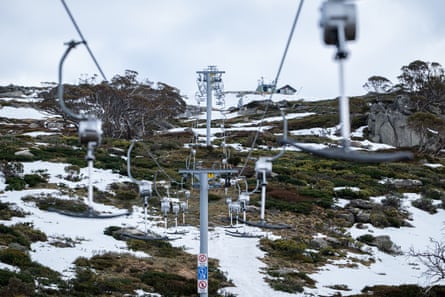
Above: Retail worker Taj Kidd about to enjoy his final snowboard of the season. Below: The Eyre T-Bar lies still over thinning snow.
Data collected by Snowy Hydro, which monitors snow depths at Spencers Creek, about halfway between Perisher and Thredbo, shows average depths declining nearly 20% since it began recording in 1954.
This year the snow depth topped out at 94cm in mid-August. It’s now sitting at just over 21cm.
This time last year, it was at 200cm.
The lodge owner
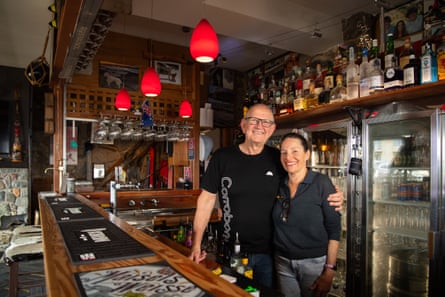
Bob Tait and his wife, Anna, have run the Corroboree Lodge just across from Perisher’s ski fields for 13 years. He agrees it’s been a bad season on the mountain, but says Perisher has done a good job of snowmaking and guests have responded to the calmer year in kind.
“I’ve found that this year there’s a mindset in most of the community … instead of a ski holiday, it’s a holiday with skiing,” he says. “They’re just taking their time out like a real holiday … and they appreciate it, and they acknowledge it.”
-
Bob and Anna Tait have run Corroboree Lodge at Perisher Blue Ski Resort for 13 years.
Tait says he’s certainly “not as buoyant as normal years” and the snow line has “undoubtedly” been getting higher. But there’s still a sense of optimism about next year.
“For us, it’s been a positive adventure because the people here have great attitudes,” he says. “I say it’s one bad season in 13 that I’ve been involved with.”
Andrew Kennedy, the Perisher resort’s head of mountain operations, says no two seasons are the same and teams are “constantly adapting”.
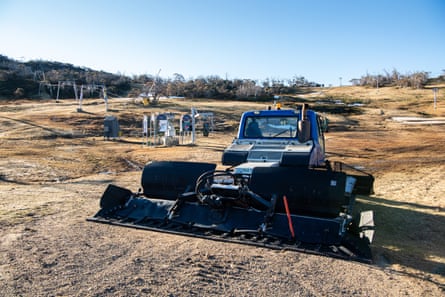
-
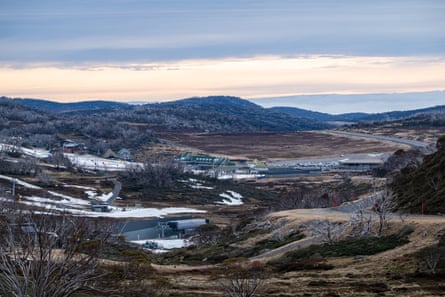
Above: The car park and Perisher Centre.
Below: A snow plough at snowless Smiggin Holes.
“The ski industry has always been weather-dependent, but we are resilient and proactive in adapting to change,” he writes in an email. “Our teams are experienced in managing the impacts of variable weather, including El Niño years, and continue to invest in energy-efficient snowmaking and summer grooming.”
The politician
The independent MP and Olympian Zali Steggall says she is concerned that shortening seasons could soon threaten the viability of some resorts.
“I remember when I trained full-time for the Olympics, the ski season started in June on the long weekend, and finished in October,” says Steggall, who won a bronze medal in slalom at the 1998 Winter Games. “Now we’re looking at a ski season being over, and it’s the 9th of September.
“It’s incredibly frustrating for so many of us that have been heeding the warnings for years,” she says. “The governments are just not doing what they need to be doing. They are still approving coal and gas projects, while ordinary Australians are left with this just tragic reality with little capacity to meet the devastation.
“Sometimes people don’t appreciate that it’s getting worse. But it really is.”
KioskNews shows a cleaned-up reading view extracted from the publisher’s page — the original always lives on their site, not ours.