‘I think of it as anti-brain rot’: how our podcast team creates space for thought

It doesn’t often happen during interviews. Something inside the person starts shifting. Fresh ideas get forged in real time.
Our new podcast series Radical Thinking with Aditya Chakrabortty has already managed to generate many such moments. Each time it happens, you can almost hear the expression changing on the guest’s face. At one point, I switched from audio to video to witness the change and then watch as they refined their thoughts.
The effect is riveting. It’s also by design.
“We didn’t want this podcast to be a boxing match,” says Kirsty Major, a Guardian deputy opinion editor and an executive producer of Radical Thinking. “We hold guests to account where needed, but ultimately it’s about giving them the space to really think.”
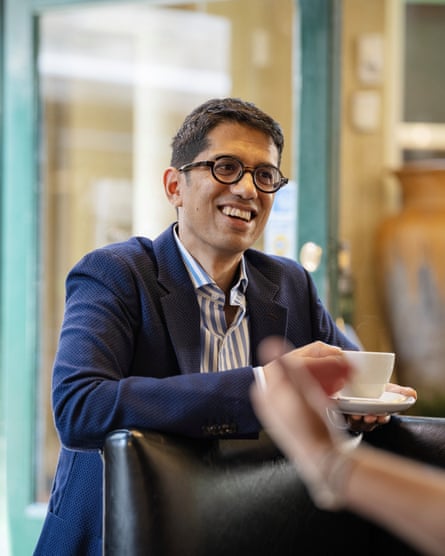
The series sees Guardian columnist Aditya Chakrabortty sit down with some of today’s major thinkers to discuss the forces that are transforming our world and how we can meet the myriad challenges that are confounding conventional wisdom.
Fellow executive producer Maz Ebtehaj likens the approach to focusing on people’s thought processes. “We’re encouraging people to think about why they think a certain thing,” she says. “We’re sort of holding a magnifying glass up to their politics and their values, but in an exploratory way not a confrontational way.”
“We’re also trying to get a better understanding of where a guest’s thinking leads them,” says Aditya. “I might not always agree with what they think, but I’m really interested in how they got there and whether we share any premises. And because the interviews are exploratory rather than accusatory, we get those moments when a guest says something they perhaps didn’t expect to say.”
Whether you are listening to the podcast or watching it, it’s striking how each episode of Radical Thinking leaves you feeling notably nourished. That owes as much to the podcast’s radical approach as it does the radical ideas discussed on the show. By deliberately letting listeners and viewers experience a guest’s thought processes rather than simply hear their hot takes, the team hopes the podcast will feel distinct.
“I expressly think of it as anti-brain rot,” says Aditya. “When people talk about doomscrolling and brain rot, notice that they often slip into the passive voice. What they’re really talking about is how they no longer feel as if they have control over their lives. People want a different way of thinking about what’s going on in their world and that’s what we’re trying to provide.”
This sense of mission is coupled with an urgency that informs the series as the far right continues to gain power around the world by exploiting people’s grievances. “We’re living through some very precarious moments right now, and that requires us to come up with new ideas urgently, or at least to press the ideas people have into service,” says Aditya.
“The systems and the ideas and frameworks that we’re used to don’t work any more, so it does call for radical thinking,” adds Maz. “Some of our guests are inherently radical thinkers. Others have radical thoughts.”
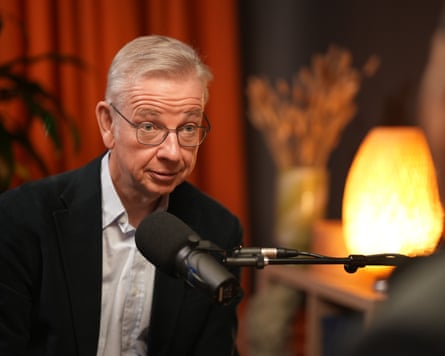
The show’s guests are drawn from across the political spectrum, including former Greek finance minister Yanis Varoufakis, Spectator magazine editor and former Conservative deputy prime minister Michael Gove, Naomi Klein and Astra Taylor, the playwright James Graham, and the writer and Guardian columnist Nesrine Malik.
“That plurality of voices comes from within the Guardian’s own traditions,” says Aditya. “There’s a fascinating bit in the interview with Gove when I ask what his abiding principle in politics is and he says, I want to fight inequality. How does someone on the right explain that to the rest of us? Not with me saying to him, ‘but you did austerity, you backed Brexit and now this new nativism’... I want to know what throughline he sees there. And actually, what he tells us is shattering.”
Another such moment from the first few episodes is when Varoufakis explains how his experience of power radicalised him. “There is the look of defeat on his face,” says Aditya. “There’s also the genuine look of surprise on Naomi Klein and Astrid Taylor’s faces when we start talking about how the left might respond when the AI bubble bursts.”
These sorts of moments are spontaneous, but also the result of the way the whole team carefully plans and structures each episode. “I’ve just come out of an all-day meeting where we were thinking about how to structure our interview with James Graham,” says Aditya. “The really big, guiding question we wanted to discuss was whether stories can heal a divided country. What is it like to be the nation’s playwright at a point when the nation is falling apart?”
Those meetings are key to the alchemy of the series. “We plot it through,” says Maz. “What’s the guiding thought? Where and what are we going to get to? For example, with Varoufakis, we started by asking him about his upbringing and how he felt during certain moments of his life – because the personal can be very revealing about a person’s political views. We have time to draw emotional connections to people’s politics because each episode is an hour long. So the conversation should feel like a story and by the end the audience should feel they’ve arrived at some sort of answer to that initial guiding thought.”
For Kirsty, some aspects of the prep were very different from the kinds of journalism she’s previously done. “I went from editing and writing articles to working with the audio team, and they’ve opened my eyes to how you might structure a conversation and plan it out,” she says. “An incredible amount of work goes into that. We have to know what’s already out there and what a guest might say, but we want to go beyond that. By the end of it, you really feel as if you live in their head.”
As well as being familiar with each guest’s body of work, Aditya has also written about some of them before. “Another thing that helps inform some of these discussions is that I’ve known some of our guests for a while during the course of my reporting,” he says. “So there’s a degree of informality. I’m not trying to impose on our guests; I want to draw out the best of them. I know their work, I know where the broader conversation is, so I can think about how it can be taken to a different place or how we can add different perspectives. Journalism to me has always been about adding value like that.”
One regular feature involves asking each guest what they would do if they had a billion pounds. The answers aren’t just instructive, they are often informed by the preceding discussion. Another feature involves Aditya summing up what he has taken from each interview – underscoring how everyone comes away from the encounter feeling fortified.
Aditya says he hopes this also extends to listeners and viewers and that Radical Thinking proves empowering for audiences – just as he felt empowered by certain news outlets back when he was growing up. “During my childhood and early youth, newspapers and the media always played that role. It was a tool for the rising classes to make themselves better informed about the world.”
The podcast’s combination of informative and informal is also aided by its physical space. “We spent a lot of time thinking about the setting,” says Maz. “It’s very dark. It’s very low-lit. At first, we had two sofas but Aditya said it didn’t feel right because it wasn’t how he’d have a conversation. So we put in a table and chairs.”
Even without the sofas, however, the work and thought that goes into each episode means the interviews very quickly morph into a more intimate conversation. “It feels pretty therapeutic,” says Aditya. “A lot of stuff spills out.”
Watch every episode of the podcast on the Guardian’s Politics Weekly YouTube channel www.youtube.com/@politicsweekly, or listen wherever you get your podcasts.
This article is taken from the Guardian’s weekly email for supporters, sent on Tuesdays. To support the Guardian’s work, please click here.
KioskNews shows a cleaned-up reading view extracted from the publisher’s page — the original always lives on their site, not ours.