What is the one big thing that could stop Xi, Putin and Trump meeting at Apec?
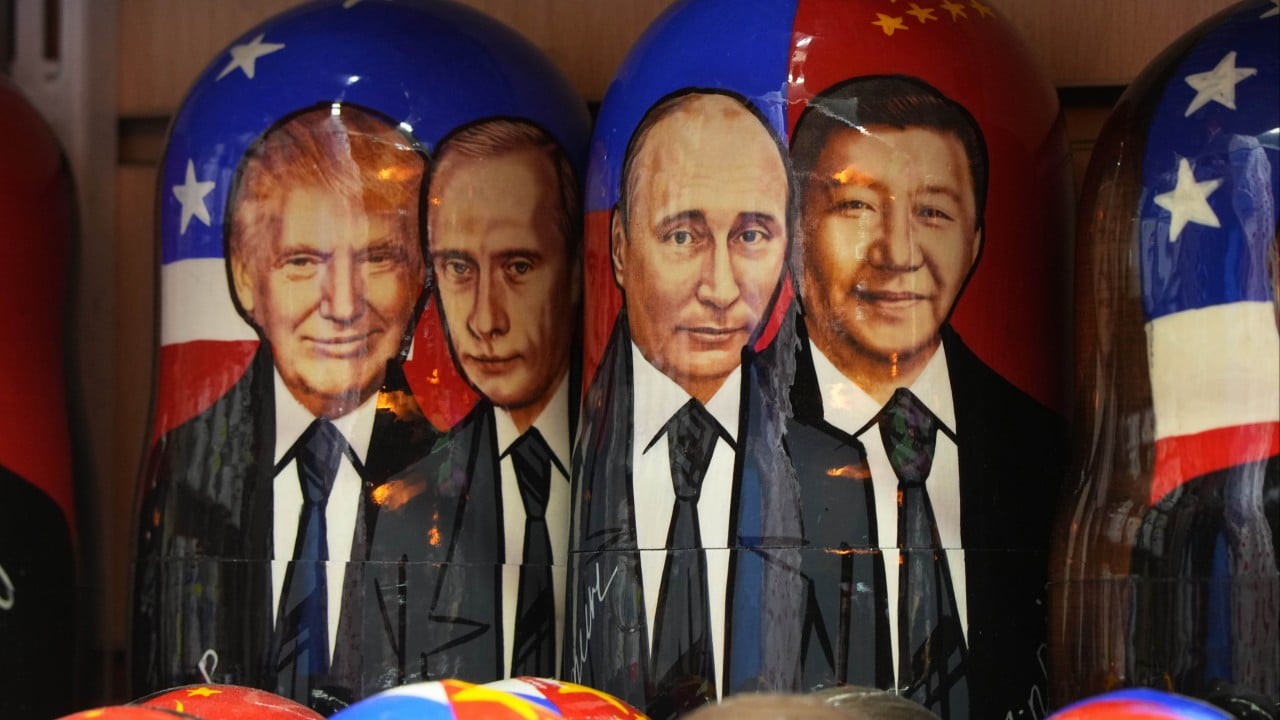
With just a fortnight until the Apec summit in Shenzhen, preparations are reportedly under way for the first meeting between the leaders of China, Russia and the United States.
If the talks go ahead, they could bolster Beijing’s diplomatic standing, although the different priorities of each power were likely to limit consensus and yield few, if any, concrete concessions, observers said.
Officials from Beijing, Moscow, and Washington had been holding serious talks to arrange the first trilateral talks between their heads of state, the Financial Times reported on Tuesday.
Dmitry Peskov, spokesman for Russian President Vladimir Putin, told the newspaper that work was “under way” to organise such a meeting.
Washington and Moscow had been pressing Beijing to agree to the talks, the report said.
On Wednesday, the Chinese foreign ministry said Beijing was maintaining communication with relevant parties regarding the talks.
It is unclear whether they will be bilateral or trilateral.
The ministry said last month that it had “no information to provide” on the trilateral meeting.
04:52
‘New joint arrangement’ on trade as Xi meets Trump at White House
Sun Chenghao, a fellow with Tsinghua University’s Centre for International Security and Strategy, said the top priorities were to avoid strategic miscalculation and reach a baseline consensus on the meeting’s purpose.
“The expectations of the three sides are currently misaligned: Washington prioritises nuclear arms control, Moscow seeks broader political engagement with the US, and Beijing is focused on the stability of major-power relations and the external environment,” Sun said.
This was echoed by Zhu Junwei, director of Chinese think tank the Horizon Insights Centre.
“In reality, there are few issues uniquely suited for a trilateral agenda, which is likely to be a major hurdle in preparations if such a summit is indeed to take place,” she said.
During a phone call with Trump last month, Putin floated the idea of a trilateral meeting with China to negotiate an end to the war in Ukraine, a conflict now in its fifth year.
Beijing, however, has shown little appetite for discussing the matter at such talks.
German President Frank-Walter Steinmeier said he raised the issue with his Chinese counterpart, Xi Jinping, during their meeting in Beijing last week, but Xi’s response indicated Ukraine would not be on the agenda.
“[Xi] explicitly pointed out that this is a European conflict in which Europeans would also have to be at the negotiating table,” Steinmeier said in an interview with public broadcaster ARD on Sunday.
Sun of Tsinghua University said that since the conflict involved European security and the sovereignty of Ukraine, “bypassing Ukraine and Europe to have three powers dictate peace terms would lack legitimacy and prove difficult to implement”.
He said that if the meeting were to take place, it would likely yield a “limited consensus” such as reaffirming the prevention of nuclear war, maintaining crisis communication, supporting diplomatic solutions to regional conflicts, and scheduling follow-up expert-level talks.
Even if the Ukraine issue is raised, it is likely to remain an exchange of positions
“Even if the Ukraine issue is raised, it is likely to remain an exchange of positions,” he said.
Last month, Trump said he was open to a three-way summit to talk about nuclear arms control and denuclearisation. However, Beijing has shown no interest in the topic either as China’s nuclear capabilities are not on the same scale as those of the US and Russia.
“Placing it within the same reduction framework risks turning unequal capabilities into nominally equal responsibilities,” Sun said.
He added that while nuclear risk reduction could be discussed, concrete disarmament involved force structures, verification and strategic mutual trust, “none of which can be achieved overnight”.
Both Sun and Zhu agreed that Moscow was the most eager to hold talks with China and the US.
Zhu said the meeting would signal to the world that Russia remained a major power, standing on equal footing with the world’s two biggest economies.
“Moscow would see such a summit project the image of a China-Russia-US ‘G3’ co-governing the world, even if that is largely an illusion,” she said.
“However, whether G2 or G3, both run counter to the multilateralism Beijing champions, putting China in a delicate spot.”
Sun added that Trump, likewise, sought a signature diplomatic win and hoped to bring China into nuclear discussions.
Yet Beijing stands to gain as well from such a meeting.
According to Sun, it could show China’s ability to bridge major powers and foster dialogue, while signalling that its partnership with Russia and engagement with the United States could advance in parallel, adding to its diplomatic heft.
“The meeting format alone is unlikely to directly yield concessions on tariffs, technology restrictions or other specific issues. The truly valuable leverage lies in making all parties recognise that China’s involvement helps mitigate risks and move matters forward,” he said.
He cautioned that the agenda must avoid eroding European trust. “Otherwise, any new diplomatic gains could easily be offset by costs incurred in other relationships.”
KioskNews shows a cleaned-up reading view extracted from the publisher’s page — the original always lives on their site, not ours.