Asia Power Index 2026: US takes the lead, India listed at No. 3
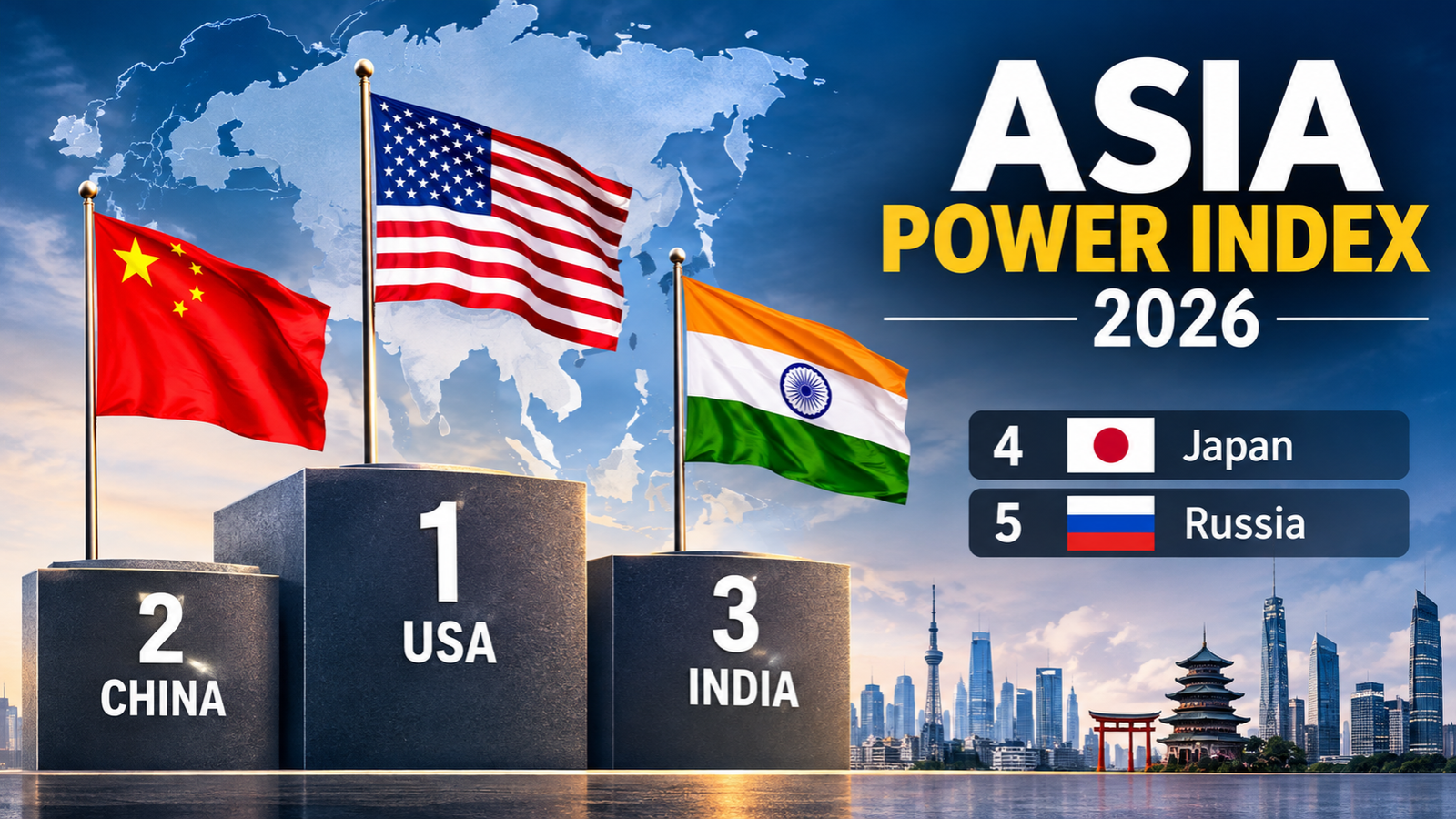
The Lowy Institute has released its 2026 Asia Power Report, evaluating resources and influence to rank the relative power of states in Asia. The index assesses the current distribution of power and tracks shifts in the regional balance of power over time.
Overall, the United States (1st) and China (2nd) were categorised as “superpowers,” while India (3rd) was classified as a “major power.” The top “middle power” nations included Japan (4th), Russia (5th), Australia (6th), South Korea (7th), Singapore (8th), Indonesia (9th), and Malaysia (10th).
Despite a dip in its relative economic capability, India continues to play an influential role in the world. Reaching an overall score of 40.5 points, India narrowed the power gap with China to its closest margin since 2018.
The Lowy Institute noted that the United States and China remain the dominant powers. However, with just 5.3 points separating the two, the US lead over China has shrunk to its lowest level since the index began in 2018.
The gap in military capability, in particular, is at its narrowest point on record. The report observed that the ongoing US war with Iran, which began in February 2026, has eroded American military capabilities by depleting its stockpile of long-range missiles and undermining perceptions of US diplomatic influence both regionally and globally.
Ranking countries
Launched in 2018, the index ranks 27 countries based on their capacity to shape their external environment.
The 2026 report represents the most comprehensive assessment of changing power distribution in Asia to date, evaluating over 131 indicators across eight key measures: military capability, defence networks, economic capability, economic relationships, diplomatic influence, cultural influence, resilience, and future resources.
Story continues below this ad
The Lowy Institute gathered most data through original research, supplemented by hundreds of publicly available national and international sources.
KioskNews shows a cleaned-up reading view extracted from the publisher’s page — the original always lives on their site, not ours.