Foreign minister Lin calls for closer ties with Texas
Minister of Foreign Affairs Lin Chia-lung (林佳龍) discussed the nation’s ambitions to expand its economic footprint in Texas, including plans for a “Taiwan Tower” business hub in downtown Houston during his trip to the US state this week.
During his visit from Friday last week to Tuesday, Lin met with Houston Mayor John Whitmire and US representatives Sylvia Garcia, Pete Sessions and Michael Cloud to discuss closer cooperation in trade, technology, talent development, energy and healthcare, the Ministry of Foreign Affairs said in a statement yesterday.
Lin and Whitmire exchanged views on the progress of the Taiwan Tower, a project the minister first proposed during a visit to Houston in May last year. The tower is envisioned as a business support center in the state’s most populous city, integrating government and private-sector resources to help Taiwanese companies expand in the US and attract US investment to Taiwan.
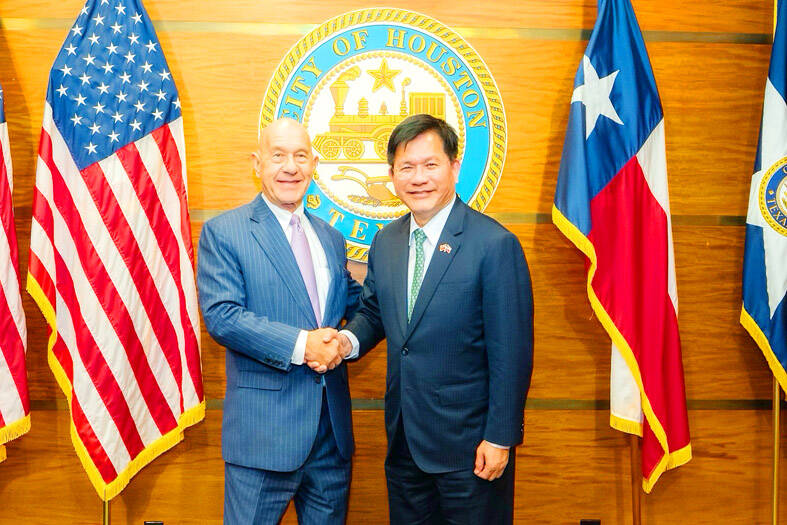
Minister of Foreign Affairs Lin Chia-lung, right, shakes hands with Houston Mayor John Whitmire in Houston, Texas, in an undated photograph.
Photo courtesy of Ministry of Foreign Affairs
The three representatives expressed support for the project and recognized the growing presence of Taiwanese businesses in Texas, the statement said.
Lin also visited five Taiwanese companies operating in Texas — LCY Chemical Corp (李長榮化學), King Slide Works Co (川湖科技), Foxconn Technology Group (富士康), Inventec Corp (英業達) and Telco International Corp (特而固) — to learn about their operations and development plans, it said.
He also hosted a dinner on Monday with Taiwanese businesspeople and Taiwanese expatriates in the Houston area.
At the inaugural US-Taiwan Most Valuable Partnership (MVP) Conference at Texas A&M University’s Bush School of Government and Public Service on Tuesday, Lin called for deeper bilateral cooperation as artificial intelligence (AI) reshapes the global economy and geopolitical landscape.
In his speech Lin said Taiwan was an indispensable partner in realizing the US’ AI ambitions.
He outlined three approaches for expanding bilateral investment: the Arizona model, built around Taiwan Semiconductor Manufacturing Co (台積電) and the supply-chain ecosystem developing around its operations; the Texas model, centered on the Taiwan Tower and potential industrial clusters; and expanded investment in Taiwan by US companies such as Micron Technology Inc.
Taiwan could serve as a “force multiplier” for US AI innovation and reindustrialization through reciprocal investment and industrial cooperation, Lin said.
He also highlighted frameworks for advancing bilateral economic and technological ties: the Taiwan-US Agreement on Reciprocal Trade, an investment memorandum, the Economic Prosperity Partnership Dialogue, and the Joint Statement on the Pax Silica Declaration and US-Taiwan Cooperation on Economic Security.
At the conference, Lin witnessed the signing of a four-year memorandum of agreement among the Taipei Economic and Cultural Office in Houston, the Bush School and National Taiwan University’s College of Social Sciences to establish a three-way partnership under the Taiwan MVP program.
The agreement is intended to enhance academic and institutional cooperation between Taiwan and the US, complementing broader efforts to deepen economic, technological and people-to-people ties, the ministry said.
KioskNews shows a cleaned-up reading view extracted from the publisher’s page — the original always lives on their site, not ours.