Government designates 18 drone testing airspaces
By Shelley Shan / Staff reporter


The government has designated 18 airspace zones for drone testing to support the development of the domestic drone industry, the Ministry of Transportation and Communications said yesterday.
The government is supporting the orderly development of the drone industry while encouraging innovation and the use of drone technology, Deputy Minister of Transportation and Communications Lin Kuo-hsien (林國顯) told participants at this year’s International Unmanned Aircraft Systems and Advanced Air Mobility (AAM) Forum in Taipei.
“Drones are no longer used solely for aerial photography or entertainment. They are increasingly being deployed in logistics, crop, pest and disease control, traffic safety management and disaster prevention and response,” Lin said.
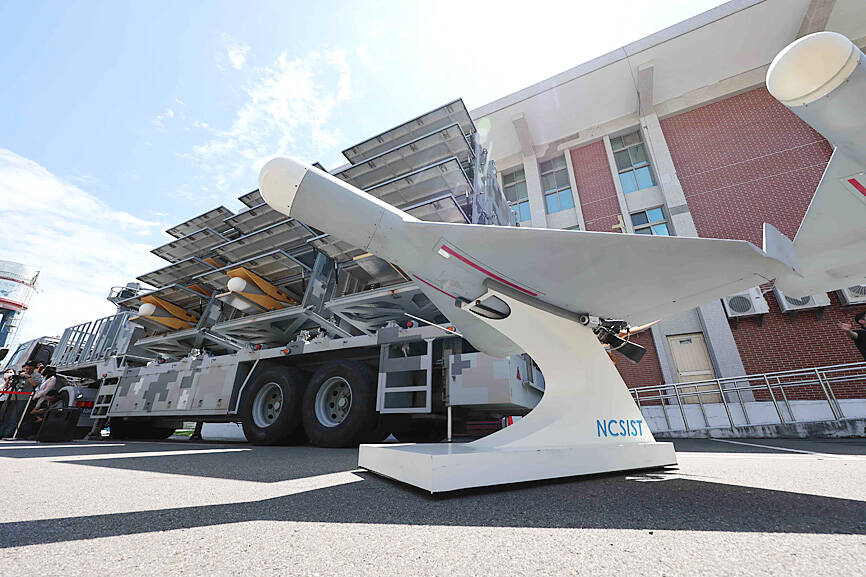
An uncrewed aerial vehicle developed by the National Chung-Shan Institute of Science and Technology is displayed on July 22.
Photo: Tsai Shu-yuan, Taipei Times
Following the passage of the Act on Strengthening National Defense Self-Reliance and Developing the Unmanned Systems Industry (強化國防自主暨無人載具產業發展條例) in September, which allocates NT$240 billion (US$7.3 billion) over six years to support the development of Taiwan’s uncrewed systems industry, the Civil Aviation Administration (CAA) conducted a survey and identified 18 potential testing areas for drone developers, he said.
While funding for drone development is jointly allocated by the Ministry of Economic Affairs and the Ministry of National Defense, the CAA is responsible for designating airspaces where drone operations are permitted and establishing inspection criteria for uncrewed aerial vehicles, he said.
In addition to the 18 designated testing areas, drones can operate without prior applications in designated green zones at altitudes below 400 feet (122m), Lin said.
The CAA is discussing the possibility of allowing large drones to be tested at Chiayi Airport and Hengchun Airport in Pingtung County with the military , he added.
As of June, Taiwan had 42,000 registered drones and had approved more than 30,000 drone-related operations, CAA Director-General Ho Shu-ping (何淑萍) said.
The Civil Aviation Act (民用航空法) regulates drones, drone operators, operations conducted by legal entities and the airspace in which drones can operate, but does not restrict the applications of drone technology, Ho said.
More than 80 percent of approved drone operations involved aerial photography, she added.
“We are supporting the development of the drone industry by consolidating designated airspace for testing. We are also promoting bilateral certification arrangements with other countries to help Taiwan play a greater role in the global drone industry,” Ho said.
The annual forum drew almost 160 representatives from the drone industry, academia and regulatory agencies in Taiwan, the US, France and Singapore, the CAA said.
This year’s forum focuses on operational models and regulatory challenges associated with AAM, an emerging field enabled by electric vertical takeoff and landing aircraft and other new technologies.
AAM applications could include urban and regional transportation, emergency response and the provision of transportation services to remote areas.
KioskNews shows a cleaned-up reading view extracted from the publisher’s page — the original always lives on their site, not ours.