Not just red noses and creepy characters: Why it’s time to give clowning another chance
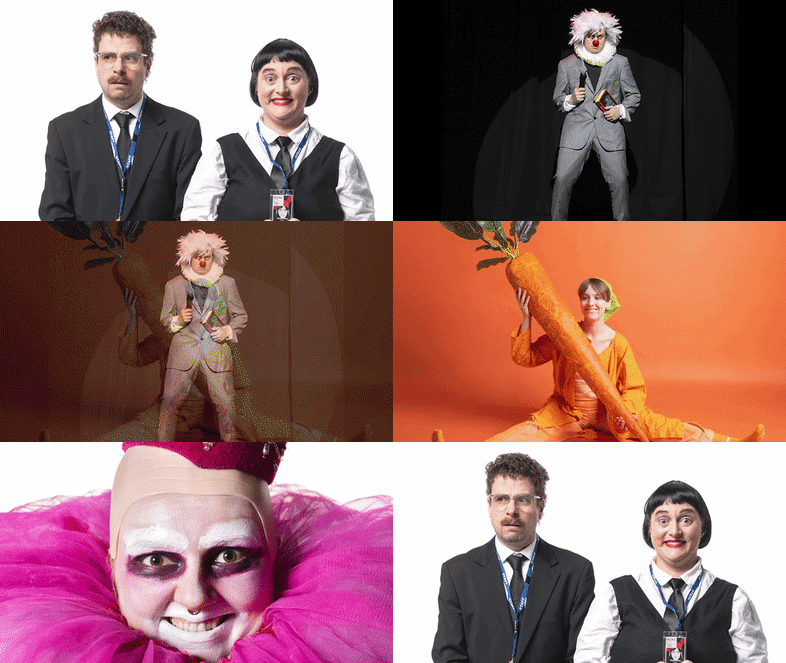
What does a clown look like to you? The oversized shoes of Ronald McDonald or Bozo the Clown’s bulbous red nose may come to mind. Or perhaps you lean darker, picturing Stephen King’s Pennywise or American Horror Story‘s Twisty. They’re either the ridiculous buffoon at children’s’ parties or the material of nightmares – there’s little in between.
There is, however, much more to clowning than this. Spanning back to ancient Egypt, when early court jesters and priest-clowns emerged, clowning has since bled into theatre, comedy, cabaret, puppetry, circus and dance. Even if a show doesn’t feature a lovable klutz in exaggerated make-up, clowning may still be woven into its DNA.
“‘Clown’ is a very broad term that can be used for so many things: Finding connection, playfulness and joy – even in walking around with a giant papier-mache carrot,” says Hayley Edwards, a clown doctor at the Royal Children’s Hospital and creator of the clown-adjacent Melbourne Fringe Festival production The Carrot Show.
The breadth of clowning is made abundantly clear at this year’s Melbourne Fringe Festival. There are more than 20 clowning-related shows on the program, 17 of which were locally produced.
This includes Edwards’ carrot performance, which combines puppetry, a large papier-mache carrot, projected image, archived documents, prerecorded interviews and several real carrots to explore how distraction and absurdity help us navigate increasingly difficult times. It’s also partly inspired by Melbourne’s own Carrot Man, Nathan, a local legend who formerly worked as a street clown in the ’80s and who now walks the city’s streets inspiring joy with his comically large vegetable prop.
“The overwhelming majority of clowns around the world aren’t the stereotypical type portrayed in the media,” Edwards says. “Some of us just carry about a giant papier-mache carrot to make people smile and connect with one another, or work in kids’ hospitals to help distract them during impossible times.”
The number of clowning shows at the festival ballooned last year, says Melbourne Fringe chief executive Danny Delahunty, and this has sustained into 2026, with shows like Freidah Will See You Now, Caitlin Duff’s show about a bewitching creature who ushers people into the underworld, and Dune but Worse, Sean Burnett Dugdale-Martin’s attempt to perform the entire Dune saga solo.
“In Melbourne, in particular, the ridiculousness is embraced as something that’s technically sophisticated. Performers spend years learning how to make something look like it’s just gone really wrong,” Delahunty says. “This is an artform that’s built and thrives on the convened chaos – in taking all this unpredictability around us and giving it an element of control against all odds.”
While there are particular styles of clowning around the world, such as California’s character clowning and improvisation or Paris’ Jacques Lecoq and Philippe Gaulier-style clowning (more physical and emotion-oriented), Melbourne offers a melting pot. Mime, mask work and ensemble clowning have been popular for decades, but North American styles have emerged over the past five years, Delahunty says, introducing more absurdity and audience interaction.
Mel McGlensey’s 2025 show Motorboat, for instance, leans into this absurdity with its woman-boat hybrid character. Benny Boot’s Die Clown Die, meanwhile, combines clowning with spirituality by featuring a clown who continuously dies ridiculous deaths in the hopes of eventually finding nirvana.
“It’s about how porous the boundaries are in Melbourne,” Delahunty says. “What makes our clowning scene unique is how relaxed and interchangeable the artform is across comparative forms.”
Few understand this better than Clare Bartholomew, a performing artist who teaches clowning in Melbourne. She has had hula-hoopers and acrobats attend her classes, keen on building their physical comedy or slapstick skills. Their shows may not technically be considered “clowning”, but after visiting her classes, they will be informed by it.
Melbourne arguably has one of the strongest networks of clown teachers and workshops, Bartholomew says, a scene that largely began with John Bolton, a renowned theatre director, teacher and clowning expert, in the ’90s. There’s also a great radical clowning scene in Australia, including “sex clowns” and clown-adjacent artists like Sydney’s Betty Grumble, a “proud ecosexual [who] believes in art as an action of her spirituality”. There’s even darker, edgier clowning that uses “Bouffon” as inspiration (satirical, physical performance centred on intense mockery, grotesque realism and dark social parody).
“This all has merit,” Bartholomew says. “It’s a broad church.”
Yet, she still often doesn’t include “clown” in her productions’ descriptions as she fears it may “put people off for the wrong reasons”. For example, The Portrait, Bartholomew’s most recent Melbourne Fringe show, wasn’t explicitly described as a clown production, rather it was labelled as “wordless satire” and physical theatre. Yet, there are plenty of clown elements in the show, which follows two oddball gallery attendants preparing for the unveiling of a notorious artist’s portrait.
The decision to omit “clown” from the description largely stems from preconceptions around clowning, Bartholomew says – the assumption that all clowns are either two-dimensional buffoons or serial killers (like US killer John Wayne Gacy, who dressed up as a clown to carry out his crimes). Unlike dance, which is sub-categorised into contemporary, hip-hop and so forth, there’s only one word for clown. This, in turn, may hold it back.
“There’s no one image of a dancer, but you could conjure up a clear image of a clown very quickly. It has a hook, and to some people, that’s negative,” Bartholomew says.
Delahunty agrees, noting that most clowns are probably “tarred in some way by the brush of Pennywise”. However, he hopes that festivals like Fringe and clowning workshops across Australia will help change these preconceptions.
“Clowning is about play, about vulnerability. It’s about pleasure in movement. It’s about collaboration, and it’s about being with other people and drawing the chaos together as a group,” he says. “It’s an artform that gives artists permission to fail. That feels incredibly appealing right now in a culture where everything is polished, optimised and packaged.”

KioskNews shows a cleaned-up reading view extracted from the publisher’s page — the original always lives on their site, not ours.