How to make the perfect venison casserole – recipe | Felicity Cloake's How to make the perfect …
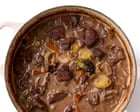
Because I don’t eat it very often, I always forget how much I like venison. Or, rather, how much I like it in certain contexts: the natural leanness of a wild animal doesn’t naturally lend itself to soloing in juicy burgers or sausages, but, when slow-cooked, it’s fabulous – rich in flavour, and soft enough to eat with a spoon, should you so desire. It also tends to be good value both in season and frozen for the rest of the year, and, as red meat goes, a pretty climate-friendly option (though not straightforwardly so, as this piece explains) that pairs beautifully with seasonal spuds and kales, and is even better when made ahead of time and reheated. In fact, it’s the perfect autumn and winter entertaining option, even if the only people you’re entertaining are yourselves, the dog and the cast of Celebrity Traitors.
The meat
Few recipes specify the cut, perhaps because venison is so often sold in chunks, so the assumption is that it’s going to be used for just this purpose, and rarely do the vendors elucidate further than saying the meat is for “stewing” or simply “diced”. Caroline Conran, whose recipe in her 1978 British Cooking is attributed to nameless “ghillies” (Scottish hunting guides), suggests using leg or haunch, while Gary Rhodes is firm in his belief that “venison for stewing should come from the haunch, or you can use neck”. Meanwhile, David Eyre calls for a whole shoulder in The Eagle Cookbook, which, like the haunch, feels like a great extravagance, even though, in truth, it is my favourite – the shoulder is better marbled than either the haunch or the diced venison I buy, which, once slow-cooked, makes for a richer, stickier result. That said, you can counteract the meat’s leanness by adding other fats, of which more later, so the only cut you should steer clear of, simply because it’s too tender for such treatment, is the saddle.
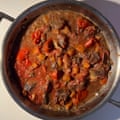
John William, “the deer man” of Raasay, whose recipe is included in Sue Lawrence’s A Taste of the Scottish Islands, soaks the meat overnight in “gutsy red wine”. I cannot speak for Raasay venison, and I imagine William knows what he’s talking about, but my testers and I don’t detect much difference with the wild Devon meat I use. Indeed, chemist Hervé This concluded that one would have to marinade meat for several days for the alcohol to have a noticeably tenderising effect, while the flavour penetration of any marinade is mere millimetres. By all means, marinate if you like, then, but I think you’re better off trusting in the mingling of flavours that takes place in the pot.
Rhodes tells readers of his book More Rhodes Around Britain that, “I like to cut the meat into large pieces rather than dice. It takes a little longer to cook, but the texture and taste are better.” Sceptical though I am that it will cook through, after trialling it I find myself inclined to agree; two-bite chunks remain juicier in the middle.
The vegetables
Everyone starts their stew with onions (though you could use shallots instead, not least because their sweetness would be welcome here), but after that is where the recipes start to diverge. Rhodes and Eyre go for a classic triumvirate with carrot and celery, and the latter, like William, also includes leek. Clarissa Dickson Wright champions beetroot, writing in the Game Cookbook she co-authored with Johnny Scott that “the brilliant food writer Claire Macdonald discovered there is an enzyme in [it] that breaks down the fibres in venison. When I was staying at Kinloch Lodge, the blissful hotel on Skye, she told me it would tenderise even the toughest old stag.” Again, wild animals are particularly hard to generalise about, especially one that might be anything from a 9kg muntjac to an 190kg red deer, but, on this evidence, I wouldn’t be rushing to add chunks of beetroot for anything other than flavour – its sweet earthiness is delicious with the meat.
Indeed, I’m going to focus on sweetness: even more than beetroot, we love the fruitiness of both the prunes in the Claire Macdonald Game Cookbook, and Clarissa Dickson Wright’s redcurrant jelly (in truth, most fruity jellies would work, should you have something similar hanging out in the cupboard). And if you’re a fan of sweet-and-sour combinations, may I encourage you to consider popping in some of Macdonald’s pickled walnuts as well – as one of my testers put it, along with the prunes, they “completely blended into the gravy and gave it a lovely richness and depth of flavour – neither too sweet nor too salty”.
I like to include as many vegetables in a casserole as possible, hence the onions, carrots and leek here, all of which will echo the sweetness of the prunes and preserve. If rich, sweet and savoury doesn’t appeal, bear William’s recipe in mind; with its chopped red pepper and tomatoes, it has a lighter, more southern feel, though if you do go down that road, maybe add some of Eyre’s garlic, too (I’d be tempted to include a glug of red wine to beef it out a bit as well, but then I don’t know the meaning of the world light).
The seasoning
Though bacon might seem to belong in the “meat” paragraph above, it’s purely here for its delicious, savoury fat, fat that the free-roaming deer hasn’t had the chance to build up on its wild perambulations. If you don’t care for pork, an extra slug of oil, plus a dash of William’s Worcestershire sauce, should prove a satisfactory replacement.
Rhodes adds bay, Dickson Wright and Eyre thyme, Eyre parsley stalks and Conran juniper berries, a classic seasoning for venison and one that I love. But seeing as we already have the jelly, I’ve stuck with thyme here, because I think its austere, savoury aromatic quality works with fruit and meat.
The liquid
Dickson Wright, who probably couldn’t move for deer carcasses and pheasant skeletons while writing her Game Cookbook, instructs me to make a game stock, which drives the dog wild for the hour it takes in the pressure cooker (expert guidance via Catherine Phipps’ excellent Modern Pressure Cooking). Should you also have bones going to waste, it’s worth your while doing the same, though both the beef stock in Conran’s recipe and the vegetable version in Macdonald’s won’t do any harm, and we don’t find we miss anything in Eyre’s version, which tops up red wine with water.

Wine, in fact, features in almost every recipe, and with good reason: its fruit, acidity and tannins combine with the browned meat and bacon to produce a richly savoury sauce. If you’d prefer to leave it out, use the same amount of beef stock and add either a glass of port, as Conran does, or an extra spoonful of redcurrant jelly and a squeeze of lemon. You’ll notice I’ve been generous with the quantity, because a couple of the recipes I try don’t have enough gravy for my testers’ liking – and what’s the point of a casserole without gravy, as one tartly (and ungratefully) observes.
The cooking
Everyone except Conran bakes their casseroles – you can, of course, use the hob for the recipe below, but I find it much easier to keep things at a constant low simmer in the oven. To my surprise, the venison doesn’t need as long as I’d imagined either: two hours at 160C proves quite sufficient for both Eyre and Dickson Wright’s offerings, and though you can stick it in a very low oven overnight, as William recommends (no doubt particularly useful if you have an AGA or similar), there’s really no need. In the interests of making the most of the fuel, I’d strongly urge you to consider baking some potatoes at the same time.
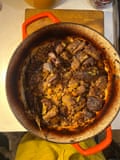
A final piece of advice: should you have the luxury of time, Macdonald’s tip that “twice cooking is almost obligatory for casseroles; the flavours are vastly better than if the casserole is made and eaten straight away”, is a good one. Take it out of the oven after 90 minutes, then, when you’re ready to eat it the next day or the day afterwards, put it back in there at the same temperature for half an hour. It also freezes well.
Prep 20 min
Cook 2½ hr
Serves 4
100g streaky bacon
800g venison, preferably boned shoulder, if available
2 tbsp neutral oil, or lard or dripping
2 tbsp plain flour
Salt and black pepper
1 large onion, peeled and chopped
1 leek, trimmed, washed and chunkily sliced
1 carrot, coarsely diced
2 sprigs fresh thyme, or ½ tsp dried thyme
fr300ml red wine
8 stoned soft prunes, halved
1 tbsp redcurrant jelly, or other fruit jelly
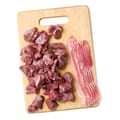
Heat the oven to 180C (160C fan)/350F/gas 4. Chop the bacon into wide pieces. Drain any liquid from the venison and, if it isn’t already diced, cut it into large, two-bite chunks.
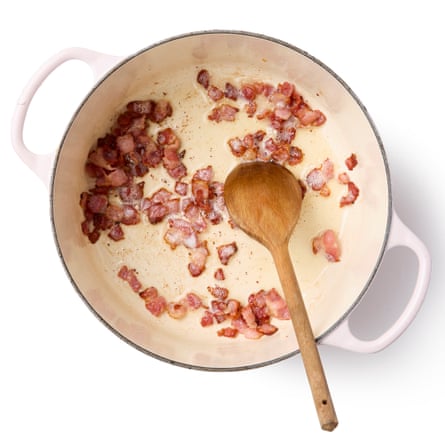
Heat the oil in an ovenproof casserole dish for which you have a lid on a medium-high flame.
Fry the bacon in the hot fat until it releases its fat and begins to turn golden.
Meanwhile, toss the venison with the flour and a good pinch of salt and pepper.
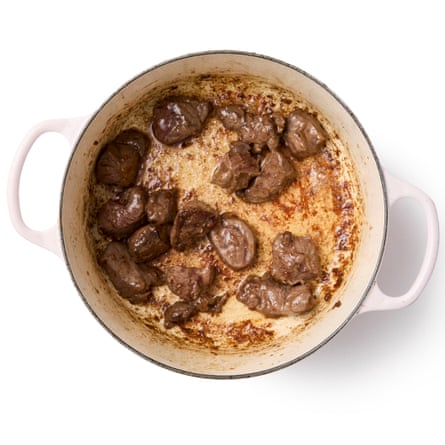
Scoop out the bacon with a slotted spoon and put in a large bowl, then add a few pieces of the venison and brown on all sides – don’t overcrowd the pan or you won’t achieve that deep, brown colour that brings with it such flavour. Scoop each batch out as soon as it’s done and add to the bacon bowl.
When all the venison is browned, turn down the heat to medium-low and add the onion, leek, carrot and a pinch of salt. Fry, stirring regularly, until the veg have softened and are starting to colour; stir in the thyme towards the end.
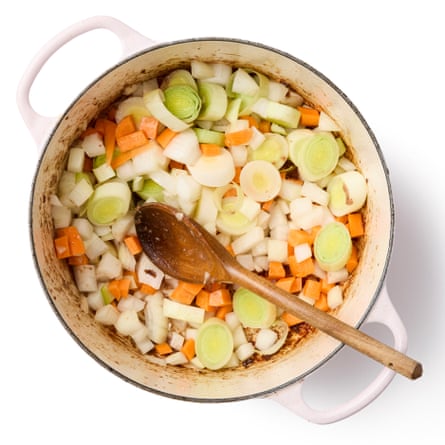
Scoop the vegetables into the meat bowl, then add a splash of wine to the pan, and stir to dislodge and dissolve any bits from the base.

Stir in the prunes and fruit jelly, then return the meat and vegetables to the pan, and add the rest of the wine and just enough water mostly to cover the meat – a few bits will stick out of the top like icebergs, but, without knowing the diameter of your pan, it’s impossible to give a precise amount of water.
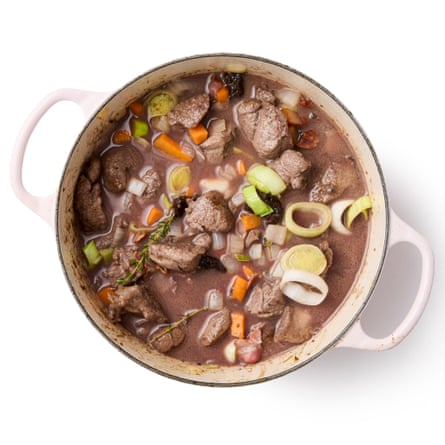
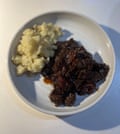
Bring to a simmer, then cover and put in the oven for 90 minutes if making ahead of time, or two hours if serving immediately. If reheating later, return the stew to the oven and cook at the same temperature for 30 minutes. Check the seasoning, stir in a little extra water if it’s too dry for your liking, then serve with mashed potato and greens.
-
Venison – love it, hate it, or somewhere in between? Is it the ethical red meat, or is this pure greenwashing and speciesism, as Peta claims? Why don’t we eat more of it in this country (Bambi?) and, if you love it, what’s your favourite way to prepare it?
KioskNews shows a cleaned-up reading view extracted from the publisher’s page — the original always lives on their site, not ours.