9-foot-tall Game Boy Color plays all the classics
We may earn revenue from the products available on this page and participate in affiliate programs. Learn more ›
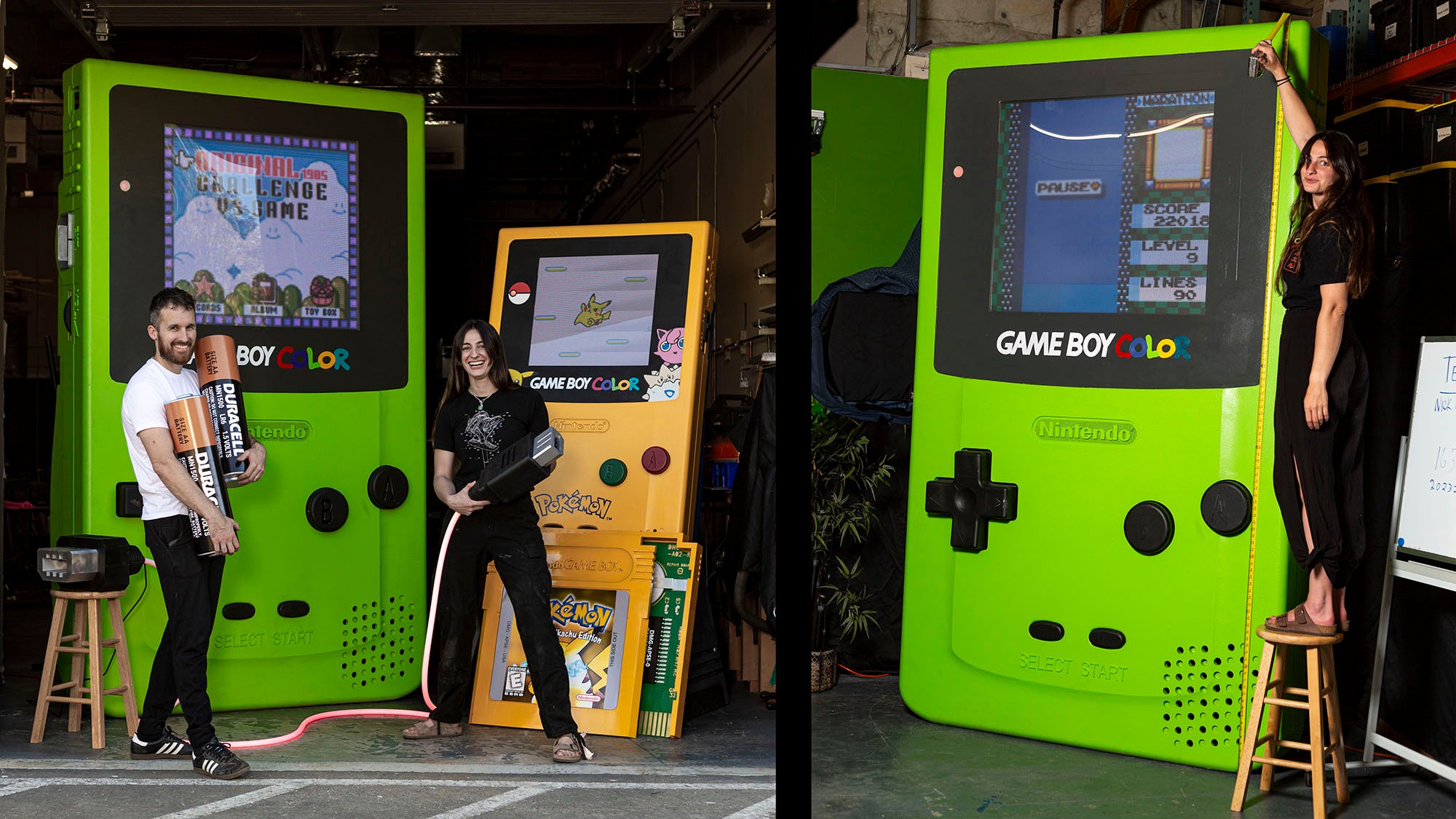
A pair of California-based engineers have built what they say may be the largest Game Boy Color ever. Standing more than nine feet and weighing around 300 pounds, the Pokémon-yellow goliath requires a U-Haul to transport and took over 1,500 collective hours in a makerspace to create. And it isn’t just for show. The giant handheld plays real Game Boy games, thanks to a pixel-perfect display scaled up from the original and software written from scratch. The designers even fabricated an assortment of to-scale accessories, including game cartridges, a cable link, and AA batteries.
The console has already appeared at several maker events, where eager kids have punched and kicked its chunky buttons. It has also prompted plenty of older millennials, in person and online, to reminisce about simpler days. Build videos posted across social media have racked up hundreds of thousands of views. But for co-creator Paige Powell, a veteran prop designer and mechanical engineer, the giant Game Boy also represents something more special: a labor of love and a chance to inspire young girls to start building things themselves.
“It [has] felt very weird to me in a very male-dominated world to build something behind the scenes and then give it to [a] guy who then takes credit,” Powell tells Popular Science. “I want people to see women making stuff!”
How a hobby became an obsession
The giant GameBoy is the joint effort of Powell (@whats_paige_making on Instagram) and engineer Nick Alvarez (@nickbuildstuff on Instagram). Powell has a long track record of building props and sets for the YouTube channel Mega Builds and the immersive art company Meow Wolf. Alvarez, meanwhile, specializes in PCB (printed circuit board) design and spent seven years as a full-time engineering manager at an aerospace defense company.
The two crossed paths while working at the Davis makerspace, just west of Sacramento. Alvarez was building a large LED wall (the kind used for screens at sports arenas) and wanted to hook up Nintendo controllers so it could play games. Piggybacking off of that, Powell proposed taking the idea a step further: a giant playable Game Boy. From there, it only made sense to try and make the world’s largest. That sent them down a rabbit hole that would consume a sizable chunk of their lives (and finances) over the months to follow.
A quick bit of research revealed they weren’t the first one with this idea. Guinness World Records actually has an official entry for the Largest Game Boy Color, an accolade claimed in 2022 by a YouTuber named Jake Carlini. His version measured in at seven feet tall. But calling that one a real Game Boy is quite a stretch. It was really little more than a few pieces of vaguely detailed plywood. Alvarez and Powell realized there was an opportunity, not just to break the record, but to build something far more ambitious.
“It [the Carlini model] was just kind of [a] slapstick way of putting it together, and we were like, ‘dude, what is this?’ Alvarez says. ”We can do something actually amazing with our background and our skillset.”
Building around constraints
From the outset, the duo gave themselves a set of constraints to build around. Their Game Boy had to be to scale to the original and functional as a game console. They also committed to making the screen pixel perfect to the 1998 original.
“Everything was built around the constraint of what the screen was going to be,” Powell says.
Fortunately, they had some help along the way. When they told Tim Keller, the head of the Davis makerspace, about the project, he agreed to let them set up shop and use the space’s CNC mills, 3D printers, laser cutters, and other equipment.
Related 'The Workshop' Stories
With goals set and tools secured, the pair then created a 3D model of their scaled-up Game Boy, starting with a smaller (though still shockingly large) 5.7-foot version. Powell quickly realized that the toughest part to fabricate wasn’t actually the console’s iconic front, but rather its geometrically odd-shaped back shell. The top of the backside starts out flat but then bulges out into a sloped shape toward the bottom where a person would hold it in their palm. The cartridge slot where the game slides into also juts out from the back, adding even more complexity
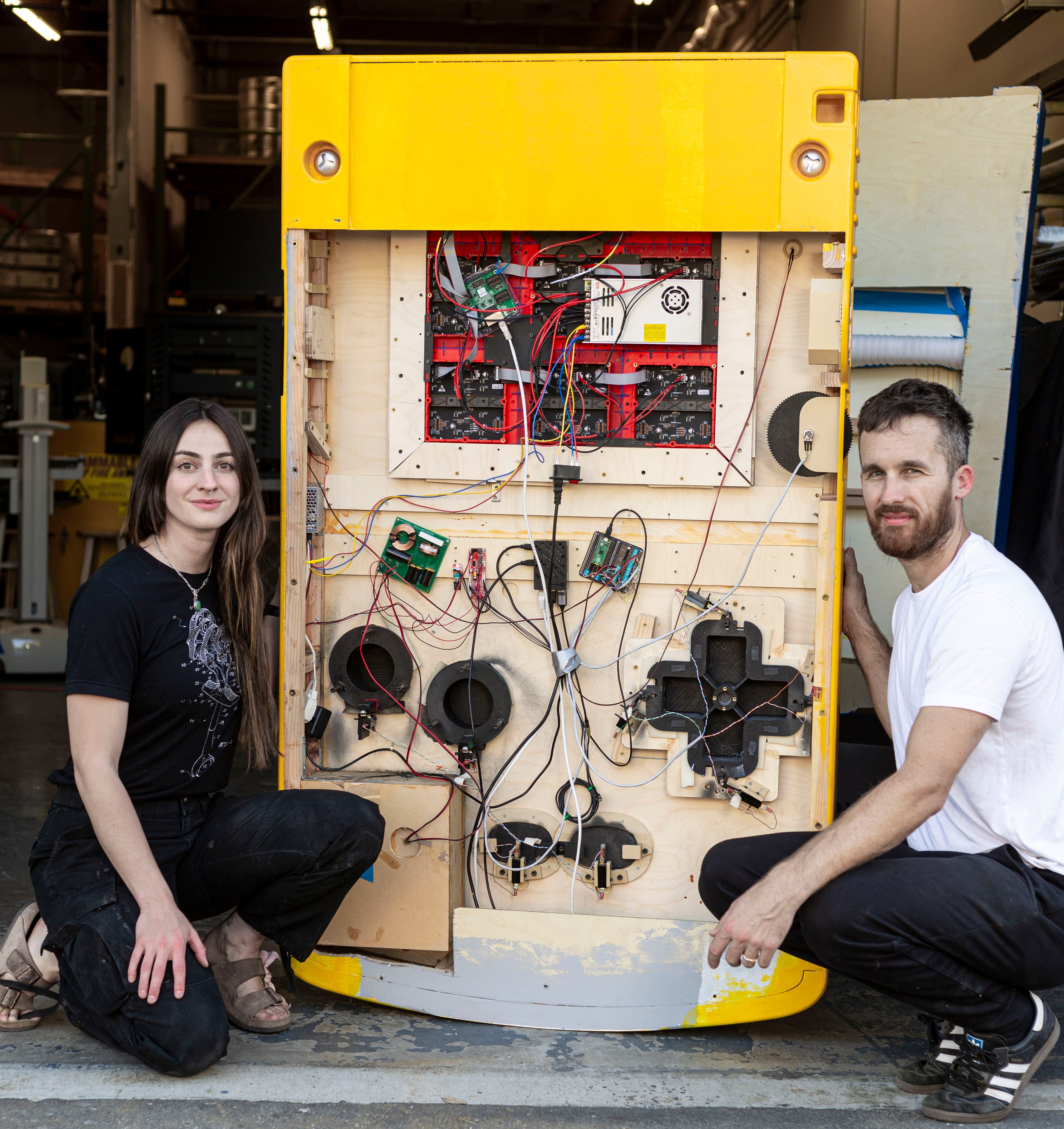
Once the 3D model was complete, Powell began building the physical body, made mostly of plywood shaped on the CNC machine, an automated manufacturing device that reads computer code and uses that to control cutting machines like mills, lathes, and lasers. CNC machines are indispensable tools in many makers’ arsenals. But a project like this requires adaptability. Partway through, Powell says, she realized the CNC machine wasn’t all that well suited to making square cuts, which meant the final product would need more hand carpentry than initially planned.
Meanwhile, Alvarez was hard at work perfecting the display and electronics under the hood (or, in this case, the shell). He built the screen from a series of HUB75 LED panels, the kind commonly used in large digital signs. The trick was getting his massive DIY display to scale up accurately from the original GameBoy’s 160-by-144 pixel screen. He also used a small microcontroller (essentially a tiny computer assigned to a specific task) to map all of the device’s buttons and switches.
When the giant Game Boy plays games, it’s running them on a specialized emulator rather than the physical game cartridge that gets slotted into the device. The emulator is a piece of software that imitates a Game Boy. Emulators are common these days and are what let hobbyists play old Nintendo games on smartphones.
The to-scale cartridges Powell and Alvarez fabricated are really more for show. That means, theoretically, their device can run any Game Boy game. Alvarez says he even built in a feature that cycles to a different game each time the power is switched on. So far, the pair have posted videos of the device playing Pokémon and Donkey Kong. Alvarez even watched The Odyssey on it.
Giant Game Boy evokes strong memories and karate kicks
Powell and Alvarez have shown off their creations at two events so far: Open Sauce in 2026 and the Bay Area Maker Fair in Vallejo, California. Getting the Game Boys there was a task in itself. The larger of the two (around 300 pounds) required a large U-Haul and four people just to load it. Once unloaded, they faced a more daunting challenge: the wrath of children. Drawn in by the device’s giant buttons, kids at the events let loose.
“Kids were coming up and karate-kicking them, and I was just like, ‘Oh my God, man,’” Powell says.
Alvarez concurs. “They were punching the crap out of the buttons.”
In a testament to its build quality, the giant Game Boy withstood the onslaught of toddler haymakers. Those who weren’t assailing the device were often absorbing an emotional gut punch of their own. Both in person and online, fans told Powell and Alvarez how the build brought back childhood memories. One commenter recalled how seeing it reminded them of a time at a school when a bully stole their beloved Game Boy. Decades later, he said, he’s still mad.
Looking ahead, Powell and Alvarez hope to find their creation a new home where it can be on display and accessible to the public. They’d like to recoup some of the money they’ve poured into it, but Powell also expressed some wariness of it winding up locked away in some buyer’s private collection. Ideally, she says, it would land in a museum of some kind, where it could inspire the next generation of budding makers.
In The Workshop, Popular Science highlights the ingenious, delightful, and often surprising projects people build in their spare time. If you or someone you know is working on a hobbyist project that fits the bill, we’d love to hear about it—fill out this form to tell us more.
KioskNews shows a cleaned-up reading view extracted from the publisher’s page — the original always lives on their site, not ours.