Carney will miss target for balancing operating budget, PBO says
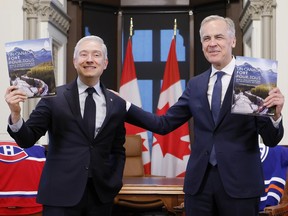
OTTAWA — A new report by Ottawa’s fiscal watchdog raises questions about when the government will eliminate its operating deficit, despite Prime Minister Mark Carney saying last week that the government now expects to balance its operating budget a year earlier than the original goal.
Sign In or Create an Account
Based on the information that the government released in its 2025 budget and this spring’s economic update, the Parliamentary Budget Office (PBO) projects that Ottawa will miss its target of balancing the operating budget by 2028-29 by a year.
The PBO says Ottawa spent about $546.6-billion on operating expenses in 2025-26 and $34.5-billion on capital costs.
The report also says the Carney government’s treatment of some of its budget items is contradictory, raising further questions about the government’s decision last year to split its spending into two distinct ledgers.
The PBO said Thursday the federal government needs to do more to sort out its definitions for capital versus operating items, wiggle room that many economists say will tempt governments to lump as much spending as possible into the rosier-sounding capital side.
That temptation will be particularly alluring for the Carney government because it’s facing massive deficits for the foreseeable future and established a key fiscal target last year of eliminating the operating deficit by 2028-29.
In a document called The Government’s Operating Budget Fiscal Anchor, the PBO says it seems contradictory to classify the government’s Agricultural Clean Technology program as a capital cost, for example, while its Agricultural Climate Solutions program is on the operating side. Both programs, the PBO says, are designed to trigger farm investments.
“This makes it difficult to anticipate how future spending will be sorted,” the PBO report says.
The PBO points out that Canada is not the first country to split its operating and capital budgets. The United Kingdom, Norway and Singapore do similar things, but the PBO points out that the U.K. also paired the move with a rule that borrowing is only allowed to pay for capital costs. The UK also used a definition of capital spending that is internationally accepted.
Franco Terrazzano, federal director of the Canadian Taxpayers Federation, said the PBO report is further evidence that Ottawa has been expanding the definition of capital spending in a way that wouldn’t be allowed in the UK.
But the real problem, Terrazzano said, isn’t the government’s accounting methods but that Carney’s “credit card government” spends and borrows way too much.
The federal government is borrowing about $65-billlion a year, Terrazzano said, more than Ottawa sends to the provinces and territories for health transfers or collects from the GST.
“We’re paying way too much paying interest on the debt.”
John Fragos, spokesman for Finance Minister François-Philippe Champagne, said the government has already identified $60-billion in savings over the next five years, allowing Ottawa to eliminate the operating deficit a year ahead of schedule. Those savings, Fragos said, will allow the federal government to spend more on capital costs that will support economic growth.
The Carney government’s first budget last fall marked the first time that Ottawa had separated capital and operational or day-to-day spending. The key distinction, according to the government, is between regular, day-to-day expenses such as wages for federal public servants and social service payments, and those capital costs on such things as ports, military equipment and other infrastructure that should provide long-term benefit.
In its spring economic update, the government said it expected to post a deficit of $66.9 billion for the past year, slightly less than expected, due to improved fiscal outcomes. But Ottawa’s broader fiscal outlook remains dire. The federal government has now accumulated $1.27-trillion in total debt, almost half of which has been added over the last five years.
National Post
Our website is the place for the latest breaking news, exclusive scoops, longreads and provocative commentary. Please bookmark nationalpost.com and sign up for our politics newsletter, First Reading, here.
Join the Conversation
This website uses cookies to personalize your content (including ads), and allows us to analyze our traffic. Read more about cookies here. By continuing to use our site, you agree to our Terms of Use and Privacy Policy.
KioskNews shows a cleaned-up reading view extracted from the publisher’s page — the original always lives on their site, not ours.