South Korea’s president forgoes ‘denuclearization’ for ‘peninsula free from nuclear weapons’ in UN speech
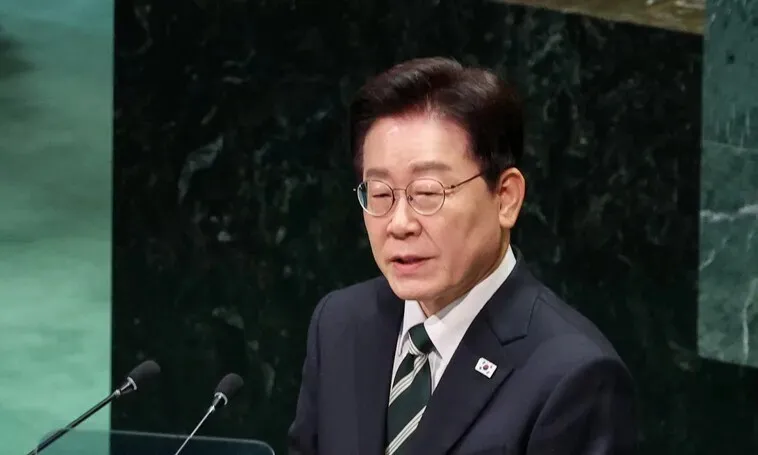
President Lee Jae Myung of South Korea speaks before the UN General Assembly on Sept. 22, 2026. (Yonhap)
President Lee Jae Myung on Tuesday proposed a three-step blueprint for achieving peace between the two Koreas at the United Nations General Assembly in New York.
“I hope the long-suspended dialogue between North Korea and the US can resume without delay. We will lay the groundwork for this to develop into a dialogue among the parties aimed at ending the war on the Korean Peninsula and transitioning to a peace regime,” he said in a keynote speech to the world body.
Lee laid out three principles for outlining a path toward “peaceful coexistence” on the peninsula. The first was “peaceful coexistence built on mutual respect.”
“The most critical task is to bring an end to this decades-old war on the Korean Peninsula and establish a lasting peace regime,” he said. “For decades, the two Koreas, along with key countries such as the US and China, have recognized the need for a peace regime on the Korean Peninsula and discussed ways to achieve it.”
His proposal is considered a concrete plan to implement his suggestion made on Aug. 15 in his Liberation Day speech for multilateral talks to end the conflict. At the time, Lee said, “Let’s drop all intentions of threatening one another and initiate dialogue among directly concerned parties in order to conclude this long war.”
In New York this time, he specifically mentioned the relevant countries like the US and China as well as both Koreas as parties to talks on a permanent peace regime.
At the same time, he commented, “Fortunately, President Trump’s resolve has recently created a hard-won opportunity for change.”
“I am confident that the dialogue for establishing a peace regime on the Korean Peninsula can provide a valuable framework not only for normalizing relations among the parties concerned, but also for fostering shared growth through multilateral cooperation and promoting stability and cooperation in Northeast Asia,” he continued.
He went on to say, “In this process, we will begin with a stop to further advances in North Korea’s nuclear and missile capabilities, followed by their reductions in the medium term, moving toward a Korean Peninsula free from nuclear weapons over the long term.”
While Lee’s speech before the UN last year explicitly stated “denuclearization” as a goal and presented a stepwise solution consisting of the stop, reduction and dismantlement of nuclear capabilities, his speech this year did not use the specific word “denuclearization.” Instead, he presented a scenario that consisted of a “stop to further advances” in the North’s nuclear and missile capabilities, followed by their “reductions” and an eventual “Korean Peninsula free from nuclear weapons.”
In a New York Times interview published Monday, Lee similarly indicated a shift in focus toward a more realistic prioritization of a nuclear freeze and reduction, rather than making denuclearization the immediate goal of negotiations.
“Aiming for denuclearization under the current circumstances guarantees that nothing will be accomplished,” he was quoted as saying.
In his UN speech, Lee said, “I hope that the United Nations, which created a pivotal moment for peaceful coexistence on the Korean Peninsula 35 years ago, and the Security Council, which has safeguarded the peace and stability of the international community, will once again play a responsible and constructive role.”
“As a direct party to peace on the Korean Peninsula, and as a pacemaker, my government will exert every effort to open and sustain the path toward dialogue,” he continued.
Lee further emphasized an “inclusive peaceful coexistence built on mutual respect.”
“Based on the respect for each other’s systems and acknowledgement of our differences, we will explore ways for shared growth through cooperation,” he said.
“We will continue to respect the North on the international stage and seek cooperation wherever possible. We hope that opportunities will emerge for us to work together in the international community, in areas such as public health, disaster response, and the climate crisis,” he added.
He went on to emphasize a “stable peaceful coexistence that renders conflict unnecessary.”
“We will work to institute mechanisms for preventing crisis and managing conflicts,” he asserted.
“Reestablishing basic channels of communication and building trust will be the first step toward a stable peaceful coexistence,” he continued.
In reference to the Strait of Hormuz, Lee stressed the importance of global energy supply chains.
“Recently, there have been repeated blockades of sea routes in the Strait of Hormuz and the Red Sea. This has underscored the stark reality that the weaponization of key energy and logistics supply routes can send severe shockwaves to the lives of ordinary people around the world,” he said.
“Freedom of navigation and safe passage through international straits is a right grounded in international law and serves as a bedrock of the global economy,” he stressed.
He went on to declare, “While making greater use of existing frameworks such as the International Energy Agency, the Republic of Korea will build a more robust framework of cooperation for energy supply chains to prevent the supply chain crisis from escalating into a broader threat to the global economy and people’s livelihoods.”
“The most urgent and realistic path is for countries with the capacity and willingness to supply global public goods to join hands and broaden the scope of cooperation,” he continued.
He described such a system as a “Partnership of Constructive Contributors.”
Lee emphasized, “I am not seeking to propose a new organization, nor an exclusive grouping. The idea is to respect the functions of the existing international order and the UN, work together in a flexible and open manner in areas where each country has particular strength, and expand our ties of cooperation into new areas.”
“By continuing to build on the achievements of collaborating ‘separately yet together,’ we can move beyond geopolitical rivalry, deadlock, and fragmentation, and rebuild trust in multilateralism,” he added.
KioskNews shows a cleaned-up reading view extracted from the publisher’s page — the original always lives on their site, not ours.