South Koreans sit key college exam mired in cheating scandal
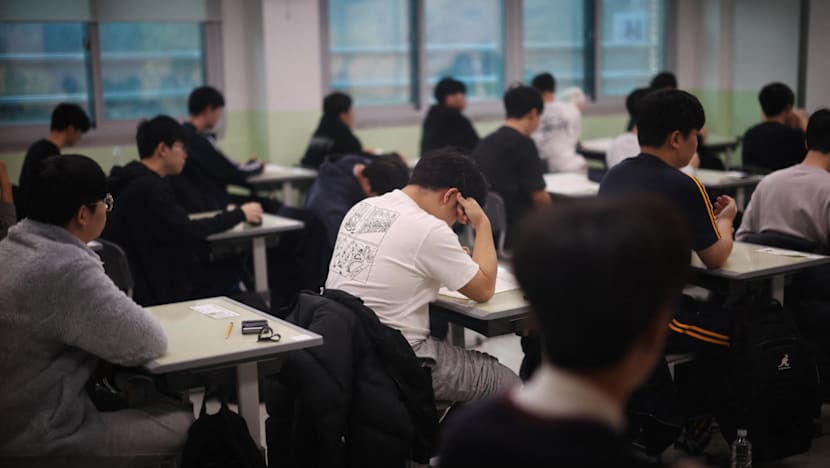
The annual nine-hour Suneung exam is widely seen as a ticket to prestigious universities, well-paid jobs, and even better marriage prospects in the highly competitive country.
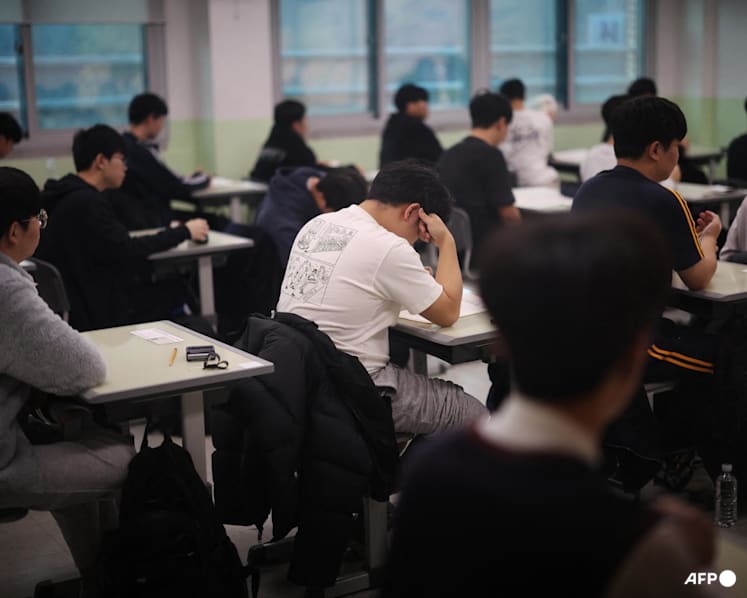
Student wait for the start of the annual college entrance examinations at an exam hall in Seoul on Nov 19, 2026. (Photo: AFP/Pool/Kim Hong-ji)
20 Nov 2026 10:39AM
SEOUL: South Korea cut Wi-Fi around exam halls and offered US$75,000 rewards to whistleblowers in an all-out battle against AI-assisted cheating as half a million students sat their gruelling college entrance exams on Thursday (Nov 19).
The annual nine-hour Suneung exam is widely seen as a ticket to prestigious universities, well-paid jobs, and even better marriage prospects in the highly competitive country.
But this year, fears of AI-assisted cheating drove authorities to extraordinary lengths, including doubling the number of supervisors and sending random emergency alerts to detect smartphones smuggled into the exam centres.
As students took the test on Thursday, Prime Minister Han Seong-sook ordered that Suneung papers from 2025 be kept "until further notice" for a cheating probe.
Earlier, anxious parents hugged their children in the South Korean capital, where temperatures dropped below zero overnight.
"I came here with a heavy heart because of concerns over AI cheating," Bang Min-ji, 18, told AFP as she prepared to enter the Yeouido Girls' High School in central Seoul.
An AFP photographer saw a late-running student race into the high school after getting a ride in a police car.
The exam kicked off at 8.40am (7.40am, Singapore time), with a nationwide mobile phone alert sounding 10 minutes beforehand.
Two more alarms rang out on smartphones between 2.30pm and 3 pm ahead of the test wrapping up at 5.40pm.
Students were told to turn up with just pencils. Erasers were provided by the test centres, as authorities tried to reduce the chances of concealed digital devices disguised as stationery.
Exam-takers were asked to avoid wearing clothes with buttons, with those who failed to comply having stickers placed over the fastenings to prevent the use of hidden cameras.
Bang said she feared that restrictions on writing instruments could disrupt her exam.
"I'm worried I might panic if I have difficulty using the stationery provided during the test."
Elsewhere in the South Korean capital, boys were pictured with their heads in their hands as they sat nervously at exam desks.
More than 20 test-takers were found with smartphones after the morning alerts were sent, vice education minister Choi Eun-ok said at a news briefing.
After the exam, Choi said 98 students had been caught cheating, including five cases involving smart devices.
Among them, one used smart glasses, another photographed an exam paper with a smartphone, and two students used a phone in the restroom, she said.
Another student used a small camera and a pair of wireless earphones.
"We will hold those who used smart devices to cheat more strictly accountable," Choi said, adding that authorities would determine penalties based on the severity of each case.
EXTRAORDINARY STEPS
Much of South Korea came to a standstill, with flights temporarily halted during the English listening section. Many offices opened an hour later than usual to ease traffic, and stock trading was delayed by an hour.
The country rolled out the extraordinary anti-cheating measures after the top scorer in the national tax accountant examination confessed to using a miniature camera and smartphone to obtain AI-generated answers, achieving a near-perfect mark.
The revelation has fuelled suspicions that other high-stakes exams had also been compromised, including law school admissions and professional licensing tests.
A man whose perfect score on a law school admission test raised suspicions of AI-assisted cheating was found "in a state of cardiac arrest" on Thursday following suicide concerns, police said.
President Lee Jae Myung has promised a bounty of at least US$75,000 for anyone reporting misconduct, as well as reduced penalties for those who turn in their accomplices.
But test taker Park So-hyun said the government's response had "come too late".
"My friends and I all think the exam may have already been compromised in the past, and we're only taking action now because of Sunday's confession," she said at the school in Yeouido.
"Adults have been irresponsible."
EXPULSION
With the AI cheating scandal erupting so close to the Suneung, a high school student had filed a constitutional petition challenging the government's decision to go ahead with the exam as planned.
But a South Korean court on Wednesday rejected the request, citing insufficient evidence of irreparable harm.
Under the tightened measures, students caught cheating could be barred from retaking the exam for 10 years and face criminal prosecution.
The anxiety over AI cheating adds to an already immensely stressful day for South Korea.
Nervous parents traditionally escort their children to exam centres, where teachers and younger students gather to hand out sweets and chant words of encouragement.
After seeing their children off, many parents flock to Buddhist temples and churches across the country to pray for their success.
KioskNews shows a cleaned-up reading view extracted from the publisher’s page — the original always lives on their site, not ours.