Rare red bat rescued in Maine gobbles up mealworms
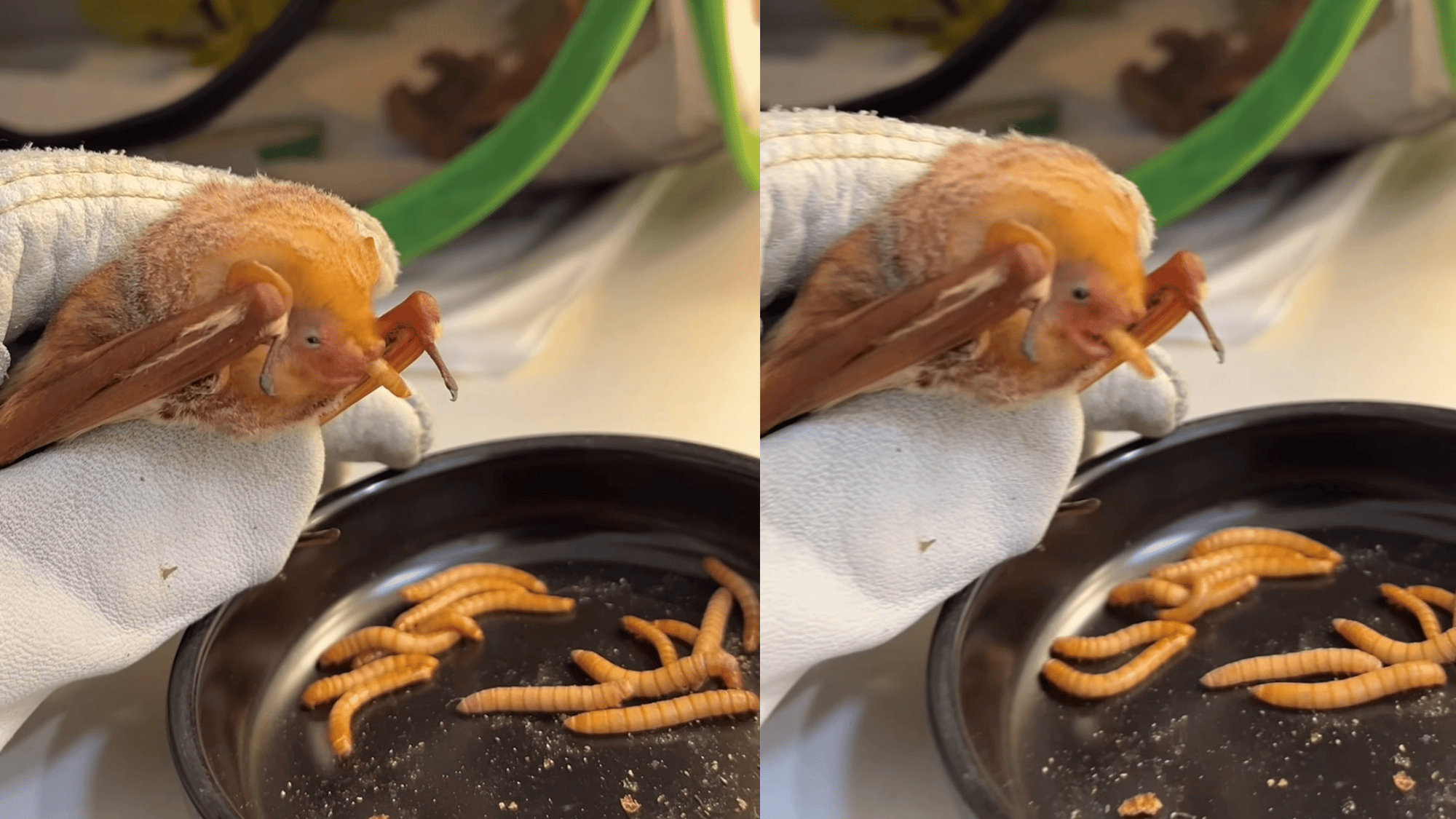
A rare Eastern red bat (Lasiurus borealis) is recovering after being found struggling in the surf on a Maine beach. Earlier this week, the Center for Wildlife in Cape Neddick, Maine, shared new footage of the winged mammal chowing down on a hearty plate of mealworms—a good sign for her recovery.
“She was very lethargic upon admission, and is now feisty and active,” Kristen Lamb, the Center for Wildlife’s Executive Director tells Popular Science. “She has been eating well, and responding to treatment including fluid therapy, temperature regulation and a specific bat habitat that allows her to mimic natural behaviors and reduces stress.”
Mealworms are the larval form of the yellow mealworm beetle and a common bat food. To keep these mealworm meals close to what a bat would be eating in the wild, the team even supplements what the worms themselves eat. This way, the nutrients inside of bugs resembles the contents of wild insects versus store-bought mealworms.
Eastern red bats like this one are one of eight bat species found in and around southern Maine. They are considered tree bats because they act more solitary and roost in trees among the foliage instead of in large communal groups or in caves like most bat species.
“They are camouflaged as they hang curled up in the furry membranes of their tails, suspended by usually one foot upside down, giving the appearance of a curled leaf or pine cone moving in the breeze,” says Lamb.
Red bats are also a species that eats “on the wing.” This means that they must be handfed or learn how to eat and drink from a dish if under human care. In the wild, they can grab insects from the air while flying, and glide and dip down to drink water while still flying.
Bats also have high metabolisms, and specific nutritional, temperature and humidity requirements. This isn’t because they are picky. These factors all help them roost.
“[Bats] hang upside down by their back feet, which their circulatory systems are adapted for versus ours which would result in a pounding headache!,” Lamb explains. “Clinic staff must have knowledge of this, along with their anatomy, physiology, sensitivity to medication and handling techniques in order to successfully treat them.”
Though humans generally think of bats more during spooky season, bats like these are a critical part of the ecosystem all year and directly tied to our health. They gobble up mosquitoes that can carry West Nile Virus or EEE, providing a natural and free form of pest control.
The team is hopeful that this little red bat can make a quick recovery and be released back into the wild, but also want to be sure she’s okay.
“Red bats are migrating right now and we don’t want her to miss her window,” Lamb says. “At the same time, she is recovering from the shock of being submerged in the cold Atlantic and if we release her before she can do everything healthy red bats can do in the wild, she would succumb to predators, the elements, or starvation shortly after release.”
The Center for Wildlife treats up to 2,500 injured and orphaned wild animals from a 100-mile radius per year. The center operates without federal funding and donations can be made through their website.
KioskNews shows a cleaned-up reading view extracted from the publisher’s page — the original always lives on their site, not ours.