Rugby continues to seek its US beachhead
Rugby players might be muscular, broad-shouldered athletes built to be seen, but some of the sport’s biggest stars barely turned any heads as they walked around Baltimore, Maryland, this week.
“We had a few people recognize us, not me necessarily but the guys I walk with,” South Africa number eight Jasper Wiese said before yesterday’s Test against New Zealand.
That anonymity captures the challenge, and the opportunity, facing rugby as it looks to capture a slice of the lucrative and crowded US sports market where the NFL, with its massive TV ratings and giant business deals, commands unmatched attention.
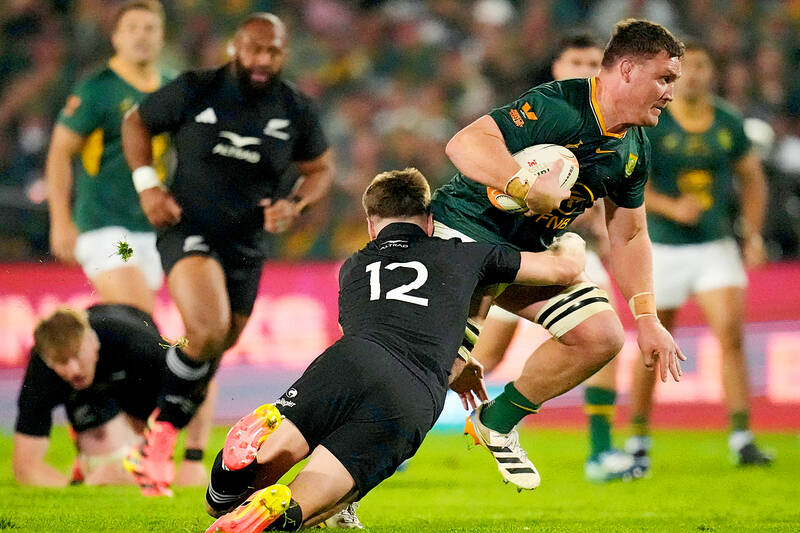
South Africa’s Jasper Wiese, right, is tackled by New Zealand’s Jordie Barrett during a Test rugby match between South Africa and New Zealand, in Johannesburg, South Africa, on Aug. 22. The two teams faced off for the last game of the series yesterday in Baltimore, Maryland.
Photo: AP
Many of rugby’s decisionmakers are undaunted and hoping to harness what could be a once-in-a-lifetime opportunity to grow the game and its fanbase in the US given the showcase events happening on American soil within the next decade.
Rugby sevens are part of the 2028 Los Angeles Olympics, and the US is hosting the men’s Rugby World Cup in 2031 for the first time before hosting the women’s tournament two years later.
USA Rugby has more than 100,000 members across youth, high school, college and senior club levels, a number the organization would like to see reach 500,000 by the time the World Cups are held in the US.
“Where it needs to go, we’ve got a long ways and a lot of work to do,” USA Rugby CEO Bill Goren said.
LEARNING CURVE
Yesterday’s match, at the 71,000-seat home of the Baltimore Ravens, saw the All Blacks and Springboks continue a century-old rivalry as part of the sport’s plan to better position itself for a breakthrough in the US.
Rugby is hoping to capture fans in a landscape where the “Big Four” North American professional sports leagues, the NFL, MLB, NBA and NHL, dominate revenues, media rights and cultural impact. Soccer has gained popularity in the US, which co-hosted this year’s World Cup.
Bob Dorfman, a sports marketing analyst, said rugby’s growth in the US hinges on a reliable sponsorship pipeline and securing regular TV exposure, while persuading millions of sports fans to learn and make room for another game.
“It’s not an easy sport to learn, a lot of complicated rules,” Dorfman said. “It’s so close to American football that I think American football fans who might be the most likely to get into rugby are so wrapped up in the NFL that who has time to really follow another sport?”
ALL LEVELS
Goren, who ran Major League Rugby’s marketing and business operations as deputy commissioner of the North American league before moving to USA Rugby, has a blueprint.
Part of the plan is to ensure all levels of rugby in the US promote the game in the same direction, building opportunities and clear pathways that make it easier for a curious person to find a place to play.
“What it’s going to take is a number of people coming together, alignment throughout our community ... aligning to promote, drive the game, build the opportunity for people to enjoy the game,” Goren said. “Today, it’s a challenge.”
Success on the field of play and household names can go a long way, he added.
Ilona Maher did her part at the 2024 Paris Olympics when she exploded in popularity on social media while helping the US to bronze in rugby sevens. Maher understood the need for rugby to connect with a younger audience and gained fans through her posts about body positivity and femininity in the athletic form, plus her cheeky Olympic village flirting.
PLENTY OF WORK
Major League Rugby co-president Alexander Magleby is hoping Saturday’s game gives Americans a chance to fall in love with rugby fans, similar to how they did with soccer supporters during the World Cup, when Scotland and Norway fans created some of the tournament’s more memorable moments.
“If people love soccer fans, they’re absolutely going to love rugby fans,” Magleby said. “And so this is an opportunity to take over another city in that regard, which is super cool.”
There is plenty of work to be done to get rugby firmly on the map. As South Africa and New Zealand players prepared for their sold-out match, it was clear that rugby has work to do in a crowded US sports marketplace.
“I think it’s a bit hard to sell it to America as a sport because they don’t know rugby like we do, and maybe they don’t appreciate [the game] as much as we do,” South Africa’s inside center Damian de Allende said. “But the best way to sell it is to have them come to the stadium and enjoy the experience, and see us play as the two best teams in the world. That’s the best rugby product they can experience right now in America, so to have the Springboks play New Zealand is the best way to sell the sport.”
KioskNews shows a cleaned-up reading view extracted from the publisher’s page — the original always lives on their site, not ours.