‘It’s not just about getting drunk!’ How Oktoberfest took over the UK

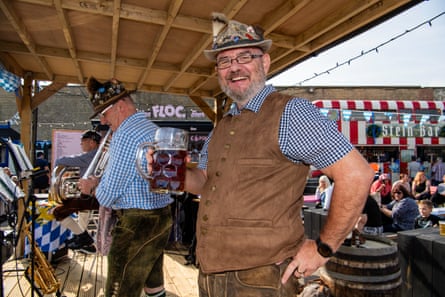
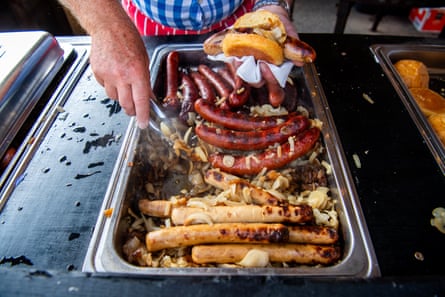
Under a sea of Bavarian bunting, vendors hand out steins of pilsner, dunkel and weissbier, alongside platters of bratwurst, pork knuckle and pretzels. The lederhosen-clad Bettesteiner Footstompers lead the cheering crowd in a boisterous oompah singalong: “Eins, zwei, g’suffa!” (“One, two, drink up!”) Foot-tapping, glass-clinking and swaying soon turn into dancing, and eventually a full-blown conga.
The spirit of Oktoberfest is well and truly upon us – but Munich is more than 500 miles away. My friends and I are at Wünder Harbour in Folkestone, Kent, a homage to the German event. Wünder Harbour has been held since 2023, first over one weekend, and now four as its popularity has rocketed. It is just one of scores of Oktoberfest tributes all over the UK, from tiny bars to enormous marquees in pretty much every major city.
The original Oktoberfest was held in Munich in 1810 to celebrate the wedding of Crown Prince Ludwig of Bavaria, later King Ludwig I, and Princess Therese of Saxe-Hildburghausen. It involved a horse race and a five-day party; the latter was such a hit it has been repeated every year since – except during wars and pandemics – and now lasts more than two weeks. Despite the name, Oktoberfest mostly takes place in September (19 September to 4 October this year).
Munich’s Oktoberfest is the world’s biggest beer festival: last year, 6.5 million people drank 6.5m litres of the stuff. Brits tend to associate the event with bratwurst, but by far the most eaten dish is Wiesnhendl, or roast chicken. It’s not just about boozing, either. According to the official report on 2025’s event, “The festival audience was a colourful mix of families with children, groups of work colleagues, young people and senior citizens – all coming to the Theresienwiese [the festival grounds] to stroll around for a few hours, try out the rides, eat, drink and celebrate in the festival tents and beer gardens.” About 30% of visitors were from abroad, with Britons in third place after Americans and Italians.
In the UK, the Campaign for Real Ale and other drinking enthusiasts have long held autumn beer festivals inspired by Oktoberfest. But outright copycat events – German-themed, often held in large tents – are a newer phenomenon. Belfast was one of the first UK cities to host one, in 2008, followed by London in 2011, Edinburgh in 2013 and Cardiff in 2014. Now they are everywhere, in city squares (such as Newcastle), parks (Cambridge, Chichester), racecourses (Beverley, Doncaster) and town halls (Portsmouth). Southampton claims to hold the UK’s biggest Oktoberfest.
Some are daytime, family-friendly affairs, like Folkestone’s. Dan Johannsen, the marketing manager for Folkestone Harbour Arm, tells me it was deliberately named Wünder Harbour rather than Oktoberfest to give it a broader appeal. There are certainly as many families eating fish and chips and ice-cream, and enjoying the free entertainment, as there are groups getting stuck into the steins. “The world needs more of this!” one man tells the band after a rousing chorus of Edelweiss.
Elsewhere, things can get a bit boozier. British beerhalls have got in on the action, such as Albert’s Schloss, whose branches in Manchester, Liverpool, Birmingham and London celebrate Oktoberfest for five weeks. I braved the opening night at another, the Bermondsey Bierkeller, which claims to host “London’s wildest Oktoberfest”. Within minutes my friends and I were standing on the table, beers in hand, singing along to an oompah version of Don’t Look Back in Anger by Oasis.
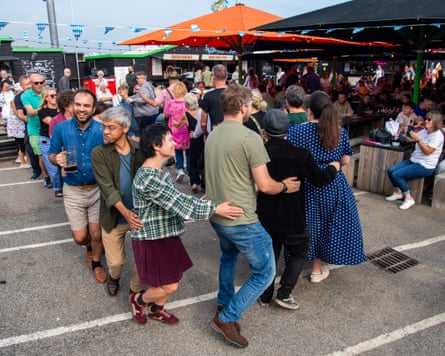
“We’re a German-themed bar, so it would be criminal not to celebrate Oktoberfest,” says Jim Gallivan, the Bierkeller’s general manager. He says the event started after Covid and has got busier every year since. He estimates that on Saturday nights, about half the crowd is in fancy dress, and we certainly spotted plenty of lederhosen and dirndls. Why does he think it is so popular? “It’s immersive, with actors, stilt-walkers and a seven-piece band. There are no airs and graces – it gets pretty rowdy,” he says. “People are looking to get as much as they can from a night out.”
Perhaps that’s it. With socialising now so expensive, people want more for their money. “I think it’s partly down to social media,” adds Beth Heath, the co-owner of Shropshire Festivals, which runs an Oktoberfest in Shrewsbury. “A themed event works as an Instagram moment.”
Heath organised the first Shropshire Oktoberfest in 2017 for her husband. “I’d been running events for years and he moaned there was nothing for blokes,” she says. “We had a festival for kids, a food festival for me, so I decided to do a beer festival for him.” About 6,000 people came – about 40% of whom were women. “There weren’t enough toilets! You need a lot more loos than you think at a beer festival.” By last year, attendance had doubled to 12,000 (the facilities have been scaled up accordingly).
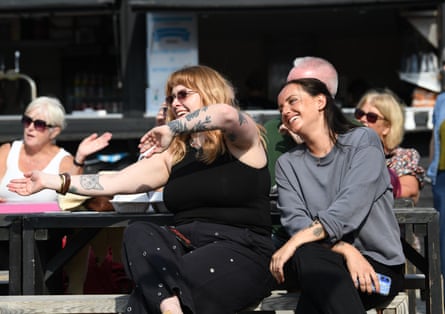
Heath says the festival is especially popular with groups of friends. “We get big groups of about 15 people, such as university reunions,” she says. “They can drink, dance and party, and still be in bed by 11. People come from all over the UK. Accommodation in Shrewsbury is booked out a year in advance.” About 70% of people come in “incredibly creative” fancy dress: “We’ve had giant pickles, sausages …”
As well as the usual oompah music, there are skiffle groups and local party bands. “It’s a wedding disco vibe,” says Heath. Other entertainment includes carpool karaoke, a giant silent disco and a big comedy tent. “It’s not just about coming and getting drunk,” she says. Of course, lots of people are there for the beer, which is sourced from Shropshire breweries. “We’re trying to be authentic but put a Shropshire spin on it.”
Heath thinks celebrating Oktoberfest is a way to beat the post-summer blues and add some excitement to a quiet time of year, before the countdown to Christmas starts. “It’s the last hurrah of the season. We have two 130-metre marquees, so there are no weather worries. Wellies and lederhosen – that’s a look!” Ultimately, she says, “It’s about bringing people together and making memories. It’s about the beer, the food and the vibe.”
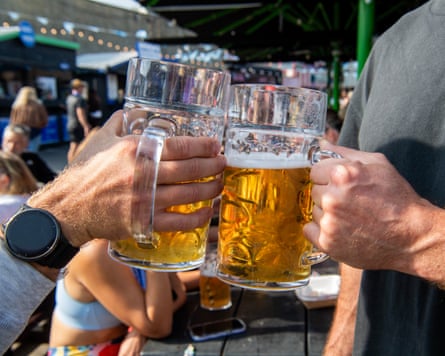
No wonder more and more Oktoberfests are springing up. New ones this year range from a down-to-earth beer and bratwurst knees-up in Darlington Market Square, County Durham, to an upmarket event at Horsley Towers, a country house in Surrey, with craft beer, wine and gin.
What do the Munich organisers of a 200-year-old tradition make of these British upstarts? “The city of Munich is very proud that many events around the world, including in the UK, are inspired by Oktoberfest,” says a spokesperson. “We are delighted that our festival has such international appeal and helps to share Bavarian culture and hospitality with a global audience.”
You sense there’s a “but” coming. “At the same time, the Oktoberfest in Munich remains the one and only official Oktoberfest. It is a protected name and a unique tradition that has been celebrated on the Theresienwiese since 1810. While many ‘Oktoberfest-style’ events capture the spirit of beer, food and music, they cannot replicate the history, scale and local roots of the original festival in Munich.”
True. But not everyone can make it to Munich. For many British beer-lovers, it’s much more convenient to raise a stein in your nearest town square or park. Or, as in Folkestone, to combine it with a fun day out at the seaside. All together now: “Prost!”
KioskNews shows a cleaned-up reading view extracted from the publisher’s page — the original always lives on their site, not ours.