Donovan’s Deep Dives: Cheng, Lu and the battle to shape 2028
This month’s election results will test Cheng Li-wun’s grip on the KMT and Lu Shiow-yen’s presidential prospects, with both women’s influence riding on who claims credit and who takes the blame
By Courtney Donovan Smith 石東文 / Staff Columnist


Though this year’s elections will choose local leaders with limited impact on national politics and geopolitics, the election results will shape who the key players are in defining the national elections held only 13 months later in January 2028.
This is especially true for the Chinese Nationalist Party (KMT). The two key people to watch will be the impact on the relative power and positions of party Chair Cheng Li-wun (鄭麗文) and Taichung Mayor Lu Shiow-yen (盧秀燕), who will be term-limited out as mayor on Christmas Day.
On the Democratic Progressive Party (DPP) side, if the party does badly then President William Lai (賴清德) will likely resign as party chair to take responsibility, but that may only be temporary. His predecessor Tsai Ing-wen (蔡英文) resigned three times for that reason, but returned to the chairmanship twice. If Lai resigns as party chair, that could impact electoral strategy, but will not do much to change the makeup of the key players.
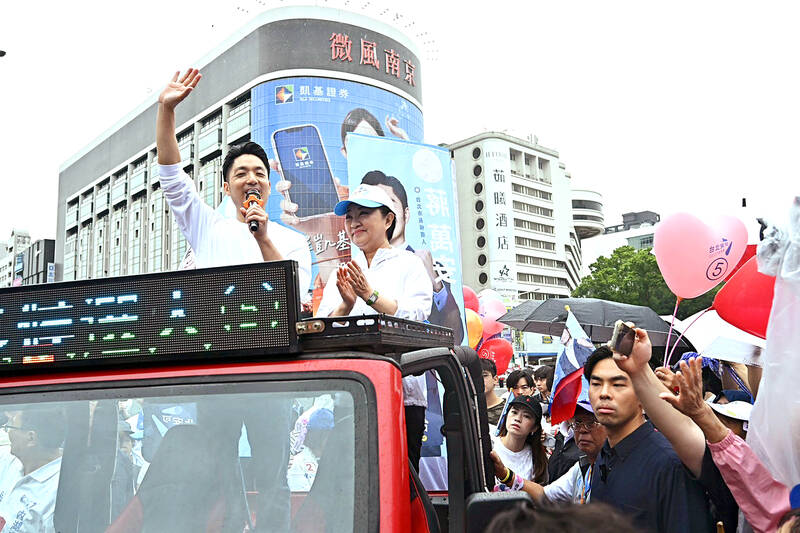
Taichung Mayor Lu Shiow-yen, right, and incumbent Taipei Mayor Chiang Wan-an on Saturday campaign in Taipei.
Photo: Tu Chien-jung, Taipei Times
The impact on the Taiwan People’s Party (TPP) will likely be more psychological and strategic rather than change the key players, of which the party really now only has two.
OTHER PLAYERS
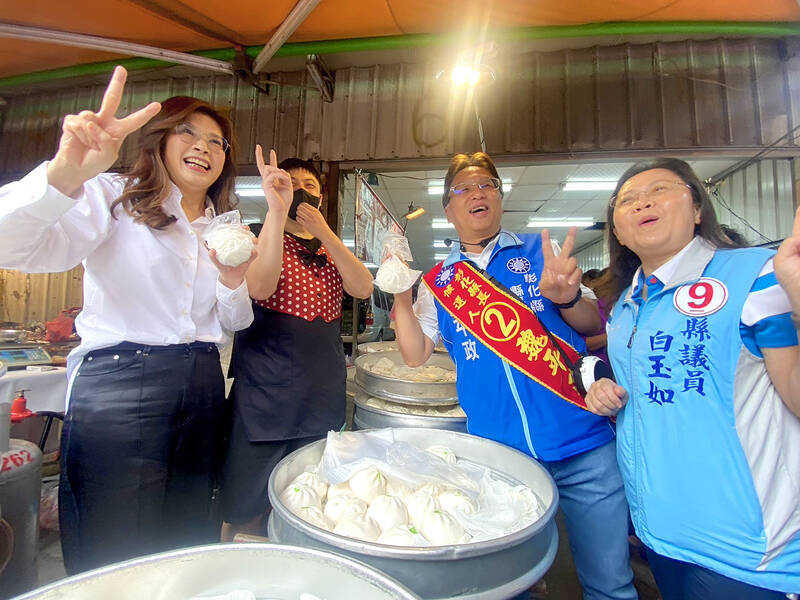
Chinese Nationalist Party Chair Cheng Li-wun, left, on Saturday campaigns in Changhua City with Wei Ping-cheng, the Chinese Nationalist Party’s (KMT) candidate for Changhua County commissioner.
Photo: Chang Tsung-chiu, Taipei Times
To focus on Cheng and Lu does not mean there are not other important luminaries in the KMT, but rather that the Nov. 28 elections are more likely to impact their relevance in the 2028 national elections.
Legislative Speaker Han Kuo-yu (韓國瑜) will remain a major player, but his position is safe. Theoretically, incumbent Taipei Mayor Chiang Wan-an (蔣萬安) could run for the presidency in 2028, and in the summer he rocketed to the top of the polls on who would be the KMT’s preferred candidate. However, his star has dimmed as a series of micro-scandals has dragged on his image, and he has struggled to contain Puma Shen’s (沈伯洋) surprising “ocean wave” challenge in the Taipei mayoral race.
This year’s elections are more likely to impact Chiang’s plans for 2032, rather than 2028. He has effectively endorsed Lu, telling media personality and politician Jaw Shaw-kong (趙少康) that given her political experience and her understanding of national policies, as well as her stature and vision, “I believe she is worthy of shouldering such a heavy responsibility.”
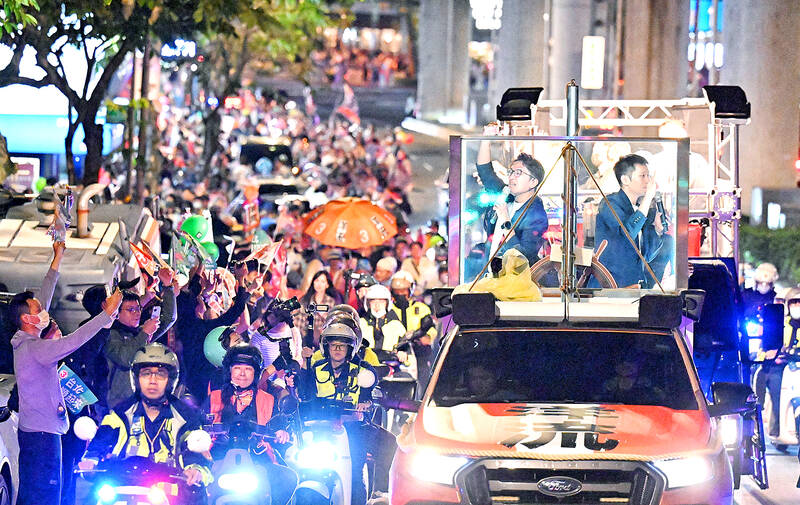
The Democratic Progressive Party’s mayoral candidate for Taipei City, Puma Shen, left with microphone, on Nov. 7 campaigns in the city’s Neihu District.
Photo: Fang Pin-chao, Taipei Times
TWO POWER PLAYERS
Lu and Cheng are a study in both contrasts and similarities.
Both are dynamic, intelligent and charismatic. Both have made strategic blunders.
Lu’s was her decision not to run for KMT chair last year, a decision she probably made because she didn’t want to split her time between Taichung and Taipei. However, what nobody saw coming was Cheng’s run and surprising win in the KMT chair race over more moderate candidates.
Cheng’s hardline Chinese ethnonationalist ideology and determination to forge a “peace framework” with the CCP, plus her initial complete rejection of the government’s proposed special military budget, alarmed many in the electability camp in the KMT.
Though the media talk plenty about KMT candidates shunning Cheng on the campaign trail, in reality only some are. More are keeping her at an arm’s length and not featuring her prominently in their campaigns.
As a result, many feel that Lu abdicated her responsibility by not running for chair when she had the chance, leading to the current tensions in the party.
Likely to atone for this, she agreed to become Chiang’s campaign headquarters chair on Oct. 19. This shows loyalty to the party by standing by their candidate facing a tough and very important race.
For Lu, this is a win-win. If Chiang loses, he will rightly take most of the blame. If he wins, it ties Chiang closer to her camp and she will have proven her loyalty. An interesting question is if Chiang’s endorsement of her running for president was a quid pro quo. With only a month and half left as mayor, the risks there are small.
Cheng has not only come under fire in the party for her ideology turning off middle-of-the-road voters, but also for her handling of the party’s election strategy, most notably in Changhua County and the conflict with the TPP in Jhubei City (竹北) .
DIFFERING FORTUNES
Broadly speaking, there are three possible outcomes to this year’s elections. Some DPP insiders expect the “ocean wave” to boost their candidates nationally by about six points, which would put swathes of the country into play that previously they had little hope of winning. This would be a disaster for the KMT, especially if they lose Taipei and New Taipei City, and fail to win Kaohsiung.
Cheng and the KMT maintain that the “ocean wave” is limited to the pro-DPP, pan-green base and will meet the same fate as last year’s “great recall” movement. They believe they will hold Taipei and New Taipei City, and could pick up Kaohsiung. They remain concerned about Chiayi City and Changhua, Hsinchu, and Yilan counties.
The third possibility is some mixture of the two.
If the KMT is right, then Cheng’s position is secure. Lu may still run for president, but Cheng will still hold the party’s levers of power and, if she keeps her promises, will set her own ideological agenda for the party based on her hoped-for negotiated “peace framework” with the CCP.
She recognizes convincing the public will be an uphill battle, but she is determined to see it through. Though I think she is more ideological than she lets on, Lu has crafted herself as a moderate and would want to set an agenda that will appeal to mainstream voters, not just the KMT’s hardcore base. This would put the party’s agenda and Lu’s presidential agenda at odds.
If the result is middling, for example, if the KMT loses New Taipei City, but retains Taipei and wins Kaohsiung, then Cheng will likely ignore pressure and refuse any calls for her to resign.
If the DPP’s hoped-for scenario plays out, then the pressure on Cheng to resign to take responsibility would be intense. If the KMT fails to win Kaohsiung and loses either New Taipei City or Taipei, that will likely be enough for many in the party to call for her to leave.
Tradition dictates that following a losing election, the party chair resigns. When asked about this, Cheng insists it won’t happen and that the KMT will hold its northern strongholds. However, some — including the aforementioned Jaw — are already speaking about her needing to take responsibility for losses.
In theory, Cheng could resist tradition and try to hold on to achieve her mission to create peace in the Taiwan Strait. Unlike when the party ousted its presidential candidate in 2015, it is far harder to dislodge a party chair because she holds some sway over the very processes needed to remove her.
If the KMT loses badly and Cheng steps down, then Lu will be in a perfect position to run for chair and consolidate her power over the party, their 2028 election strategy and her presidential campaign.
Donovan’s Deep Dives is a regular column by Courtney Donovan Smith (石東文) who writes in-depth analysis on everything about Taiwan’s political scene and geopolitics. Donovan is also the central Taiwan correspondent at ICRT FM100 Radio News, co-publisher of Compass Magazine, co-founder Taiwan Report (report.tw) and former chair of the Taichung American Chamber of Commerce. Follow him on X: @donovan_smith.
KioskNews shows a cleaned-up reading view extracted from the publisher’s page — the original always lives on their site, not ours.