Boasting South Korea footballers spark rethink of military service exemptions
The behavior has prompted Seoul to reconsider a decades-old system originally designed to reward athletes for bringing prestige to the nation.
By Kang Jin-kyu / AFP, SEOUL


For South Korea’s gold medal-winning footballers, victory at the Asian Games came with a reward beyond sporting glory: exemption from mandatory military service.
But the way some players celebrated that benefit has sparked a public backlash, prompting Seoul to reconsider a decades-old system originally designed to reward athletes for bringing prestige to the nation.
The controversy erupted after Asian Games football captain Lee Gi-hyuk proclaimed with a smile “I’m not going to the military” after beating hosts Japan in the men’s final this month.
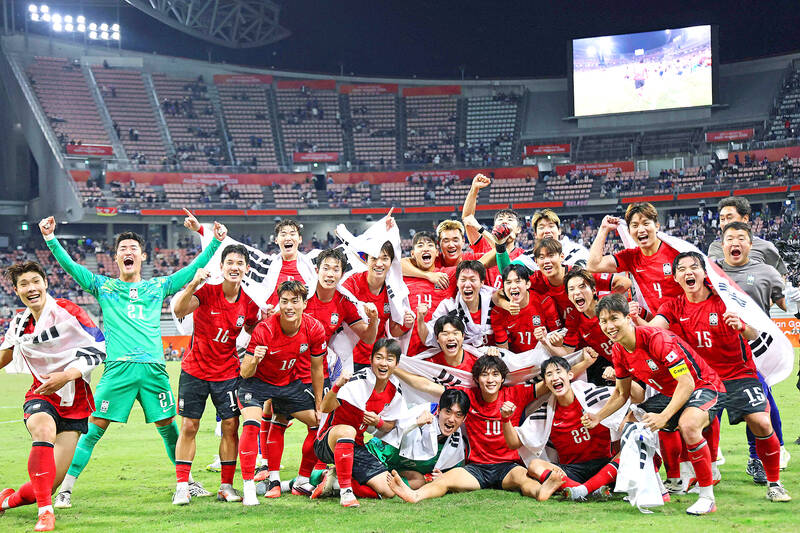
South Korean players on Oct. 3 celebrate after winning the gold medal in the men’s football final match between Japan and South Korea in the 2026 Asian Games at Toyota Stadium in Toyota.
Photo: AFP
He said he would have had to report for duty just nine days later had his team lost, interrupting a lucrative career at its peak.
A video of Newcastle United’s 19-year-old Park Seung-soo wearing a military discharge cap tilted to one side and giving a smiling salute further fueled the outcry.
Both players later apologized.
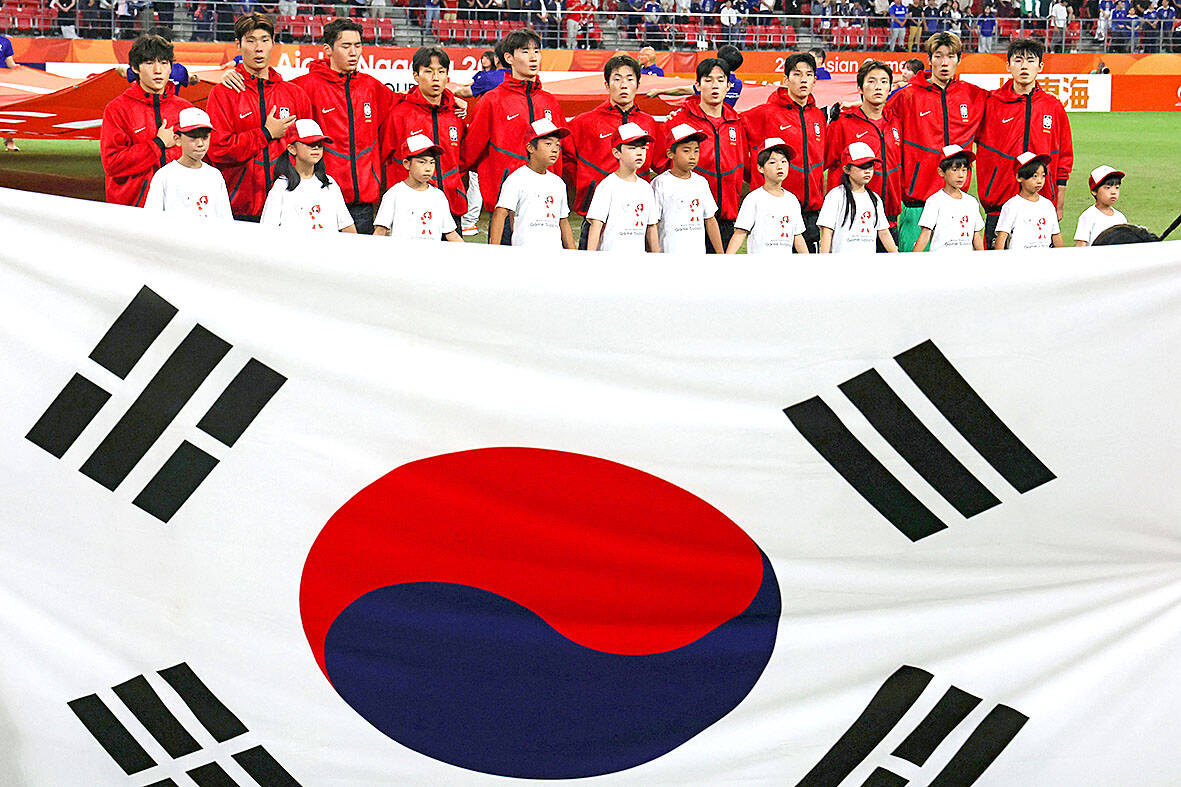
South Korean players on Oct. 3 sing the national anthem prior to the men’s football final match between Japan and South Korea in the 2026 Asian Games at Toyota Stadium in Toyota.
Photo: AFP
Their actions contrasted with the cautious approach traditionally taken by South Korean athletes towards exemptions, long a sensitive subject in a country where most young men are required to serve.
Former Tottenham captain Son Heung-min, who earned his exemption after leading South Korea to gold at the 2018 Asian Games, was famously measured.
Asked about the exemption, Son said: “Rather than thinking about that, we came here to win this tournament.”
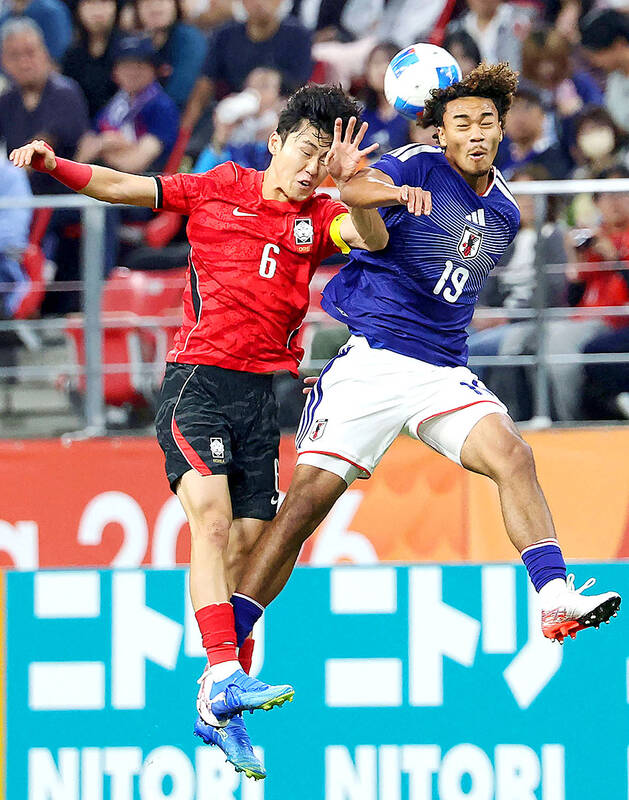
South Korea’s Lee Gi-hyuk, left, on Oct. 3 fights for the ball with Japan’s Uche Brian Seo Nwadike during the men’s football final match between Japan and South Korea in the 2026 Asian Games at Toyota Stadium in Toyota.
Photo: AFP
South Korea requires most able-bodied men to perform between 18 and 21 months of military service, as it faces off against nuclear-armed North Korea, with which the country technically remains at war.
But under a system introduced in 1973, athletes who win an Olympic medal of any color or an Asian Games gold are eligible for an exemption for “enhancing national prestige and promoting culture.”
Artists who win prizes at designated competitions can also get an exemption.
UNFAIR?
For some, the latest controversy has laid bare the perceived unfairness of a set-up that rewards only a select few while hundreds of thousands of young men report for duty every year.
“What has become clear from this controversy is that military exemptions have come to be regarded as a reward, even though only just a few dozen people every year benefit from them,” an official with ties to the draft process said, speaking on condition of anonymity.
When a select few openly boast about their exemptions, “it symbolically turns military service into a punishment for around 180,000 young men who enlist every year to serve,” the official said. While prize-winning classical musicians and dancers have at times also qualified for an exemption, pop stardom has famously not met the bar.
All seven members of supergroup BTS served out their military obligations, despite supporters noting the act generated billions of dollars for the South Korean economy.
Those who qualify for an exemption are still required to undergo three weeks of basic military training and complete 544 hours of community service related to their speciality over a 34-month period.
Responding to the recent controversy, Defence Minister Kang Shin-chul has pledged to gradually scale back the benefits, with the ultimate goal of abolishing them altogether.
The interviewed official suggested replacing full exemptions with shorter periods of military service.
“We need an alternative in which elite athletes get a reduced military term instead of getting a full pass around it,” they said.
PRODUCT OF BYGONE ERA?
With pressure mounting for reform, the Military Manpower Administration is conducting a review of the system, including eligibility criteria and public service requirements.
The study is expected to be completed by mid-November.
The debate also reflects how much South Korea has changed since the system was introduced more than half a century ago, said Kim Seong-sheen, a professor at Hanyang University.
“The exemption system introduced in 1973 was a product of an era when success at international sporting events was closely tied to national prestige,” he said.
The controversy underscores how times have changed, he said. “More than 50 years later, South Korea is grappling with a shrinking pool of military recruits, the commercialization of sports and growing public demands for fairness.”
KioskNews shows a cleaned-up reading view extracted from the publisher’s page — the original always lives on their site, not ours.