‘Absolute joke’: World Cup unrest over haves and have-nots
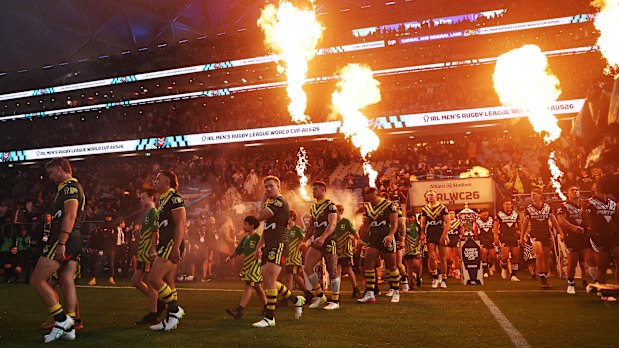
Australia’s staging of the Rugby League World Cup has been a raging success on the surface, drawing strong crowds and television ratings and already featuring an epic showdown between the Kangaroos and New Zealand.
But behind the scenes, there is unrest about a landscape of haves and have-nots in the international game rearing its head.
Officials from some of the cash-strapped nations are disgruntled about having to fork out tens of thousands of dollars for corporate boxes at their own games to the Australian Rugby League Commission, the tournament organiser.
ARL Commission executive chairman Peter V’landys has hosted guests in plush facilities at the Kangaroos’ two matches to date, against the Kiwis at Allianz Stadium and against Fiji at Brisbane’s Suncorp Stadium last Sunday.
But governing bodies from other nations have been forced to dig into limited funds to pay for corporate suites to entertain their VIPs and sponsors when their teams are playing, rather than having them provided by the World Cup hosts. On Friday, V’landys defended the planning for the tournament, pointing to the funds provided to competing nations.
According to sources with knowledge of the issue, speaking on the condition of anonymity, Papua New Guinea officials even considered abandoning hosting games during the World Cup if boxes were not made available.
There was heightened sensitivity over that situation given the Australian government is ploughing $600 million into the code to bankroll the incoming PNG Chiefs and the expansion of rugby league in the Pacific and ward off the influence of China in the region.
In the end, the policy was relaxed for PNG. The men’s national team, the Kumuls, and women’s side, the Orchids, have since played two World Cup games each in Port Moresby.
Other nations, however, have had to stump up as much as $30,000 to the ARL Commission for corporate facilities, a departure from the Pacific Championships where boxes and suites have been supplied to participating countries.
“It’s been an absolute joke,” one national official said.
Competing nations are also unhappy about the gulf between the treatment of their players and the Australian team.
There is a long-standing disparity in player remuneration – members of Kevin Walters’ squad will receive $40,000 for the World Cup while players from other countries will earn only $850 per game. The Australian fees are dictated by the Rugby League Players’ Association’s collective bargaining agreement with the ARL Commission.
But officials at the World Cup are also annoyed at their players having to share twin rooms at rundown hotels and at times sleep in single beds while the Australians are put up in their own rooms at top-end lodgings.
V’landys, who has been on a trip to China this week to source equipment for his planned “NRL Land” entertainment centre and meet stadium representatives in Hong Kong, explained the role of the World Cup hosts on Friday.
“Every nation executes a participation agreement. Accordingly, we pay each nation a participation payment,” he said.
“In addition, we make payments to the players, pay for flights, accommodation, travel and meals for 32 players and officials [per team]. We also provide 112 complimentary admission tickets [and] prize money of $475,000 each for the men’s and women’s [World Cups]. We invite travelling administrators into [the] official ARLC function.
“As you can see, we cover nearly all costs and pay them to participate. They signed an agreement and knew of the terms. [It’s] disappointing they cherry-pick; as you can see, they receive a very good deal.”
V’landys said the pre-tournament complication with PNG emerged because administrators there mistakenly believed they were a host nation and had committed to providing boxes they weren’t entitled to.
“We helped them out by giving up the ARLC box and other boxes to cover their mistake,” he said. “We acted in good faith as they made a mistake and were never threatened about them pulling out.”
Another source of displeasure among some officials is suggestions that Australia and New Zealand will get first choice of hotels for the semi-finals in Sydney and Newcastle despite the fact the Kiwis will finish second in Pool A in the men’s tournament following a 24-22 defeat to the Kangaroos on October 15.
The reward for winning Pool B, meanwhile, is a six-day turnaround in a secondary hotel in Newcastle.
National teams are wary about airing their frustrations publicly, considering the importance of Australia to international competition and the comparative commercial might of the ARL Commission, which owns the NRL.
However, the experience of this World Cup could shape decision-making regarding the next one.
Sources say the International Rugby League will no longer sell rights to the World Cup to a host country or countries and instead plans to run future editions itself, possibly in partnership with the ARL Commission.
Under one scenario to be discussed at an IRL board meeting next week, the ARL Commission would jointly underwrite the 2030 World Cup despite Australia not physically hosting it. The location of the tournament is set to be announced next month.
Recent developments have helped convince the international federation, on whose board V’landys sits, to go in the new direction.
The IRL is in dispute with England’s Rugby Football League over $800,000 in allegedly outstanding payments from the 2022 World Cup, while the original host of this year’s tournament, France, withdrew for financial reasons, leading Australia to step in.
KioskNews shows a cleaned-up reading view extracted from the publisher’s page — the original always lives on their site, not ours.