NTU satellite that uses AI to detect forest fires, oil spills launched by SpaceX rocket
SINGAPORE - A Singapore-made eye in the sky was on Oct 2 launched via a SpaceX rocket into space, where it will keep watch for events such as forest fires and oil spills, and send pings back to Earth if it thinks such disasters are detected.
This shoebox-sized satellite developed by NTU is the first nanosatellite built here to be equipped with AI technologies that can help it analyse and filter cloud-free images, so it only relays useful data.
This cuts out the tedious work for scientists on the ground, who previously needed to sieve through every image.
The satellite, called CRIMSON-1, will be tested during a year-long mission.
Researchers will study how well the 5kg satellite’s computing system manages heat and uses up power under heavy workloads, said NTU and Singapore’s space agency in a joint statement on Oct 2.
The space vehicle will also test a new type of solar cells - which convert solar energy into electricity - in harsh space environments.
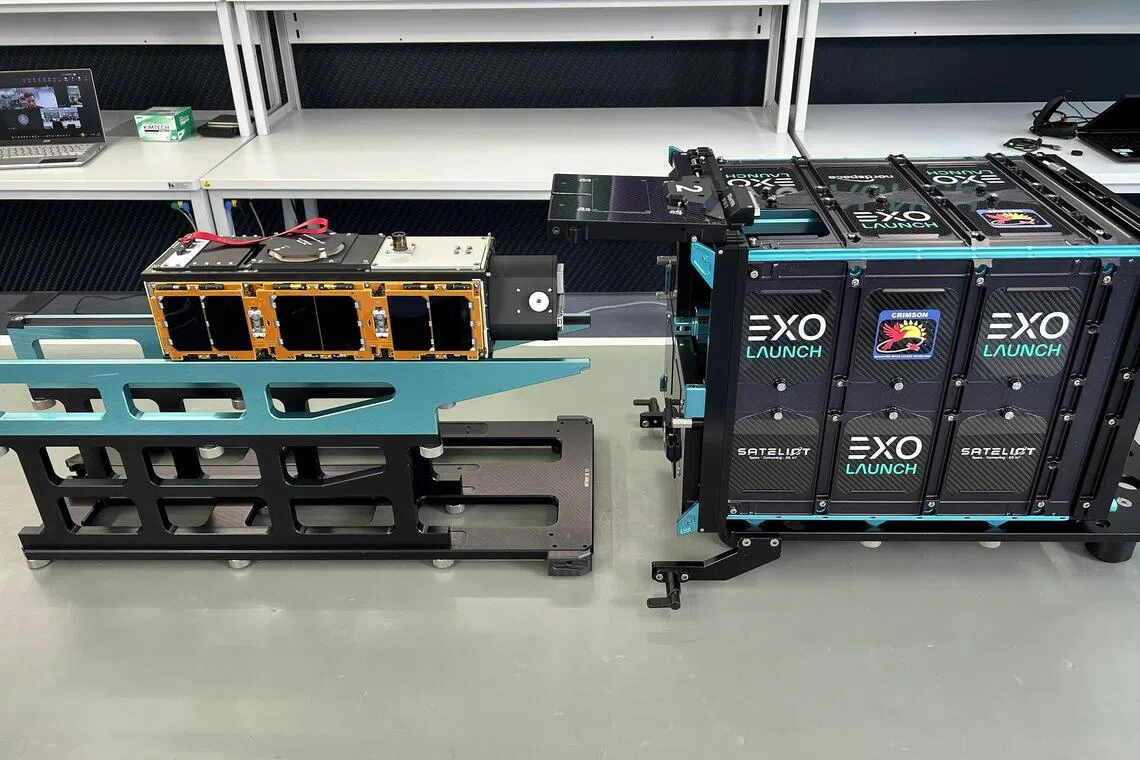
The CRIMSON-1 satellite (left) being integrated into the EXOpod Nova system, a satellite deployment system, which deployed the satellite into space after the SpaceX rocket was launched.
NTU Singapore
The new solar cells mounted to the satellite are made of an advanced material called perovskite, which are lighter and potentially cheaper than the solar panels used in space, made of gallium arsenide. This technology was developed by NTU researchers and NUS spin-off Singfilm Solar.
Gallium arsenide solar cells can cost between US$250 (S$319) and US$450 per watt, while conventional silicon-based solar cells used on earth are cost less than a dollar per watt.
Perovskites, however, are much thinner and lighter than gallium arsenide, and potentially much cheaper to manufacture, making them attractive for future spacecraft.
CRIMSON-1 will test how well the perovskite cells’ hold up in space and how much electricity they can generate. But the satellite itself will still be powered by gallium-arsenide based panels.
The 30cm-long machine was one of 130 space vehicles that was launched by a single SpaceX rocket from California in the late morning of Oct 1 (2.30am on Oct 2, Singapore time).
CRIMSON-1 was released about 520km away from earth around 55 minutes after SpaceX’s Falcon 9 rocket took off from the Vandenberg Space Force Base.
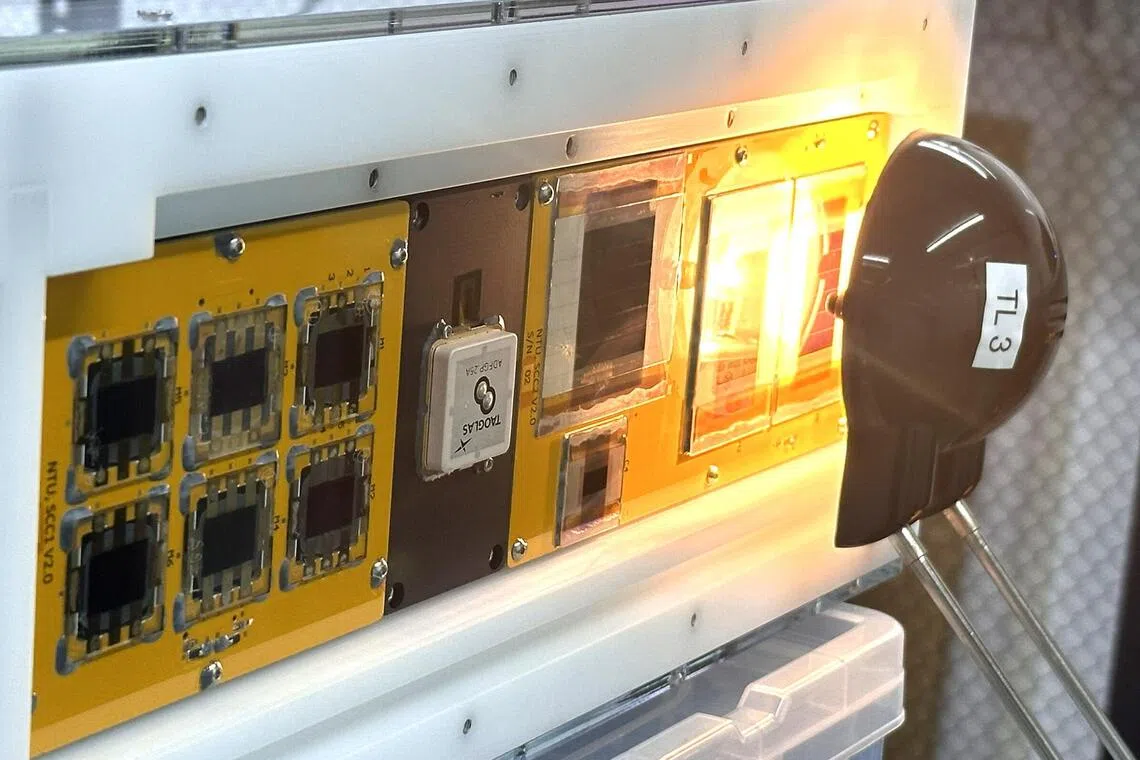
Close-up of the CRIMSON-1 satellite, where the various perovskite solar cells are being tested at a lab facility.
NTU Singapore
This is NTU’s 14th research satellite, and to date, more than 30 Singapore satellites have been launched over the past two decades.
The 30cm by 10cm by 10cm satellite was built by Singapore-based space tech firm Satoro Space, with NTU’s AI technology and perovskite cells plugged into it.
The satellite’s development is among the first projects supported by the National Space Agency of Singapore, which was formed in April 2026, under its $210 million Space Technology Development Programme.
The programme aims to boost the country’s space industry and research ecosystem, while making opportunities for homegrown tech to be tested in space.
Ngiam Le Na, chief executive of the National Space Agency of Singapore, said: “Perovskite solar cells will provide a compelling advantage over conventional solar panels – their thin, lightweight properties make them particularly well-suited for space applications, where every gram matters.”
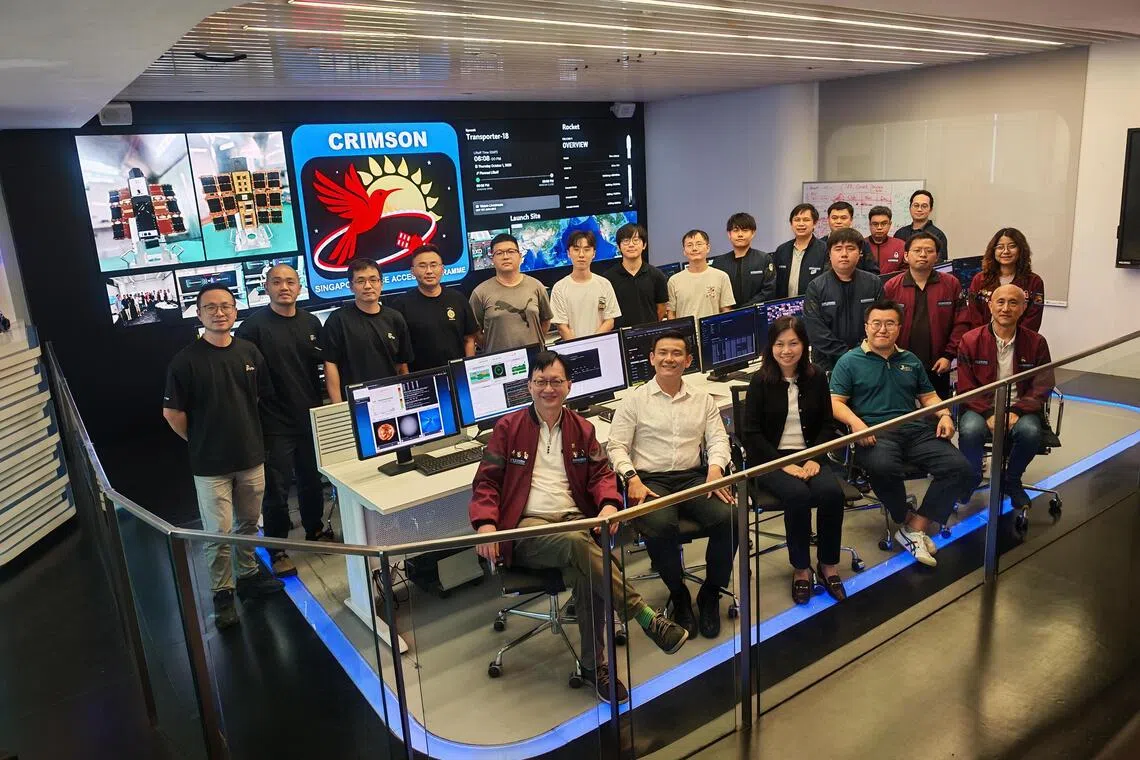
The team behind CRIMSON-1 at NTU Satellite Research Centre.
NTU Singapore
New solar technologies must prove that they can survive the physical stresses of a rocket launch and endure the harsh conditions of space while generating consistent power, said the space agency and NTU.
“CRIMSON-1 will test the cells’ physical durability and efficiency after their journey from the ground into space and measure how much electrical power they generate,” they added.
The 130 space vehicles carried by the 70m-long Falcon 9 rocket also included mini satellites, two spacecraft, and an AI data centre satellite, which is an experiment by Google.
KioskNews shows a cleaned-up reading view extracted from the publisher’s page — the original always lives on their site, not ours.