Is India's Stock Market Heading For Its Worst Year Since 2008 Crisis?

Stock Market News: Dalal Street is having a brutal year. Indian stocks have come under heavy selling pressure, wiping out nearly Rs 30 lakh crore in market value from BSE-listed companies.
Given the pace of this decline, many share market experts are wondering whether India's stock markets are heading for their worst year since the 2008 global financial crisis. And for good reason.
The Nifty 50 has fallen around 14 per cent so far this year. That puts it on course for its steepest annual decline in at least 18 years, according to market data. Excluding Indonesia, India has also emerged as the worst-performing major market globally this year, according to a Bloomberg report.
Also Read | Layoffs Are Rising In Tech, But These Skills Are Helping People Unlock Better Pay
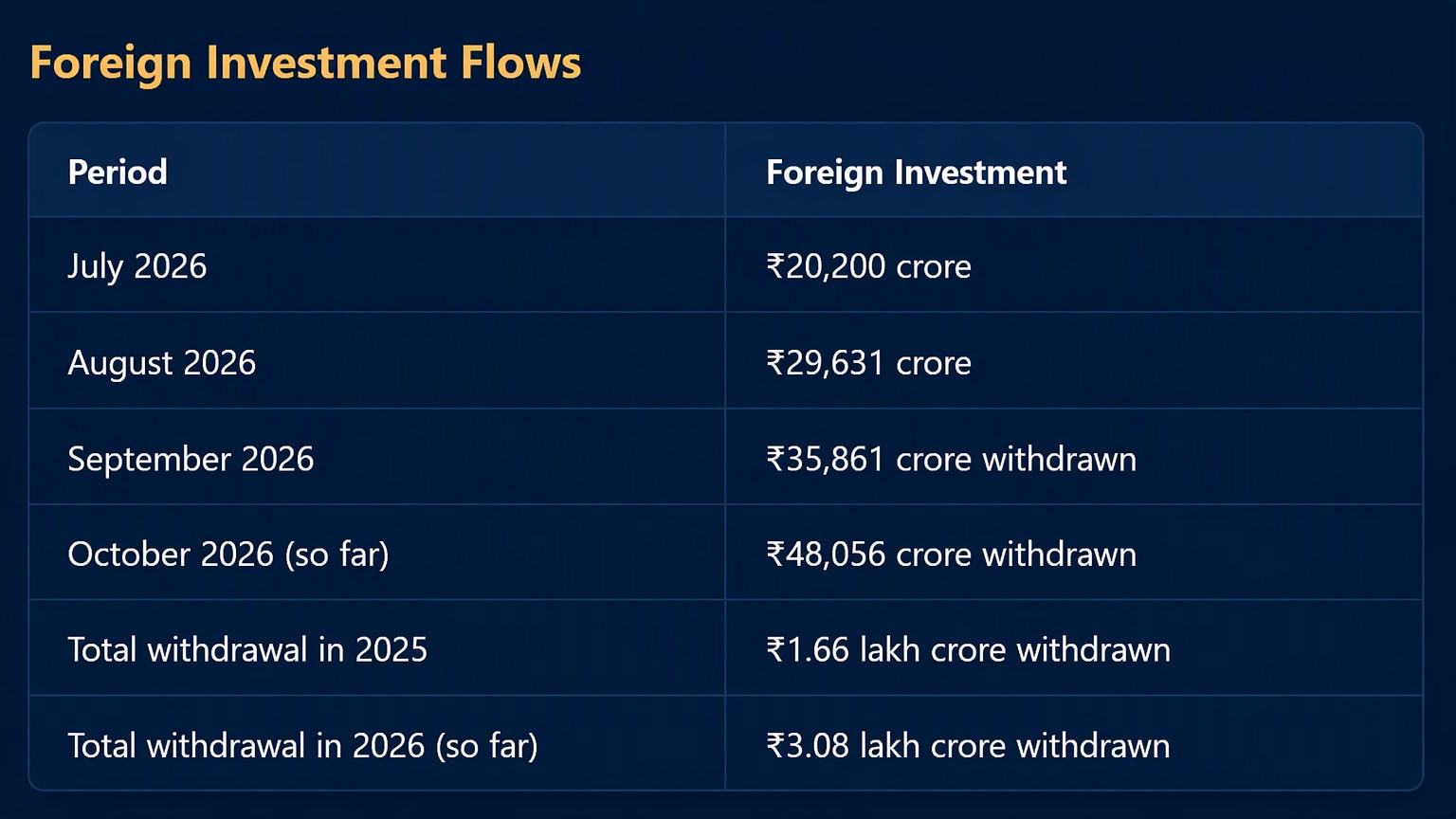
The sell-off marks a sharp reversal for a market that had long been regarded as a global outperformer. Meanwhile, foreign institutional investors (FIIs) have withdrawn nearly $32 billion, or more than Rs 3 lakh crore, from Indian markets this year. The sustained outflows have added to the pressure on share prices.
Nifty's Biggest Losers: ITC, Maruti, HDFC Bank
The weakness is visible across the Nifty 50. Of its 50 constituents, 38 are trading lower for the year, while 25 have fallen at least 10 per cent. ITC has dropped 36 per cent so far this year, making it one of the benchmark's worst performers. Maruti Suzuki has declined 34 per cent, while Jio Financial Services and HDFC Life Insurance have each lost around 31 per cent. HDFC Bank has fallen 30 per cent. Several other Nifty stocks have also suffered losses of between 20 and 30 per cent.
The damage has been even more pronounced in parts of the broader market. Mid-cap stocks had held up better than the rest of the market until recently, but that resilience has faded. The latest four sessions have seen a sharp reversal, with mid- and small-cap shares coming under intense selling pressure.
Besides, the Nifty Midcap 100 has fallen around 8 per cent this year, with six percentage points of that decline coming in the latest week alone.
Mid-Cap, Small-Cap Stocks Take A Bigger Hit
Among mid-cap stocks, KPIT Technologies has fallen 54 per cent this year. Aditya Birla Fashion and Retail has declined 50 per cent, while PB Fintech has lost 44 per cent. Muthoot Finance is down 38 per cent, and PI Industries has fallen 37 per cent.
Small-cap stocks have faced equally severe losses. KEC International has dropped 56 per cent, Inox Wind has fallen 52 per cent, and Jupiter Wagons has lost 49 per cent. IRCON International is down 45 per cent, while NBCC has declined 44 per cent.
Several other stocks in the mid- and small-cap segments have lost between 30 per cent and 40 per cent this year. The breadth of the decline is another warning sign. During the latest week, only six stocks in the combined universe of the Nifty Midcap 100 and Nifty Smallcap 100 ended in positive territory.
Why Are Foreign Investors Pulling Money Out?
The decline comes as overseas investors continue to reduce their exposure to Indian equities. Foreign portfolio investors (FPIs) withdrew a net Rs 47,955 crore from the stock market between October 1 and 15.
Vikram Subburaj, CEO of Giottus.com, told NDTV that higher taxes on equity gains, currency movements and uncertainty over tax liabilities are adding to the challenges faced by foreign investors. "India has made equity investment more expensive through higher taxes," Subburaj said.
The Union Budget in July 2024 raised the long-term capital gains tax rate on specified listed equity investments from 10 to 12.5 per cent. The short-term capital gains tax rate increased from 15 to 20 per cent, subject to applicable conditions.
The change affects how much investors retain when they sell shares at a profit. On every Rs 100 of taxable long-term capital gains, an investor now keeps Rs 87.50 after tax, compared with Rs 90 earlier, before surcharge and cess.
Foreign investors also face currency risk. If the rupee weakens against the US dollar during their investment period, their returns shrink when converted back into dollars.
However, higher taxes alone cannot explain the scale of the selling. Global market conditions, valuations, geopolitical risks and investor expectations also influence capital flows. Subburaj said foreign investors still held equity assets worth Rs 65.94 lakh crore under custody as of October 15. Their decisions on whether to increase or reduce those holdings will remain important for the market.
He also flagged uncertainty around tax liabilities when investments are moved between different pools within a fund, or when tax demands arrive after some investors have already withdrawn their money. Clear rules on fund restructuring and a reliable process for settling liabilities could help address these concerns, he said.
"Lower tax rates alone would leave these difficulties unresolved," Subburaj said, adding that the government should review the revenue from higher taxes alongside the practical difficulties faced by funds.
KioskNews shows a cleaned-up reading view extracted from the publisher’s page — the original always lives on their site, not ours.