36 Years Later, Law & Order's Opening Line Is Still The Most Powerful Quote In Crime Drama History

Cher Thompson is a Senior Staff Writer at Screen Rant, where she covers everything from explosive reality TV moments to cast interviews about the twists and turns of scripted dramas. With a background in creative writing, marketing, and teaching, Cher knows how to spot both the storytelling genius and the guilty pleasures in pop culture. Her work blends wit with insight, making readers feel like they’re chatting with a friend who just happens to know way too much about TV.
Sign in to your ScreenRant account
When Law & Order premiered on NBC in 1990, the opening narration established almost everything viewers needed to know about the series in just a few short seconds, and unknowingly changed procedural television forever. The introduction of Law & Order, which has been adapted to fit the show's various spinoffs throughout the franchise's expansion through the years, gives viewers insight into the larger premise of the series. Delivered by Steven Zirnkilton, Law & Order's iconic opening narration shares that both the officers investigating crimes and the attorneys who prosecute offenders are equally important in keeping things fair and just, allowing for equitable outcomes.
The narration is powerful because of its precise nature. Rather than introducing a character, pointing to a specific story, or talking about a particular system, Law & Order's opening narration provides crucial context about the justice system that viewers need to understand going into each episode of the series. The narration also explains the interesting structure of Law & Order as a series, specifically the flagship show. In pointing out that the officers and the attorneys are equally responsible for investigating a crime and then prosecuting it appropriately, the narration makes it clear the show will feature both sides of the coin.
As the narration has become bigger than the original series, branching out across the franchise with different iterations, it's clear that Law & Order has a distinct opening and a specific style. The opening narration is one of the most effective on network TV, and its longevity proves why it works.
Law & Order's Opening Narration Became An Iconic Aspect Of The Franchise

The opening narration of Law & Order, which comes in at the top of every episode of the series, is quick and to the point. Zirnkilton's deep-voiced overlay informs viewers, "in the criminal justice system, the people are represented by two separate yet equally important groups: the police who investigate crime, and the district attorneys who prosecute the offenders. These are their stories." Followed by the franchise's ominous two-toned sound cue, viewers know immediately what they're in for when they hear the beginning of a Law & Order episode. With TV franchises like Law & Order quick to change, the narration is consistent.
This consistency hasn't only been beneficial to the flagship show, but has also come into play with the various spinoffs of the Law & Order franchise. Law & Order: Special Victims Unit modified the opening to explain its focus on sexually based offenses, while Criminal Intent shifted the emphasis toward the NYPD's Major Case Squad, and Organized Crime used the narration to introduce the Organized Crime Control Bureau. Despite their differences, the introductory narrations are constructed in similar ways and allow each show to maintain their distinct identity as a series while still living well within the recognizable Law & Order franchise umbrella.
The line's cultural recognition has also extended far beyond the shows themselves, as it's taken on its own life within the zeitgeist. With the opening narration having a bit of cultural cache, it functions on two levels: as a practical way to provide information and as a signature for viewers who have been invested in the franchise for years.
Question 1 of 3
The "Criminal Justice System" Line Perfectly Sets The Tone For Law & Order

The greatest strength of the Law & Order opening narration is that it explains the fundamental philosophy of the show without over complicating things or pointing to a specific outcome. The line quickly explains that the criminal justice system is dictated by two equally important sectors, but makes it clear that they're separate from one another. Setting the tone for each episode, which typically launches into an investigation before moving into a courtroom setting to see a case tried, the Law & Order narration makes it clear what the viewer will be seeing upfront, preparing their expectations for each episode without spoilers.
The narration also makes the distinct choice not to tone itself down for the sake of the viewer. Rather than dulling down the language or softening itself, the narration is clear on the fact that viewers are jumping into a series that deals with criminal investigations and law. While each episode tells a full story, the language in the narration is meant to feel more institutional, allowing viewers to understand the structure they're about to see. That combination of institutional language and personal storytelling creates the central identity of Law & Order, which has remained surprisingly powerful for nearly 40 years.
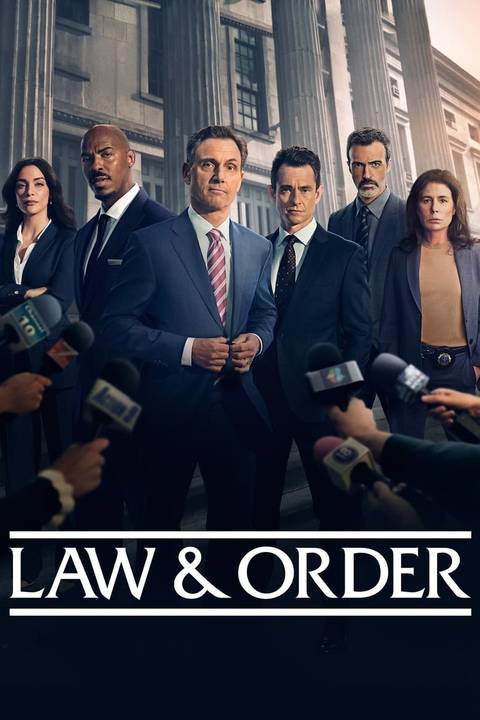
- Release Date
- September 13, 1990
- Network
- NBC
- Showrunner
- Rick Eid
- Directors
- Constantine Makris, Edwin Sherin, Jace Alexander, David Platt, Matthew Penn, Martha Mitchell, Don Scardino, Christopher Misiano, Jean de Segonzac, Michael Pressman, Daniel Sackheim, Alex Chapple, Fred Berner, Fred Gerber, Gloria Muzio, James Frawley, Jim McKay, Vincent Misiano, Michael W. Watkins, Vern Gillum, Alex Hall, Dann Florek, Darnell Martin, David Grossman
- Writers
- René Balcer, Matt Witten, David Slack, Aaron Zelman, David Wilcox, Morgan Gendel, Pamela J. Wechsler, Lynne E. Litt, Marc Guggenheim, Stephanie Sengupta, Scott Gold, Walon Green, Gerry Conway, Sean Jablonski, Nick Santora, Chris Levinson, Christine Roum, Gordon Rayfield, Hall Powell, Keith Eisner, Julie Martin, Gia Gordon, Joe Gannon, Jonathan Collier
-

Sam Waterston
Jack McCoy
-

S. Epatha Merkerson
Lieutenant Anita Van Buren
KioskNews shows a cleaned-up reading view extracted from the publisher’s page — the original always lives on their site, not ours.