Latvia expected to keep EU course as Russia looms
THINGS TO CONSIDER: Issues such as security, Ukraine support, a sluggish economy and regional disparities would be driving factors in the Baltic state’s election
Latvians vote tomorrow in an election dominated by the threat from Russia, and despite progress made by populist and protest parties, they are expected to confirm the country’s pro-European and pro-Ukrainian course.
The Baltic state is a key pillar of NATO’s eastern defensive flank, and experts said there is widespread support for supporting Ukraine in the war with Russia.
“The stance toward Russia is the main reason for Latvians’ Western, NATO and European anchoring,” a Western diplomat said, adding that it would be hard to imagine major political changes.
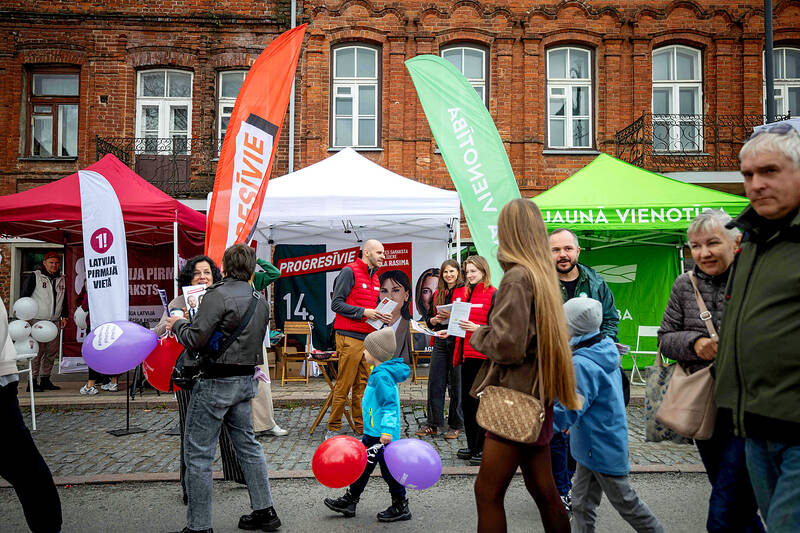
A crowd is seen on Latgales Street during the harvest festival in Rezekne, Latvia, on Sunday, as political parties have set up tents and are handing out leaflets for their candidates ahead of the country’s parliamentary elections tomorrow.
Photo: AFP
Polls predict the center-right United List, led by Latvian Prime Minister Andris Kulbergs, would emerge the largest party in parliament the vote.
However, his center-right coalition, which also brings together the centrist New Unity, nationalist National Alliance and the Union of Greens and Farmers, is expected to emerge weakened from the election.
Security is at the top of voters’ minds in a country bordering Russia.
There is broad consensus on maintaining military spending at nearly 5 percent of GDP and on supporting Ukraine, LaSER analyst Roberts Kits said.
The economy is also a major concern for voters. Latvia is the least affluent of the three Baltic States in terms of living standards. Growth is sluggish, with voters pointing to the cost of living, the state of the healthcare system and the difficulties of public finances.
Complicating this are major regional disparities.
Around Riga, GDP per capita reached 101 percent of the European average in 2024, according to a Brussels report.
However, in other regions this figure does not exceed 50 percent.
As elsewhere in Europe, economic concerns have given a boost to populist parties in the run-up to the election. The Sovereign Power party, critical of aid to Ukraine and increased military spending, is polling at 9 percent — and could reach second place in parliament. Considered pro-Russian by its critics, the party emphasizes Latvia’s economic difficulties. However, the party is isolated politically and barring a huge upset has no chance of entering a future governing coalition.
Another populist party, Latvia First, is also at 9 percent, and its businessman leader, Ainars Slesers, is regularly compared to US President Donald Trump.
The party is winning support with a conservative message and promises of economic revival, and could become an indispensable partner in coalition talks.
Long rallied behind the “Harmony” party, Russian-speakers, who make up about 35 percent of Latvia’s population, no longer vote as a unified bloc.
Harmony, which won several parliamentary elections without ever entering government, disappeared from parliament in 2022 and has very little chance of returning.
“We should not look at Russian-speaking voters as a single bloc with a uniform electoral behavior,” Kits said.
While identity issues have not disappeared, a growing part of this electorate now votes according to economic and social criteria.
KioskNews shows a cleaned-up reading view extracted from the publisher’s page — the original always lives on their site, not ours.