‘There is no secret agenda’: Nara Smith on home-making absolutely everything, raising four kids at 25 – and why she’s definitely not a tradwife

Nara Smith is not a tradwife, she wants you to know that. Nor is she an ex-tradwife – pace the New York Times who included her in a feature on how ex-tradwives are as popular a movement now as the tradwives were in the first place. Nor was she peddling a tradwife-adjacent lifestyle choice by marrying at 18, having four children by 24, and devoting hours to cooking and documenting it online. Nor is she Mormon, by the way. Although, yes, her husband, the model and former teen heart‑throb Lucky Blue Smith, was raised Mormon, but we’ll get to that. Nor was she telegraphing subliminal religious messages in her content: “There is no secret agenda.” Nor was she abandoning her biracial heritage by wearing her hair in a sleek little bob. Nor was she leaning into a 1950s housewife archetype – even when dressed in a pink and red polka-dot minidress to batch-cook sourdough.
Smith wants you to scrap everything you think you know about her and start again. She also doesn’t care if you don’t. As with her content: “Those that get it, get it. Those that don’t, don’t. And that’s totally fine. I tell people: ‘If you don’t like my content, I won’t see you scroll past me.’ ‘If you need to block me for your own sanity, please do. I promise I won’t know.’ And if you want to stick around, that is beautiful, I’m grateful, welcome.”
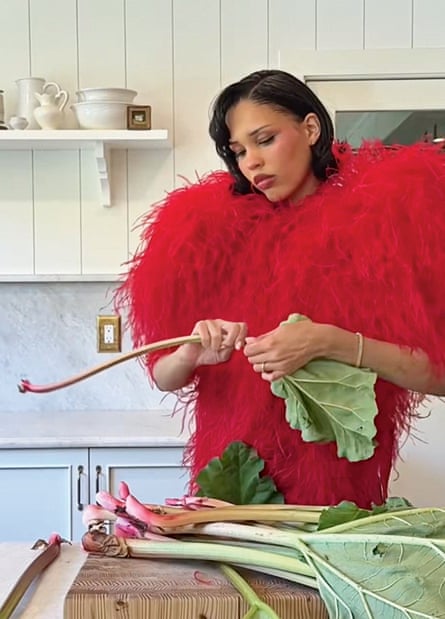
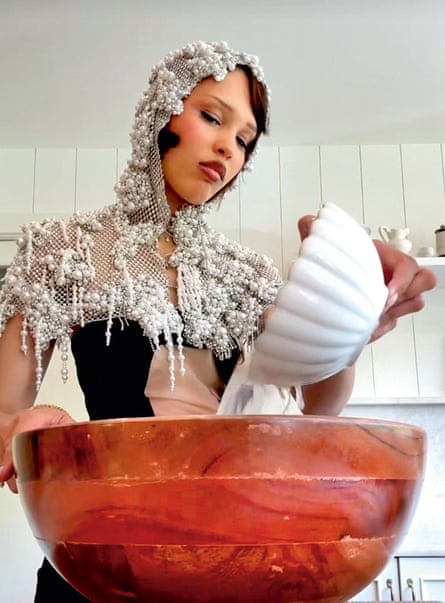
For those new to Nara Smith, she is a model and influencer with 12.5m TikTok followers (plus 879m likes) and 4.8m on Instagram, who makes eccentric, seductive cooking videos in which she narrates each step in a passive hushed voice while making dupes of everyday supermarket products from scratch. Her videos start with the same shtick: her husband or children have a request – eg “Lucky leaned over, asking me whether I wanted to go grab some frozen yoghurt after the kids go to bed. I turned to him and told him it wouldn’t be as good as if I just made it. And, even though he was reluctant at first, he just went with it.” In a custom-made $900 white-satin corset dress – no apron – she’s straining the yoghurt starter, combining it with kefir, vanilla, sugar, cork gum; juicing apples and cherries to make gummy bears for the topping, whisking in gelatine and honey. Throughout, Smith stays expressionless. Throughout, her movements are mannequin smooth. Nothing splatters on her front, ever (luck, she insists, not because she exceeds all standards of perfection).
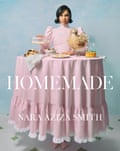
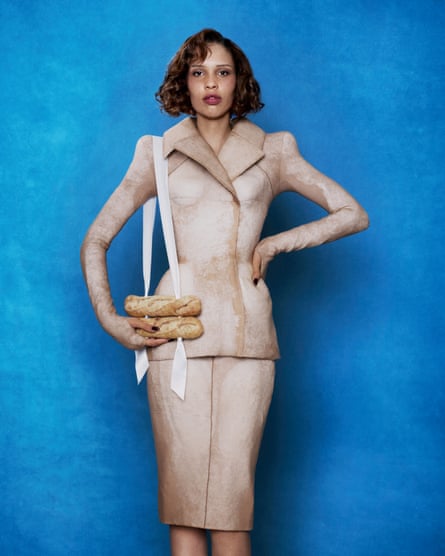
These clips blow people’s minds. Her grilled cheese video has been viewed 49.6m times. Elsewhere she’s made Nutella, ketchup, Cheez-Its, Pop-Tarts, Skittles and Snickers. She’s even made bubblegum. There’s the novelty of the recipes – she now has a cookbook of scratch-made ones, Homemade, coming out. Then there’s the outfits. She wore a $5,000 cashmere Prada suit to make chicken drumsticks, a $10,000 Schiaparelli to grate tomatoes for a gnocchi sauce. Nigella, Gwyneth, your domestic goddessing has been out-luxed.
All of which brings me to Deborah Ann’s Sweet Shoppe in the white clapboard town of Ridgefield, Connecticut, where Smith is sitting opposite me in the narrow red booth, tapping her phone with acrylic nails. Around us is the loud hum of ice-cream refrigeration units, the smell of hot fudge and candy floss. There are sugar pourers and napkin dispensers and Jay & the Americans sing Come a Little Bit Closer on the radio. Smith surely had a sense of humour when she chose this as the backdrop to talk about not being a 1950s homemaker? “They have the best soft serve,” she says, a hint of smile. “And Lucky comes for the cotton-candy ice-cream.”

Today, a fortnight shy of her 25th birthday, Smith, is in jeans, a white vest, Chanel flats and a lot of flashing jewellery (“I love a diamond ring”). For the record, she drove here in her own car. And, while it is true that Lucky once said that he drove “no matter what”, that he was “bothered” by the sight of a woman driving a man, she loves driving. She listens to her favourite podcasts while doing so – Aspire With Emma Grede, founder of Skims, and for fun, The Girls Bathroom – “so entertaining. And I do love an audiobook also. I love fantasy. Are you into fantasy?” I ask if she made the gum she’s chewing. She laughs. “Not today.”
Smith’s content attracts millions from advertising (among others, she works with Marc Jacobs, Miu Miu and YSL). As well as her cookbook, she acts, and has two films in post-production. One is an indie film she can’t talk about. The other is Tyrant, “a culinary thriller” starring Charlize Theron, Demi Moore and Paapa Essiedu. Then there’s a “consumer goods brand”. I ask what. “We’ll talk about that later. We’re still figuring it all out.”
Does she make more money than her husband? “That’s a loaded question. How do I even answer that?” She can answer it with a broad smile? “Yes, I will do that.” She has excellent teeth.
What is staggering about Smith is that as well as devising and researching the recipes themselves, she does all her own styling, makeup, art direction, video editing, voiceover and mixing, spending upwards of eight hours a day on one 90-second clip. Her agents and managers beg her to take on help. “I always say no. I am very type A.” Type A? “Very rigid, very scheduled.” Her assiduous attention to detail and devotion to her “art” mean “I’m still figuring out where to relinquish control”, she says.
I ask if she’s like The Princess and the Pea when something is not quite right. “That’s literally me. That should be the title. I can’t sleep. I’ll be tossing and turning, bruised.” The cookbook is a sumptuous, high-production volume, but the recipes are down-to-earth in a homely way. They include some from her German childhood: milchreis, schnitzel, rouladen. She doesn’t shy away from refined sugar. There’s meat, there’s chicken in cream, there’s roast potatoes in duck fat. “Do I have sugar and duck fat all day every day? Absolutely not. But roast potatoes occasionally? Absolutely. A little dessert once in a while? Absolutely.”
What I try to keep in mind while she’s telling me all this is that Smith has four children: Rumble Honey, Slim Easy, Whimsy Lou and Fawnie Golden. (“Unusual names build character; Lucky had an unusual name and it helped him in ways.”) The book photoshoot took place three weeks after the youngest was born. So, as well as organising and slipping into, for instance, the Rodarte custom-made gingham dress on the cover, she was breastfeeding a newborn and overseeing renovations to the family home they had just moved into here in Connecticut.
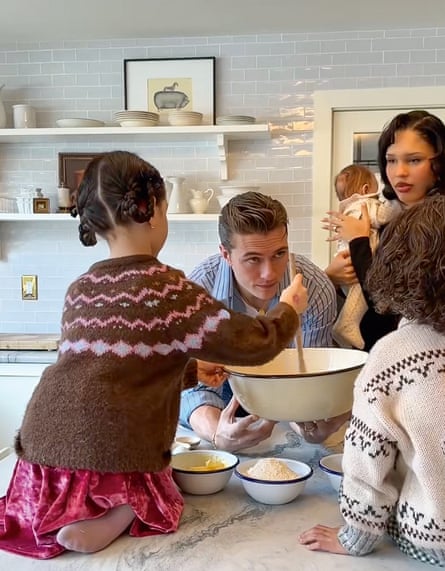
Then not long after, while the cookbook was still being edited, her daughter Whimsy Lou was diagnosed with cancer. It was Lucky’s mother who first noticed “this thing on her body” (for her daughter’s privacy, Smith doesn’t want to go into specifics) while they were all together on a family photoshoot for the holiday season late last year. “My mother-in-law was, like, ‘I don’t want to alarm you, but maybe you should go to the ER.’ Long story short, the doctors did a bunch of tests, from biopsies to ultrasounds, and then called us back and said: ‘She has cancer. She needs to start treatment immediately.’”
Smith’s world “flipped”. Until that point, the couple didn’t even have childcare. Suddenly they were juggling work, kids, chemotherapy appointments, “while also making sure that we weren’t falling apart for her”. Five days out of every fortnight or so, depending on her blood count, Lucky stayed with Whimsy in hospital when she went through treatment while Smith was at home breastfeeding. They couldn’t explain to Whimsy what was happening to her. “She was under two years, so there wasn’t a lot she’d understand.” But they explained it to the older two, “and we got children’s books about cancer that would explain the hair loss and different parts of this journey through stories”.
They found “a community” of mutually supportive parents – the reason Smith publicly disclosed Whimsy’s condition once she was in remission. “You don’t realise how many parents or children go through similar experiences until you’re in that situation in the hospital,” she says. “People speaking about it makes you feel less alone.”
The shellshock is palpable. She sounds dazed as she runs through the litany of family upheaval that preceded diagnosis – new house, new book, new baby, big dose of postpartum anxiety. “I was still in the thick of dealing with all of it mentally, being pulled multiple different directions [when it happened]. Then all I wanted was to be present for Whimsy. It was hard.” Smith’s mother, Joyce, a nurse, not long free of her own treatment for breast cancer, flew in from Germany to help. “Everyone rallied in my family, and it was beautiful to see.”
Without doubt she’s been changed by the experience. “When you come that close to a life-changing thing, you view the world a little differently.” On the one hand, she appreciates the beauty of “mundane moments”; on the other, she’s tougher. A lot of thought now goes into what her job means in terms of exposure of her children online. “But I’ve always had a boundary around my kids. I show as little of them as possible while acknowledging that they are part of my life.” When people come up to ask for her photograph, her children automatically turn their backs, or stand behind her, or move to a corner of whatever store they are in. “I try to avoid certain places if I can during peak hours.”
Will she keep them off screens? “Like phone screens?” Her face is a picture of horror. “Oh, I’m not going to get them phones! No, I’m going to get them a little – I don’t know what they’re called, a Firefly? A Brick? I want them to be able to communicate with me and get a hold of me. I’ll get them a camera because my kids love taking pictures. But I don’t see the need in having them be on social media, or playing video games, or any of that. I deliberately moved to an area where there’s nature, stuff they can do and explore outside; not be on screens.” Until what age? “I don’t know, 18? I mean, if I could have my time again, I would have done it so different.” Does she ever wonder what her life would look like if she hadn’t done all these videos?
“All the time. All. The. Time.” Later, she says: “The landscape on social media has changed so much. I had to learn the hard way and reconsider what I put on the internet.”
Most nights, Smith takes her computer to bed. Her bedtime routine is specific. “I need clean sheets, that’s non-negotiable. I love freshly washed sheets.” Every night? She stalls. “Twice a week, probably. Linen sheets. I need a shower every night, take my makeup off, do my skincare, brush my teeth, have water on my bedside table, and then I just work in bed until my eyes are rolling.” Often, she’ll look over and Lucky is already asleep. “Sometimes, he’s, like, ‘You can go to bed, and I promise the email is still going to be there in the morning.’” She gets up around six after one night‑time interruption (she insists on doing nights with Fawnie: a, because of the guilt of travelling a lot, and, b, because this baby is her “last”). First thing, she takes their dog Archie out back. He’s a pyrenees-pitbull cross (He’s adopted. Lucky wanted a puppy, but she said no). It something of a relief to learn she doesn’t exercise. “I wish I could. That just feels … too much.”

A common theme in her stories is meticulousness in being willing to start from scratch. Three months after her kitchen had been done here in Connecticut, it flooded because of an ice dam on the roof. Ripping the whole thing out was not the headache you imagine because, she says, “I hated every decision that the designers made. I trusted them instead of my gut. So, we redid it the way I wanted and now it’s beautiful and totally different.
“I feel like an adult now, having bought a home and furnishing it for the first time.” The vibe: “I want people to feel like a grandma lives here, not a 24-year-old. Grandma chic with an English twist” – because Ridgefield reminds her of the Cotswolds, she says, where she would have moved “in a heartbeat”.
I ask what makes her lose her shit. “Mess,” she shoots back. “I get very stressed out by mess. I don’t like a messy house. I don’t like a messy kitchen. I don’t like a messy closet. Messes are overstimulating. On top of everything else that’s going on in the home, four kids running around, screaming and everything, messes then set me over the edge. So, I don’t necessarily lose my shit. I’m, like, ‘Let’s just tidy it up, OK? Everyone, start picking up your stuff.’”
The children tidy? “I make the kids do their stuff. Anything they may need help with, like, putting socks together, sometimes they can’t do that, I’ll help. But usually the kids do their messes, I do our messes, and we’ll get it whipped super quick.”
Twice a month she has a cleaner who comes to “deep clean”. Everything else, she and Lucky do themselves. Laundry? “I do it.” Ironing? “I steam.” If I opened her cupboards, would they be neat and ordered? “They would. Because it just makes everything more efficient. I love a system when it comes to getting dressed or doing laundry or schedules or routines or the kitchen. It makes life so much easier if you don’t have to think about all these small things.”
While she talks, Smith is miming tidying on the laminate-top table between us. She is funny on the potential hazards of her daughter choosing her own outfits. “My eldest is very opinionated. She’s got good taste, so usually I don’t have an issue with it.” If she had bad taste, would she? “I would.” She laughs. “Sometimes it’s the craziest combinations. I have to intervene and kind of bargain a little bit. I’m, like, ‘Tights and socks over pants? That’s crazy.’”
Elsewhere, the need for this level of control can be “stressful”. “A lot has changed over the last six years. Being very type A makes it hard when things happen that I can’t control,” she says. Any “wildcard” causes excessive anxiety. “When it came on, I didn’t know what it was.” She read self-help books, had individual therapy, she and Lucky went to couples counselling.
She’s laughing when she says she’d been convinced she was a “brilliant” communicator until she got to couples therapy. They go in person, when they need it. “We married so young and have so much life ahead, so it’s more a prevention than cure, if that makes sense.
“I grew up in Germany. He’s American. Sometimes, we kind of miss each other a little bit. One time I said ‘I don’t care’ about something, and he was, like, ‘You don’t care?’ It was just, like, ‘I don’t care about talking about it any more.’ Because I speak German, and the language is different, when I translate it into English, it comes across harshly, blunt, to an American. He was, like, ‘Whoa, that’s a little crazy, honey.’ But it’s small things.”
Nara Aziza Smith was born in South Africa to a German father, a teacher of history and biology, and Mosotho mother, who grew up under apartheid (“She saw things no person should ever see or go through or have to deal with”). After Smith was born, the family moved to Frankfurt and two younger siblings followed. As a child, Smith had a host of allergies including to eggs and was hospitalised twice at young age for eczema (she also remembers a later operation on her “janky” toes). She describes herself as a child who wanted to hang out with adults, who saw the kids’ table as a punishment: “Like what am I going to do with these kids my age? Play tag?” She was fascinated by figures from history and mythology: Marie Antoinette, Medusa, Athena. She could recite Maya Angelou’s Still I Rise.
Banned from Facebook by her parents, she signed up to Instagram, which they’d never heard of, and used it as a way into modelling. She was scouted at 14 by IMG Models through an online programme and her parents took her to castings. In many ways it was a great experience. “But it was also taxing on my 14-year-old mind: the pressure to look a certain way; the focus being only on how you look.” Back then, measurements were very particular, she says. “Getting older, your body changes. So, it was hard on me at times to maintain the standard [weight].” She wouldn’t “necessarily” want her children to go into the business, but if they did she would support them. “But would I recommend it over other interests that they may have? No.”
“Obviously” she knew who Lucky Blue Smith was before she met him. “He was a crush of mine aged 15. I watched his Ellen interview and I remember thinking, ‘That guy is really fit.’ Then when he DM’d me on Instagram years later, I was, like” – dramatic intake of breath – “it’s him!” In that first message, Lucky asked her where she was from. He didn’t text back to her reply. Sometime later he messaged: “I’m going camping with a friend so I’ll be off grid for a little bit. But when I’m back, I would love to hop on a phone call.” He was in Los Angeles; night-time in Frankfurt. They spoke all night and she watched the sun come up. Over seven hours, they covered family, hobbies, interests, teen stuff. “After that there wasn’t a day that we didn’t spend time on the phone, whether it was two hours or seven hours. We would fall asleep on the phone.”
She was attracted by his calmness. How mature he seemed. “Also he’s beautiful, which was a bonus.” They decided to marry not long after their first meeting. Posted it all online, photos of them in bath towels, the ring. It was cute, until you looked at the comments. How did she deal with the racism? “Race has been something that I’ve always talked about with my parents. I’ve always been aware of it growing up in Germany and not looking like the other blond girls. I remember this specific time: I left the school bathroom with my hair out of a ponytail for the first time, and as I walked out one of my friends burst out laughing. I was mortified. I never wore my hair out in school again.
“When Lucky and I got together … I don’t know, I kind of just brushed it off because it said more about the other person and how they choose to treat people. Did I talk to Lucky about it? Sure. Did I sometimes get sad about it? Yes. But I just tried to ignore it.”
When she relocated to the US to be with Lucky, old health issues started to flare up. She started checking the labels on the food she was eating. “I wasn’t aware how many ingredients were involved. Bread had 20‑plus ingredients, some of which didn’t necessarily belong. I realised it would be easier and healthier if I started making things myself.” In this way, cooking from scratch became “a necessity … I wasn’t just coming up with crazy recipes.”
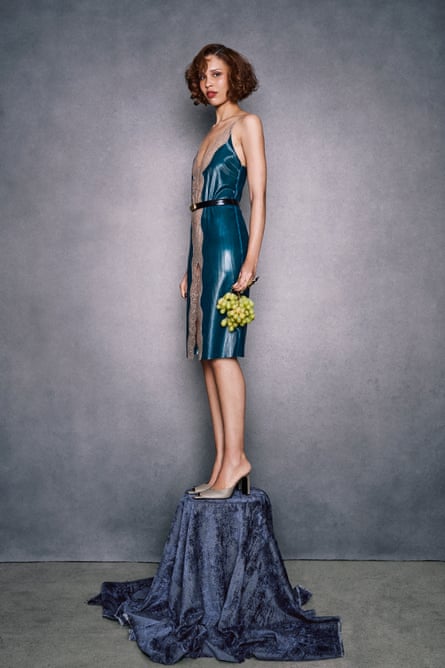
Like other gen Zs, Smith’s early content was “fit checks” and get-ready-with-me videos. And she wasn’t wildly different from other “mommy” influencers when she began propping her phone on a tripod to film herself cooking dupes of, say, Oreo ice‑cream or ranch dressing. But something about the package – the exquisite face, the heart-throb husband who goosed her at the stove, the fashion, the breathy monotone used because she was recording at nap time and didn’t want to wake the children, but which everyone compared to ASMR – elevated her above the rest.
Then there was her willingness to keep taking it to the next level. She made cough drops. She made sun cream. She made Coca-Cola. She coordinated outfits and recipes so that she made Capri-Sun in a yellow gown with balloon sleeves. Fellow chef Ruby Tandoh wrote of Smith’s content: “It’s addictive. The low-stakes suspense of seeing just how much Too Much she’s going to do this time.” In less than a year, Smith went from under 1 million to 9 million followers. Among them, Bella Hadid, Ariana Grande, Selena Gomez, SZA and Doja Cat.
All this coincided with a new and toxic movement online: tradwives. They were a domestic expression of the rightward swerve in American politics. Religion often played a part in their commitment to maintaining patriarchal structures. Women claiming their sole ambition was to serve men were suddenly all over the internet packing their husband’s lunchboxes. What Smith did seemed of a piece. Internet sleuths spied The Book of Mormon behind her in one clip. It’s a backstage prop, they argued, an attempt at mass conversion.
It didn’t help that Smith was friendly with Hannah Neeleman, the 36-year-old Juilliard graduate and mother of nine who makes home-cooking videos dressed in vintage prairie dresses at Ballerina Farm in Mormon Utah. The internet ecosystem encourages influencers to cross-fertilise. Smith and Neeleman milked cows together. They posed on the farm porch, babies dandled on hips, husbands looking cocky in jeans and cowboy boots. Smith was accused of promoting regressive gender roles, of promoting teenage pregnancy, as well as “culturally appropriating” Mormon life, and distancing herself from her black heritage. Thinkpieces followed. Memes. Reams of Reddit discussion.
Smith sighs when I put all this to her. “To begin with, I didn’t think too deeply about what I was doing. Cooking was something I did for health and because I enjoy it, and I also enjoy fashion. I had fun. I put it on the internet. People started reading into things, deciphering outfits, deciding I was saying things that would never even cross my mind.”
Now she thinks that making your living in the kitchen is always going to be political. “It just is,” she says. “I feel people always want to put women in boxes, to try to explain them, to read into things they do. This is an expression of myself through food and fashion. People tune in for the voice, or the fashion, or the recipes, or all of it.”
Does she see herself as a feminist? “Yes, absolutely. A woman should have the right to do it all, to do whatever she needs to do.”
Does she vote? “I would vote in the United States, but I’m not an American citizen so I’m not allowed.” But she worries about politics. “It’s scary everywhere right now.” She talks to family, to friends, to Lucky, about the rise of the AfD in Germany, deliberately keeps it offline. “People who see me know what I stand for. I have four kids. I’m a mum. I’m a woman. I would hope that people can put the pieces together. I don’t feel the need to speak about it on my socials because that’s for my artistic expression.”
The Mormon thing? Well, she was curious, she admits. It was her husband’s background, she was open to hearing about it, to seeing if she identified with any of it. “If you marry someone that grew up that way, and you’re building a family, you’re figuring things out. That was happening when my social following exploded.” Are her children Mormon? “No. Our family isn’t. It’s a perception that people hold, but I’m not a Mormon, I was never a Mormon. I never got baptised. I never did anything that would make me Mormon. We figured out what we’re doing for our family, and it’s not being part of the [Mormon] church.”
Every Wednesday and Thursday, Smith does three hours of acting class over Zoom with a teacher in Los Angeles, which she tops up with individual in-person sessions when she is in the city. She caught the acting “bug” on the set of Tyrant. She watched the big Hollywood names make mistakes, try it again, interpret lines in different ways, and realised you didn’t have to be perfect first time. Somehow, that blew her mind. She realised acting was an extension of what she was doing anyway. “I called my team after. Like, ‘We need an acting manager.’” She signed with a big agent and has started auditioning.
Can she envisage a time where she’s not doing her cooking videos any more, or at least there’s less emphasis on that? “Yeah. I could see a time where my content evolves. I’ll never not be on social media because it’s such a pillar of my work, my business and the way I connect with people.”
Is she competitive? She hmms and tilts her head to the side. “I wouldn’t say competitive. I’d say, what’s the word?” She snaps her fingers in the air. “Ambitious. That’s the word I was looking for. I’m very ambitious. But it’s one-upping myself. I couldn’t care less about one-upping other people. I’m in my own lane, and I have a goal I want to get to.”
We’re ready to leave. As we rise from our chairs, a sea of teenage girls I hadn’t noticed converge. They look tiny next to Smith’s towering 6ft frame. They’ve been waiting, phone cameras at the ready. “You’ve, like, inspired me. I’ve been making stuff from scratch,” one says, grinning in train-track braces. “I love that,” says Smith. “What have you been making?” “I’m trying to make bread. It hasn’t gone well … ” “You know what? That takes a hot minute. It took me a hot minute. But you’re going get there.” She gives them a little hug.
KioskNews shows a cleaned-up reading view extracted from the publisher’s page — the original always lives on their site, not ours.