OBITUARY: Phumzile Mlambo-Ngcuka — deputy president who sat through Aids denial, then helped end it
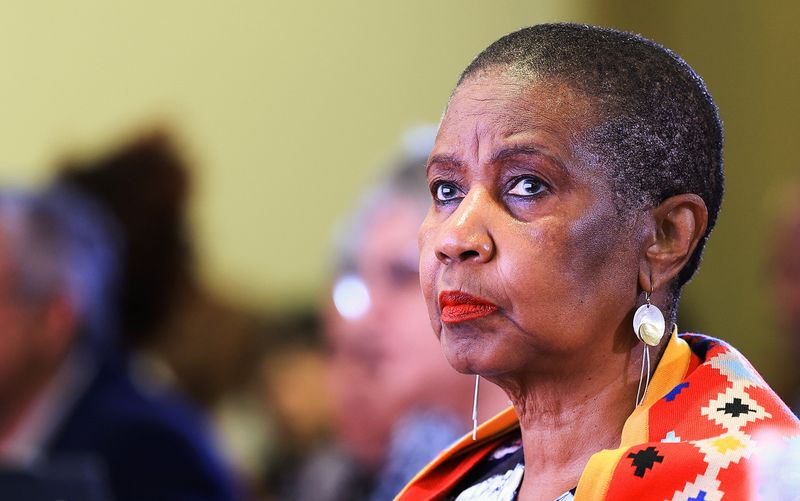
Phumzile Mlambo-Ngcuka’s mother was a community health nurse by day, and in the evenings she turned the kitchen of the family house in Clermont, a township outside Durban, into a school. The pupils were adults whom apartheid had kept out of the classroom or given an education that taught them almost nothing. Her 11-year-old daughter was the assistant.
Nearly 60 years later, in an interview with the Robert Bosch Academy in Berlin, she remembered what had moved her. “The greatest joy was when they had learned to write and to count,” she said. “Then they could manage their own money. The seed was planted there.”
Her father, Michael Mlambo, was a schoolteacher who brought exercise books home to mark. Learning was the work of the house. As a young girl at primary school in Clermont, she decided she would love to be a professor. From there she went to Inkamana Abbey, a Catholic school in northern KwaZulu-Natal, and matriculated at Ohlange High School in Inanda. John Dube, the first president of the African National Congress, had founded it, and Nelson Mandela cast his vote there in 1994.
Her first year at university, 1976, was the year of the Soweto uprising, when tens of thousands of black schoolchildren walked out of their classrooms to protest against an education system that forced them to learn Afrikaans. The government answered with deadly violence. Mlambo-Ngcuka organised protests and was barred from studying in South Africa, so she crossed into Lesotho and took her degree in arts and education at the National University of Lesotho, as much activist as student.

Her fiancé, Bulelani Ngcuka, a lawyer from Middledrift (iXesi) in the Eastern Cape, went to prison for refusing to testify against members of the ANC. Back in Durban, teaching at Ohlange and serving as the first president of the Natal Organisation of Women, she discovered that the security police were monitoring her too.
A conference of the Young Women’s Christian Association in Singapore gave her a way out. She pressed for an anti-apartheid resolution, and the attention won her a post in Geneva as youth director of the association’s world body. For five years she travelled Africa, Asia and the Middle East on youth programmes while campaigning to isolate South Africa. “I always say to people, it’s exhausting to be black,” she said. Wherever she went, she was an ambassador for the fight against apartheid, and it consumed her.
Bulelani was released in 1985 and joined her in Geneva. They married in August, 12 days after he came out of prison. They returned to Cape Town in the last years of the decade. She ran a development organisation that worked with women in informal settlements and African independent churches, then directed a funding agency for development groups.
After the first democratic election in 1994 she took a seat in Parliament, chairing the committee on the public service. Two years later she became deputy minister of trade and industry and, in 1999, minister of minerals and energy. She pressed ahead with electrifying communities, and her mining policy ended the arrangement by which large companies could retain rights to mineral deposits indefinitely, whether they worked them or not. Unused rights would be forfeited, making them available to a far wider range of people, including black South Africans long excluded from the industry. She later described her time at the ministry as probably the period of her greatest impact.
Freedom meant working alongside people who had once been the enemy. From Mandela, she said, she learnt that a freedom fighter’s greatest victory was to liberate the oppressor, something sustained anger could never achieve. Mandela grew fond of her in return. Zelda la Grange, his former personal assistant, said he “considered her as a daughter”, and that whenever they were in the same city they began the new year together over lunch.
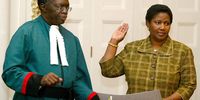
Her promotion in June 2005 came out of another man’s disgrace. President Thabo Mbeki dismissed his deputy, Jacob Zuma, who had been implicated in a corrupt arms deal, an allegation Zuma denied, and appointed her in his place. She became South Africa’s first woman deputy president.
Zuma blamed her husband. Bulelani Ngcuka, as national director of public prosecutions, had said there was evidence against Zuma but never brought a case, and a government watchdog later judged his conduct “unfair and improper”. Zuma’s supporters booed Mlambo-Ngcuka at a rally in KwaZulu-Natal, demanding that he be reinstated. Asked in Parliament about her treatment, Mbeki said she needed no particular protective measures because she was “a very grown-up girl”.
In August 2005 she told a conference in Pretoria that South Africa had lessons to learn from Zimbabwe on land reform, “how to do it fast”, at a time when Zimbabwe was evicting commercial farmers, often by force. The Democratic Alliance, the main opposition party, replied that she must be joking and called the remark irresponsible. In Parliament two weeks later she said South Africa could equally learn how to avoid Zimbabwe’s experience, and asked: “Is that so bad to learn?”
A question from her time as minister was never answered. In 2005 she was drawn into the Oilgate affair, which centred on a R15-million advance paid by the state oil company PetroSA to Imvume Management, a company with links to the ANC. About R11-million of it was passed to the ANC before the 2004 election. Mlambo-Ngcuka was accused of improperly influencing the payment.
Lawrence Mushwana, the Public Protector, the state’s ombudsman, investigated and cleared her. The Mail & Guardian challenged his inquiry, and in 2009 the high court set his report aside. The Supreme Court of Appeal upheld that decision in 2011, finding the investigation so inadequate that it could scarcely be called one. The appeal court did not decide whether the allegations were true. The affair left a question mark over her time as minister, though nothing established that she had acted improperly.
HIV/Aids
Her record on HIV needs the same candour. For six years she sat in the cabinet of a president whose government questioned the science, resisted the widespread provision of antiretroviral drugs and fought the doctors and activists who demanded them. Her ministry had nothing to do with health, and there is no readily established public record of her breaking ranks with Mbeki. But she was part of the collective’s cowardly omertà.
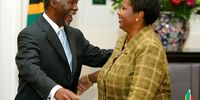
In 2006 the government put her in charge of its Aids policy, sidelining the health minister, Manto Tshabalala-Msimang, who had promoted garlic, lemons and beetroot. At a conference in September, Zackie Achmat, the HIV-positive co-founder of the Treatment Action Campaign, told the new head of the effort: “Our government has failed us.” The crowd roared for him and gave her muted applause, a day after it had roared for Zuma.
Five weeks later, however, at a congress of Aids activists, Achmat walked arm in arm with her in his HIV-positive T-shirt, and she told delegates: “We must take our fight against Aids to a much higher level.” She affirmed that HIV causes Aids, revived the national Aids council, which had seldom met under Mbeki, and in December announced plans to halve new infections and make antiretroviral drugs available to everyone who needed them. It was a welcome change, but it came after years of unnecessary suffering and death.
Her standing did not outlast Mbeki’s. In December 2007 delegates to the ANC conference elected a slate loyal to Zuma, and she lost her seat on the party’s National Executive Committee. Nine months later the party recalled Mbeki, and most of his cabinet resigned with him. Zuma became president in 2009.
Mlambo-Ngcuka left office, the New York Times wrote, a highly respected technocrat. She was exhausted, she said, and had long wanted to return to education. In early 2009 she joined the Congress of the People, a party that had broken away from the ANC, but shortly afterwards returned to the ANC.

She founded the Umlambo Foundation to support schools in poor areas and completed a doctorate at the University of Warwick in England on how mobile technology could help train teachers where resources were scarce. A master’s degree in educational planning from the University of Cape Town, taken in 2003 while she was a cabinet minister, had come first.
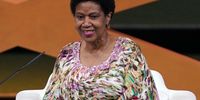
Later, Ban Ki-moon, then secretary-general of the United Nations, appointed her executive director of UN Women, the agency formally named the United Nations Entity for Gender Equality and the Empowerment of Women. Her signature project, HeForShe, asked men to commit publicly to equality. A later phase was launched at the World Economic Forum in Davos in 2015 by the actress Emma Watson.
There she told the Guardian that the ministry for women was the least funded and least prestigious in every country. Leadership mattered, she said: “When the president wants it done, you know it and you get it done.” Culture, she added, was too often used as an excuse for harm to women. “Culture is not invincible.” South Africa was no exception. The tolerance of crimes against women remained a problem, she said. “We definitely need to get our act together much better.” She argued that social media and better data could help close the gap, and that technology was how she intended to reach men and women alike.
She found the UN no more exempt from inequality than anywhere else, and campaigned openly for it to choose a woman as secretary-general. A woman at the top, she said in 2016, would mean that women would come out “and lead, run for presidents, run as the CEOs”.
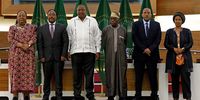
No woman has been secretary-general, and several are running to succeed António Guterres when his term ends. The world had made strides for women and girls, she said in 2022, but “our best is not good enough”. That year she was one of the African Union mediators at the talks in Pretoria that ended the war in Tigray, northern Ethiopia.
‘Never any drama or agendas’
People who dealt with her tend to recall small things. Viwe Mtshontshi, chief executive of the Umlambo Foundation, first met her in Washington, when both were taking part in a fellowship and Mlambo-Ngcuka was deputy president. She was struck that a world leader behaved as an equal among the fellows. Not long before the end, at a UN anniversary celebration, Mtshontshi watched everyone drift towards her, from ambassadors to young women who had been children when Mlambo-Ngcuka was deputy president. “They still loved her,” Mtshontshi said.
Pinky Kekana, the deputy minister of public service and administration, called her Sis P and said that Mlambo-Ngcuka always took her calls, never made her feel a burden and corrected her when she needed it. Zelda La Grange said she treated everyone with the same respect, however small their part, and that around her there was “never any drama or agendas”. The television presenter Kayise Ngqula asked, after her death, what the women of Mlambo-Ngcuka’s generation had understood about leadership that Ngqula’s own might lose, and whether it was building anything as solid for those who would follow.
Mlambo-Ngcuka was a Catholic and a member of the Catholic Women’s League. In 2006, as deputy president, she gave the memorial lecture for Archbishop Denis Hurley in Durban, praising him as a fearless opponent of apartheid who valued women’s leadership. The next year she told more than 2,000 young Catholics gathered in Pretoria for the pilgrimage of the World Youth Day Cross to live by moral principles, and asked the government, the Church and communities to work together against HIV and Aids.
She told Amnesty International that her mother’s health work sometimes brought her into tension with the Church’s position on family planning. In a recorded message to Catholic businesswomen in Johannesburg in 2018 she urged them to take their place in leadership: “As women, we must sit in those boardrooms like we belong there.”
At 70 she became a student again. In June she began a fellowship at the Robert Bosch Academy in Berlin, studying how Germany trains its young people for work, hoping to draw lessons for a continent whose median age is 19. The question was an old one for her.
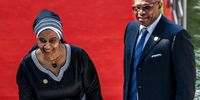
As deputy president she had led the Joint Initiative on Priority Skills Acquisition, a campaign to close the gap between what South Africa taught and what employers needed, with internships for students and young graduates sent abroad for work experience.
People who had been through the programme would come up to tell her where they had ended up, she said, and it warmed her heart. She was chancellor of the University of Johannesburg and, since 2023, an independent director of the mining company Ivanhoe Mines.
Phumzile Mlambo-Ngcuka, who was born Phumzile Mlambo in Clermont on 3 November 1955, died on 20 November 2026, 17 days after her 71st birthday. Her family said the cause was complications after a medical procedure about two weeks earlier.
At the state memorial service on Tuesday at Our Lady of Lourdes Catholic Church in Rivonia, Johannesburg, Deputy President Paul Mashatile said he had recently met her to ask for help with peacebuilding and credible elections in South Sudan, where he is South Africa’s special envoy, and that she agreed at once.
She is survived by her husband, Bulelani Ngcuka, and their five children. Fr Lawrence Mduduzi Ndlovu, administrator of the Cathedral of Christ the King in Johannesburg, last saw her on 3 October, when she came to his investiture. She told him about her health. Then, he recalled, she said: “Oh look, the Cardinal has finished eating, let’s go and greet him.”
Even in that final encounter, her attention was on someone else. DM
KioskNews shows a cleaned-up reading view extracted from the publisher’s page — the original always lives on their site, not ours.