Milei government wants to fast-track US trade deal before year-end
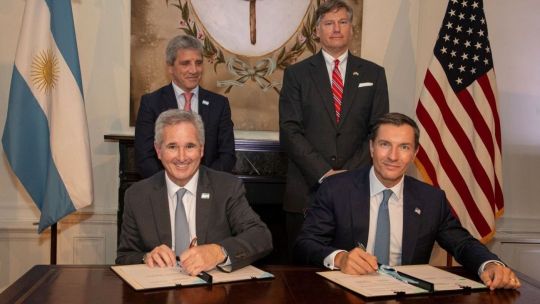
President Javier Milei's government is stepping up efforts to submit its proposed trade agreement with the United States to Argentina's Congress before the end of the year.
One of the most sensitive issues will be the treatment of tariffs on steel and aluminium, which were initially excluded from the agreement and remain subject to a 50-percent tariff. However, any negotiations to include them will be conditional on the policies adopted by Milei's government towards China and the degree of industrial protection Argentina is prepared to maintain.
The ultimate goal for Argentina's domestic steelmakers is to secure access to the US market for steel and aluminium at a tariff below the threshold imposed globally by US President Donald Trump's administration. The actual figure could be "anything" that allows them to compete with some degree of protection, at a time when the Asian powerhouse continues to expand its influence while Argentina maintains an almost unrestricted commitment to opening up its economy, a senior industry executive told Perfil.
So far, Milei's government has maintained a degree of ambiguity in discussions surrounding the initiative, which is still being drafted and currently contains no proposed amendments. After Foreign Minister Pablo Quirno signed a series of agreements, designed to avoid the risk of the deal becoming entangled in US courts following the Supreme Court's decision to block Trump's sweeping tariffs, the administration is now keen to avoid another political setback.
Chinese traceability and triangulation
Nevertheless, the White House is examining product traceability with a fine-tooth comb. While officials with connections in the US maintain that alignment with Trump remains an asset, despite favourable electoral results for the Democrats and questions over a possible weakening of his political standing, Washington is particularly concerned about trade triangulation.
As with the financing of strategic resources such as minerals and energy, where US policy is not to support projects involving Chinese interests, the issue is not simply whether a product is "made in China," but whether Beijing has been involved in its smelting or any other stage of the industrial process.
This was one of the central debates at the Alacero Summit 2026, where Argentine companies are playing a prominent role and wielding considerable influence.
A report by the organisation representing the region's major steelmakers provides the framework for the message companies want to convey. Its shared position is that measures should prevent "steel originating in third countries from acquiring a new origin through minor reprocessing operations in an intermediary country."
The report identifies a structural problem for Argentina: while countries around the world are tightening controls to prevent "the relocation of part of China's productive capacity to neighbouring countries, particularly within ASEAN," the Casa Rosada is dismantling its customs safeguards, effectively turning the country into a gateway for trade triangulation.
The study reflects the position of an organisation whose members include ArcelorMittal Acindar and the Techint Group, owned by industrial magnate Paolo Rocca.
Anti-dumping measures, customs rules
According to records from the Trade Secretariat, Milei's government has allowed several anti-dumping measures to expire this year. Under Resolution 172/2026, for example, the executive lifted the 28 percent ad valorem anti-dumping duty on aluminium imports, in force since 2020, rejecting a request by producer Aluar to extend the protection.
It also launched a review of a measure introduced in 2015 covering steel fittings, temporarily suspending its application while the investigation is under way. The measure had imposed a minimum FOB import price, despite continuing concerns about unfair competition.
The industry report also detailed how, following the closure of northern markets, Chinese steel exports to Latin America "grew by 90.6 percent between 2020 and 2024."
Faced with this massive diversion of exports, driven by a state policy under which "steel subsidies in China doubled from US$8 billion to US$16 billion," Argentina has opted to retreat from trade protection.
RIGI, Mexico and Brazil
The report explicitly describes Argentina as the regional "counterpoint..While major economies are undergoing a "gradual shift from border measures towards behind-the-border measures," such as conditional financing and preferences in public procurement, Milei's administration has deepened its commitment to sweeping deregulation.
The business report is particularly critical of Milei's flagship RIGI investment incentive scheme for major investors, arguing that it "offers benefits to major investments without imposing robust local-content or domestic-supplier procurement requirements."
For US officials, this regulatory imbalance is the main cause for concern. RIGI attracts investment in mining and energy, but by failing to include domestic procurement requirements, it leaves the door open for major projects to be built using Chinese steel sold at dumping prices.
Alacero's report highlights Mexico as "leading the Latin American response." The country has raised domestic-content requirements to 65 percent in public tenders and strengthened customs controls through licences verifying the origin of goods.
Brazil, meanwhile, has advanced commercial defence measures and tariff-rate quotas, imposing a 25 percent duty on imports exceeding historical thresholds.
Both countries are following the prevailing international approach, echoing the principles of "Build America, Buy America." Argentina, by contrast, "has adopted a more liberal orientation in recent years," lowering tariffs to reduce costs in the short term.
KioskNews shows a cleaned-up reading view extracted from the publisher’s page — the original always lives on their site, not ours.