Top 10 controversies that have rocked the Asian Games


Controversies have always found a way of seeping into sporting events, and the Asian Games is no different in that regard. | Photo Credit: AFP

Controversies have always found a way of seeping into sporting events, and the Asian Games is no different in that regard. | Photo Credit: AFP
The Asian Games 2026 in Aichi-Nagoya, Japan, will start on September 19 and conclude on October 4.
Controversies have always found a way of seeping into sporting events, and the Asian Games is no different in that regard.
From wushu athlete Divyanshi Chaudhary getting dropped at the last minute for the upcoming edition to protests surrounding Indian wrestlers Bajrang Punia and Vinesh Phogat in 2023, here are 10 controversies which rocked the quadrennial event.
2026: Divyanshi Chaudhary’s last-minute axing from wushu squad

In a video posted on social media, Divyanshi launched a scathing attack against her replacement, Roshibina Devi Naorem, an Asian Games silver medallist and Arjuna awardee. | Photo Credit: Divyanshi/Instagram
In a video posted on social media, Divyanshi launched a scathing attack against her replacement, Roshibina Devi Naorem, an Asian Games silver medallist and Arjuna awardee. | Photo Credit: Divyanshi/Instagram
Wushu athlete Divyanshi Chaudhary was dropped from the Asian Games squad at the very last minute because of injury reasons, according to the Wushu Federation.
However, the 18-year-old cried foul play, stating that she was fully fit and alleging she was dropped because of politics.
In a video posted on social media, Divyanshi launched a scathing attack against her replacement, Roshibina Devi Naorem, an Asian Games silver medallist and Arjuna awardee, who Divyanshi had defeated in the selection trials to qualify for the Asiad.
Divyanshi claimed the federation had mentally harassed her and was partial towards Roshibina, who originally finished fourth in the trials and missed the cut.
Divyanshi’s father Sunil also got involved. While Sunil admitted that the 18-year-old had sustained a knee injury, he maintained that his daughter had got the necessary clearance from the doctors to compete in the Games.
However, after a conversation with the federation, Sports Authority of India and sports minister Mansukh Mandaviya, Divyanshi Choudhary dialled down her anger, saying she has full support of the governing body to make a stronger comeback.
2023: Bajrang, Vinesh’s direct entry into Asian Games raises questions

Angry wrestlers and their family members threatened to boycott the trials in protest of the exemption given to Olympic medallist Bajrang Punia (65 kg) and Worlds medallist Vinesh Phogat (53 kg). | Photo Credit: SHIV KUMAR PUSHPAKAR
Angry wrestlers and their family members threatened to boycott the trials in protest of the exemption given to Olympic medallist Bajrang Punia (65 kg) and Worlds medallist Vinesh Phogat (53 kg). | Photo Credit: SHIV KUMAR PUSHPAKAR
The wrestling trials for the 2023 Asian Games turned into a big controversy after the ad hoc committee handed direct entries to Vinesh Phogat and Bajrang Punia, who led the protest against then outgoing Wrestling Federation of India (WFI) chief Brij Bhushan Sharan Singh.
The Indian Olympic Association (IOA)-appointed ad hoc committee decided to conduct the Asian Games wrestling trials behind closed doors after the parents of some of the wrestlers got into a heated argument with panel members.
Angry wrestlers and their family members threatened to boycott the trials in protest of the exemption handed to Bajrang and Vinesh.
2010: India’s cricket boycott
The Guangzhou 2010 Asian Games included the first official international cricket matches that took place in China, but the refusal of India to take part in that edition soured the sport’s debut in the tournament.
India was one of the biggest advocates of including cricket in the Asian Games. Therefore, when asked about the boycott, India cited “prior international commitments” as the reason for not participating.
The controversy further boiled when Pakistan engaged in a war of words with India, saying that, unlike its archrival, it would honour its commitment to “close friend” China.

India cited “prior international commitments” as the reason for not participating. | Photo Credit: THE HINDU
India cited “prior international commitments” as the reason for not participating. | Photo Credit: THE HINDU
Bangladesh won the gold medal in that edition after defeating Afghanistan, which had secured a shock win against Pakistan in the semifinal to reach the summit clash.
2006: Iraqi bodybuilder Faeaz disqualified without lab tests
The 2006 Asian Games was the last time bodybuilding was featured as an event.
The edition will always be remembered as Iraq’s Saad Faeaz became the only athlete in the Games’ history who was thrown out without undergoing proper laboratory tests.
The bodybuilder was caught with 134 ampules of nandrolone, an anabolic steroid, on arrival at Doha airport. But strangely, he was still allowed to compete on a technicality in the 75kg category days later. He finished seventh, before later being disqualified.
2006: Soundarajan’s failed gender test
Indian female athlete Santhi Soundarajan was stripped of her 800m silver medal, having failed a gender test.
The implications extended beyond the Asian Games as the athlete went through public shame in her village after the news broke out.
The talented athlete eventually found work in a brick kiln, despite being one of India’s most decorated athletes with 11 international medals.
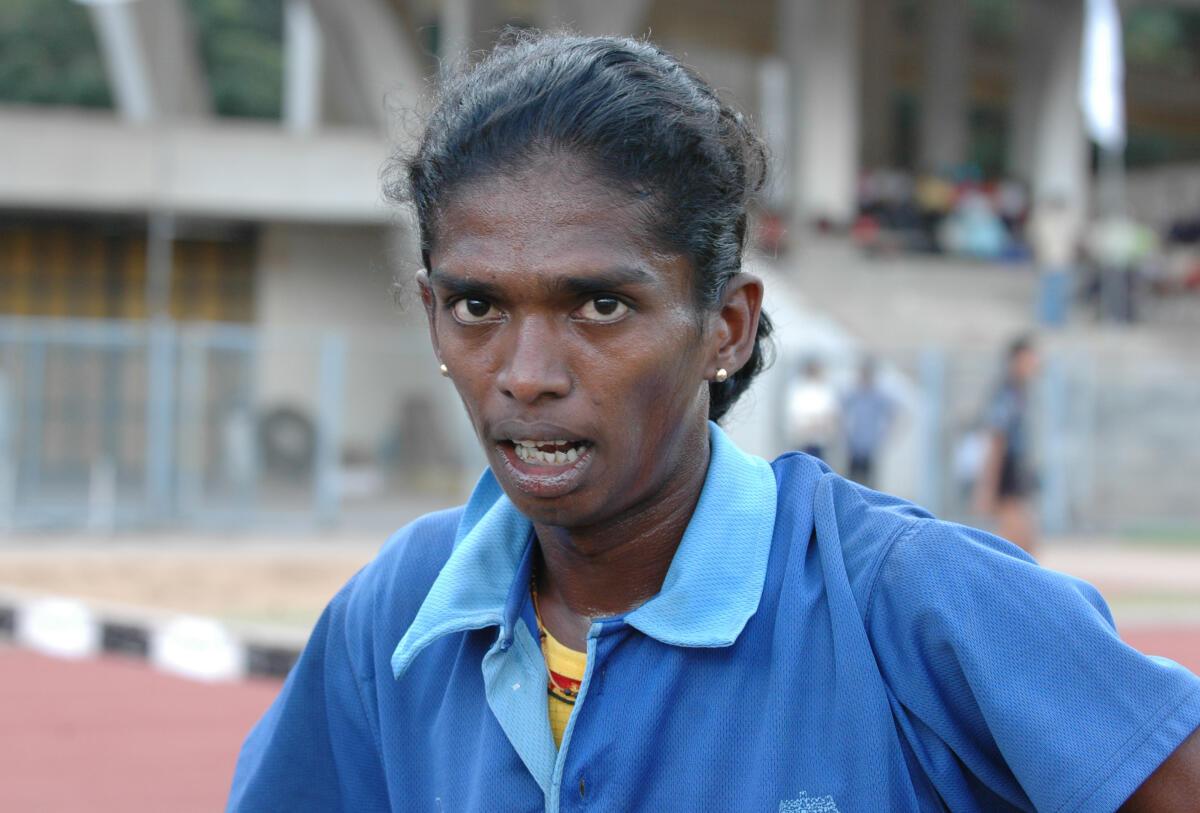
File Photo: Santhi Soundarajan of Tamil Nadu looks on during the 2005 Inter-State Senior Athletics Championship in Bangalore. | Photo Credit: G. P. Sampath Kumar
File Photo: Santhi Soundarajan of Tamil Nadu looks on during the 2005 Inter-State Senior Athletics Championship in Bangalore. | Photo Credit: G. P. Sampath Kumar
It was not before 2012 that the Tamil Nadu Government recognised her achievements and assisted her in fulfilling her long-held ambition to become a qualified athletics coach.
2010: The ‘Sockgate’ incident

Taiwan’s taekwondo athlete Yang Shu-Chun staged an hour-long sit-in when she was disqualified for having unauthorised scoring sensors on her socks. | Photo Credit: AFP
Taiwan’s taekwondo athlete Yang Shu-Chun staged an hour-long sit-in when she was disqualified for having unauthorised scoring sensors on her socks. | Photo Credit: AFP
One of the most bizarre controversies in Asian Games history happened in 2010 when Taiwan’s Yang Shu-Chun staged an hour-long sit-in when she was disqualified – on the brink of victory in the first round in 2010 – for having unauthorised scoring sensors on her socks.
This raised widespread furore, and politicians in Taiwan claimed that the disqualification was “an insult” to the country. Conspiracy theories about the ‘Sockgate’ scandal started doing the rounds when China’s Wu Jingyu -- Yang’s main rival -- went on to win gold.
It did not stop there. The Asian Taekwondo Union’s website was hacked after it published an article titled “Shocking Act of Deception by Chinese Taipei”.
2006: Tragedy strikes Equestrian

Kim, gold medallist in the 2002 Asian Games, could not control his horse Bundaberg Black when its front legs hit a 1.08-metre jump. The impact threw Kim over, and the horse landed on him, crushing his chest and head. | Photo Credit: AFP
Kim, gold medallist in the 2002 Asian Games, could not control his horse Bundaberg Black when its front legs hit a 1.08-metre jump. The impact threw Kim over, and the horse landed on him, crushing his chest and head. | Photo Credit: AFP
The equestrian competition at the 2006 Asian Games witnessed a horrible tragedy when 47-year-old South Korean rider Kim Hyung-chil was killed at the eighth jump on the cross-country course.
On a rainy day, Kim, gold medallist in the 2002 Asian Games, could not control his horse Bundaberg Black when its front legs hit a 1.08-metre jump, which was one of the smallest in the course.
The impact threw Kim over, and the horse landed on him, crushing his chest and head.

Korean athletes pay their respects to Kim. | Photo Credit: AFP
Korean athletes pay their respects to Kim. | Photo Credit: AFP
Kim did not regain consciousness even after immediate medical attention. Later, he was buried with honours in Korea’s National Cemetery and posthumously received the country’s sporting medal.
2014: Iranian official kicked out after sexual harassment
The 2014 Asian Games in Incheon, South Korea, saw an Iranian official, Amereh Ahmad, being kicked out after sexually harassing a female volunteer. He was issued strong warnings after two alleged cases.
The Olympic Council of Asia (OCA) issued a ban on Ahmad from the Games site and instructed the Iranian football team to send the equipment manager home for verbally harassing the volunteer.
There was another incident where a Palestinian footballer was accused of groping a female worker in the athletes’ village laundry room. He was banned from leaving the country as organisers decided to investigate the matter.
2018: Japanese basketball players kicked out
The 2018 Asian Games in Jakarta and Palembang, Indonesia, saw four Japanese basketball players kicked out after they bought the services of sex workers in the red-light district of Jakarta.
Commenting on the incident, the OCA said that kicking the Japanese basketball players should serve as a warning to other athletes.
2018: World champion stripped of gold medal

The Olympic Council of Asia (OCA) confirmed Orkhon Purevdorj had been disqualified as a result of a failed in-competition drugs test. | Photo Credit: AFP
The Olympic Council of Asia (OCA) confirmed Orkhon Purevdorj had been disqualified as a result of a failed in-competition drugs test. | Photo Credit: AFP
In the 2018 Asian Games, then world champion Orkhon Purvedorj of Mongolia was stripped of her gold medal in the women’s 62-kilogram event after testing positive for a banned substance.
The Olympic Council of Asia (OCA) confirmed Purevdorj had been disqualified as a result of the failed in-competition drugs test after she tested positive for the anabolic steroid Stanazolol during the Games.
Purevdorj was not the first wrestler to get involved in a doping incident in the 2018 Asian Games. Turkmenistan’s Rustem Nazarov, who exited the tournament at the first-round stage, tested positive for Furosemide, a masking agent, in a pre-competition urine test.
KioskNews shows a cleaned-up reading view extracted from the publisher’s page — the original always lives on their site, not ours.