Old masters, wider worlds
From Rembrandt’s intimate portraits to Goya’s playful children, Fubon Museum’s exhibition explores how power, global trade and everyday life shaped European painting
By Bonnie White / Staff Writer


Van Gogh once said that he would starve himself to spend time with Rembrandt’s The Jewish Bride.
“I should be happy to give 10 years of my life if I could go on sitting here in front of this picture for a fortnight, with only a crust of dry bread for food,” van Gogh said.
The quote can be found at “Old Masters From Rembrandt to Goya,” an exhibition of 52 masterpieces from the Toledo Museum of Arts at the Fubon Museum in Taipei.
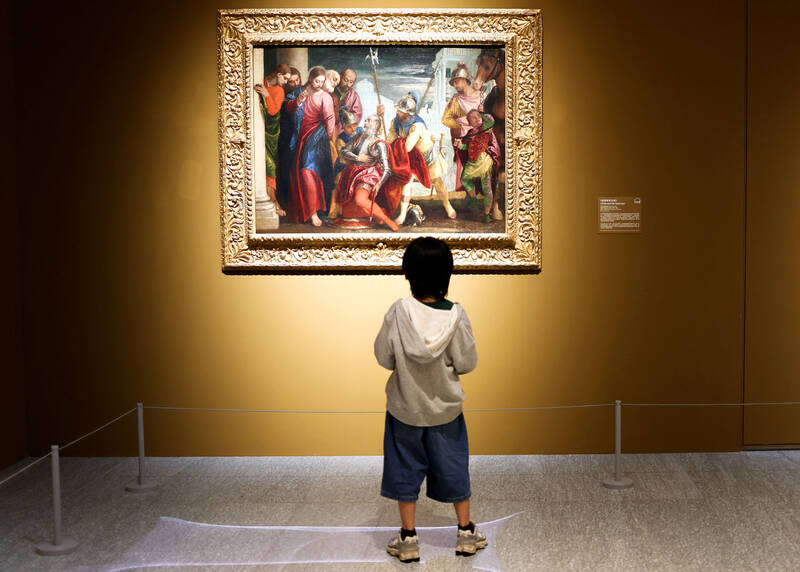
A child stands in front of Christ and the Centurion (1575-1580) by Paolo Veronese at the exhibition Old Masters from Rembrandt to Goya currently on view in Taipei.
Photo: Bonnie White, Taipei Times
Rembrandt’s deep influence on van Gogh is a central theme to the exhibition which shows how European artists not only influenced each other, but were also influenced by their society and foreign cultures.
It is Rembrandt’s mastery of chiaroscuro and his unmatched ability to portray the emotional depth of his subjects that inspired van Gogh to spend hours looking at his paintings in Dutch museums.
In the section titled “Painting and Power”, monastic depictions and Napoleonic propaganda show how royal patrons and wealthy elites sought influence by wielding artistic commissions.
In The Oath of the Horatii (1786) commissioned by King Louis XVI, Jacques-Louis David contrasts determined male postures with women slumped in desperation to frame militaristic ambition as a moral virtue.
Seventeenth-century Dutch painters fractured this dynamic. Bypassing church and royal patrons, artists catered to a rising middle class.
Rembrandt embraced this shift to paint uncommissioned character studies. Two of his tronies displayed by van Gogh’s commendation, portray anonymous characters in theatrically flamboyant costumes.
The portraits, from his early and late period, offer a transfixing repertoire of his ability to grasp evocative facial expressions and capture light and shadow.
Yet, this emancipated merchant market still demanded structure. Thomas de Keyser’s portrait of authoritative Dutch guild officers debunks the lone genius trope to reveal how production markets actually sustained painters such as Rembrandt.
This new market based on a flourishing colonial economy also brought new artistic focus, introducing painters to imported commodities and turning bustling ports into landscape studios.
In the “European Art in a Global Context” section, Chinese porcelain, rare Turkish tulips and shells from the Indonesian archipelago in van der Astat’s Fruits, Flowers and Shells (1620s) reveal the Dutch East India company’s vast colonial expeditions.
Across the room, van Goyen’s View of Dordrecht (1649) shows billowing clouds above fleets of boats in the bustling Dutch port, capturing the momentum of a nation securing dominance over trade routes.
By the eighteenth century, artistic influence spread beyond colonial conquests and stolen luxuries. Genre work was popularized as painters elevated as subject matter ordinary people and everyday life.
In the “Everyday Beauty” section, Jean-Simeon Chardin paints textured surfaces and light effects in The Washerwoman and The Woman Drawing Water at the Cistern (1733-39), to transform laborious domestic settings into harmonious scenes.
“We have learned from Chardin that a pear is as living as a woman, that an ordinary piece of pottery is as beautiful as a precious stone,” said French writer Marcel Proust.
This elevation of feeling over form laid the groundwork for nineteenth-century Romanticism, during which artists rejected the order, logic and classical restraint of the Enlightenment to portray emotions.
In the “Capturing Nature” section, Theodore Rousseau’s Under the Birches, Evening (1842-43), shows an idyllic summer evening in the countryside by contrasting a darkening dusk sky with colorful autumn trees set ablaze by fading light.
Using impressionist-like brushstrokes and dabbed highlights John Constable brings movement to his landscape Arundel Mill and Castle (1837). Shifting clouds, the rustle of trees and dappling sunlight seemingly extend beyond the canvas.
While Rousseau and Constable searched for emotional resonance, Francisco Goya was inspired by the human condition.
Often remembered for his work consumed by the dark, psychological depths of his permanent deafness and the brutal French invasion of Spain, the exhibition anchors Goya in an earlier, unshadowed chapter of his life.
In his tapestry cartoon Children in a Cart (1778), Goya captures an optimistic world with playful and smiling youth before the political and personal upheavals that would eventually shatter his life and alter European art.
For art enthusiasts, this is a unique opportunity to map the societal shifts and cultural revolutions that transformed European painting from the Renaissance to Neoclassicism.
For your information
Exhibition notes:
What: Old Masters from Rembrandt to Goya: Treasures from the Toledo Museum of Art I When: Until Oct. 19; open Monday to Sunday from 11am until 6pm Where: Fubon Art Museum (富邦美術館), 79, Songgao Rd, Taipei City (台北市松高路79號) Admission: Regular ticket NT$500; discounted tickets available On the net: www.fubonartmuseum.org/ExhibitionDetail?PKNO=X008B01L
KioskNews shows a cleaned-up reading view extracted from the publisher’s page — the original always lives on their site, not ours.