German Ambassador Jasper Wieck at Idea Exchange: ‘Important to engage in political debate, exploitation of political issues has no place in democracies’
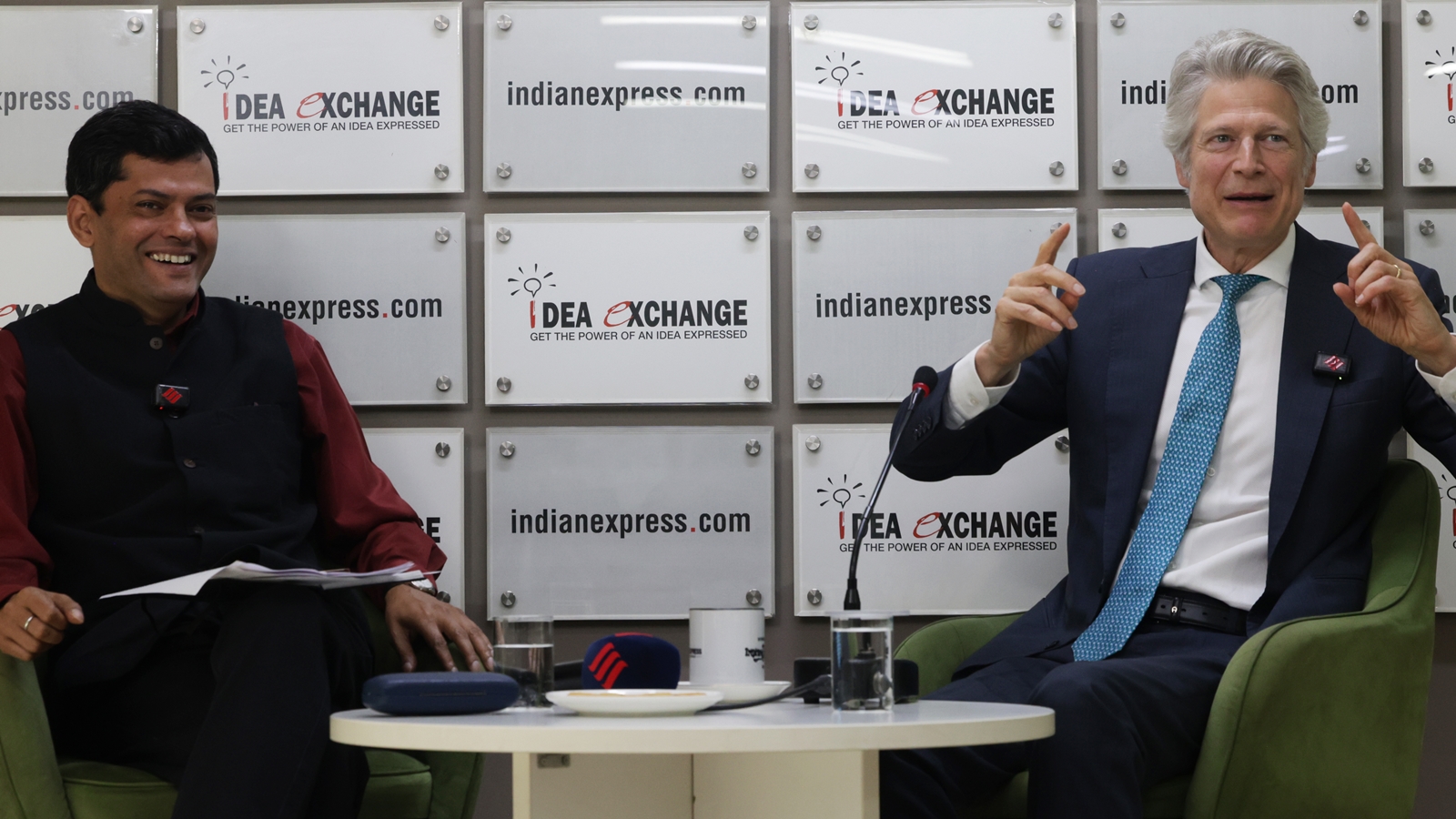
German Ambassador Jasper Wieck on how to bring Russia to the table for talks, how Indian and Germany can strengthen their bilateral ties and why it’s important to be cautious when doing business with China. The session was moderated by Shubhajit Roy, Diplomatic Editor, The Indian Express
Shubhajit Roy: As you begin your stint in India, could you talk about the priorities you have outlined for yourself?
My first priority is to see the signing of the Free Trade Agreement (FTA) between the European Union and India at the end of this year. The task is to tap into the potential of this FTA; we have to facilitate matchmaking between interested companies. The second priority will be to focus on the implantation of our Migration and Mobility Partnership Agreement (MMPA), an agreement that helps Indians come to Germany, find jobs there and become part of our society. Each year, we issue roughly 60,000 long-term visas in India, this includes visas for students as well as their families. In my first term, when I came to India (2017), there were 17,000 Indian students enrolled in German universities, now we are at 70,000. My third priority is our defence and security partnership, in particular deepening our defence industrial cooperation.
Shubhajit Roy: In the mid-90s, you served in Moscow, in Baku, and then in Berlin. This was the time of post-reunification, the collapse of the Soviet Union. Could you give us a sense of that time?
It was a captivating time, both personally and politically, because in Europe we were full of enthusiasm to overcome the Cold War division of Europe and to create a pan-European security architecture that included Russia. We wanted to ensure that the security interests of all nations in Europe are respected. But already then, we had a sense that Russia was struggling with the new status quo. With the collapse of the Soviet Union, all the former Soviet republics, such as Ukraine and Belarus, became independent. We sensed the dissatisfaction in Russia about this development. Our idea was, that the best way to deal with this revisionism was to invite Russia to become part of pan-European security, economic and political structures. Hence, the OSCE (Organization for Security and Co-operation in Europe) and the NATO-Russia Council was created, also we turned G7 into G8. Still, we failed. Russia’s inherent revisionism was stronger than its readiness to become part of a united Europe. This is a rather sad chapter of my career.
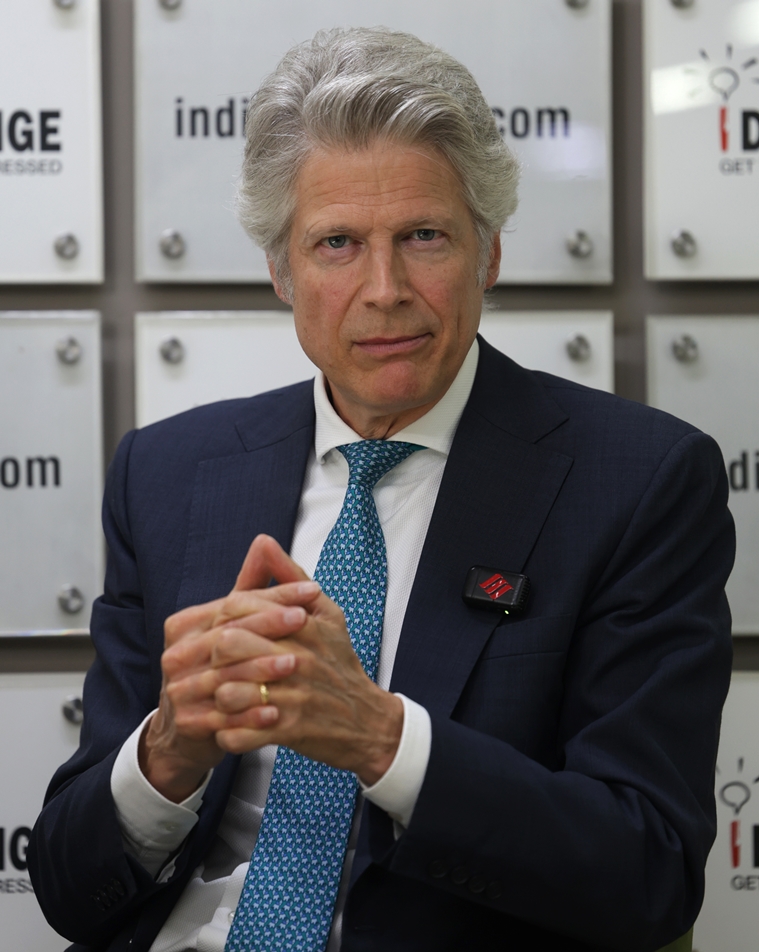 German Ambassador Jasper Wieck. (Photo: Renuka Puri)
Shubhajit Roy: You didn’t anticipate this change?
That Russia would invade Ukraine with over 100,000 soldiers was beyond our imagination. I think it happened because of a misjudgment on Russia’s behalf. Russia thought that Europe is so weak and busy with its domestic issues that we would simply let Ukraine go. But that would have come with huge costs, since the ultimate goal of the Russian leadership is the restoration of Soviet-style hegemony in large parts of Europe. As sovereign countries in Europe we simply cannot allow that.
Story continues below this ad
If Putin gets his way in Ukraine, Russia will feel encouraged to move on towards the west. Russian advancement may not necessarily happen with troops but certainly by putting pressure on sovereign governments so that policies shaped in Warsaw or Berlin would be to the liking of the Kremlin. That’s why we Europeans work so hard, why we support Ukraine and why we have put all these sanctions in place. We are defending our own freedom and sovereignty.
On Russia’s revisionism | If Putin gets his way in Ukraine, Russia will feel encouraged to move on towards the west. That’s why we Europeans work so hard and why we have put sanctions in place. We are defending our own freedom and sovereignty
Shubhajit Roy: To play the devil’s advocate, the Russian view is that it was NATO which was threatening Russia. How do you respond to this framing?
I would simply invite everyone to look at the statistics. Germany spent hardly 1.1 per cent of its GDP on defence in 2015 — one year after Russia had annexed Crimea, when Russia, so they claim, felt threatened by NATO. In the decades after the end of the Cold War, NATO had no contingency plans, no meaningful joint exercises; in essence, NATO had become a paper tiger when it came to collective defence. After having spent tremendous amounts on defence during the Cold War, Europeans where simply exhausted. Therefore, my take is that it was not out of fear of possible NATO aggression that Russia attacked Ukraine but quite the opposite — a perception of European weakness and ‘decadence’, so from the Russian perspective: an opportunity to revise the territorial status quo in Europe.
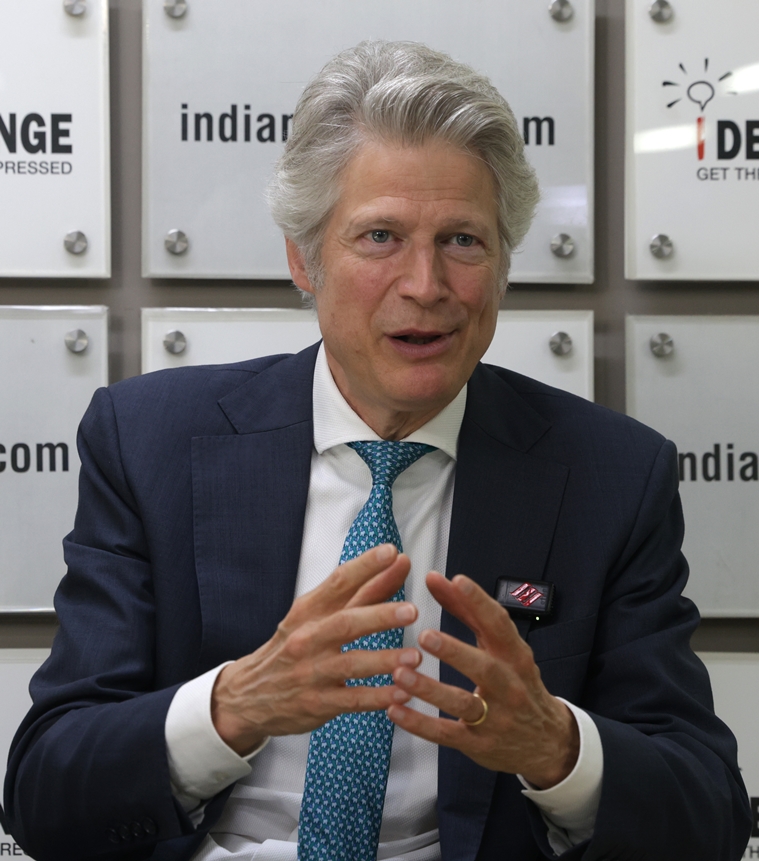 German Ambassador Jasper Wieck. (Photo: Renuka Puri)
Shubhajit Roy: What became the turning point? How did the needle move for the increase in defence budget?
Story continues below this ad
For Germans in general, it was a huge shock to see pictures of Russian soldiers and tanks invading Ukraine. Until then, and despite of the annexation of Crimea and the ensuing proxy war in eastern Ukraine, Germans didn’t think Russia would threaten our national security or the NATO alliance. The invasion was a turning point in public awareness, and therefore Chancellor Olaf Scholz seized the opportunity to announce a €100 billion investment into the armed forces. At the same time, we also understood that it’s not wise to build capacities on a purely national level; you need a collective approach. Thus, we cooperate closely with our European partners in developing our capabilities together and in strengthening our collective defence.
On civic protests | There was always a dialogue…That’s what makes our societies different from authoritarian countries, where protests are suppressed. That can lead to grave mistakes by the ruling class because they don’t accept criticism
Shubhajit Roy: Four-and-a-half years into the war, Russia is still standing, Ukraine is still there, and there is a stalemate. What is your prognosis of the war?
This war will not be decided on the battlefield. If you look at the frontline, the infantry has disappeared and been replaced by the use of drones and long-range weapons. We definitely need a sustainable political solution. Ukraine is ready for a ceasefire but Russia refuses to even engage in debate. The European approach is twofold: on the one hand to increase military, humanitarian and material support to Ukraine, and, on the other hand to tighten the sanctions against Russia. This way, we try to contribute to bringing Russia to the negotiation table.
Shubhajit Roy: How do you view India’s advocacy role?
Story continues below this ad
We welcome the initiative by India. I can hardly think of a country better positioned than India to mediate this conflict because you have functioning channels of communication with Russia and with Ukraine. If we can be of any help to India in this regard, we, of course, stand ready, but we know that since we clearly support Ukraine, we cannot fulfil the role of mediator. We need countries like India to step in — and we need the commitment of the US also when it comes to monitor the implementation of a cease-fire agreement.
Shubhajit Roy: On defence and security cooperation, Germany has capabilities in drones and submarines. What are the other sectors where India and Germany can exchange knowledge transfer?
Airbus, for example, is building transport aircraft and light utility helicopters in India. We are cooperating on the Eurodrone reconnaissance drone, where India is an observer and where a maritime variant for specific
Indian needs can be developed. We are also cooperating on anti-submarine warfare related systems. German companies are also ready to partner with Indian companies, among others, in missile technology, sensor technology, communication technology, unmanned systems, signalling. There is an almost finalised submarine deal that will include comprehensive technology transfer; the final design will be developed jointly by German and Indian shipyards.
Story continues below this ad
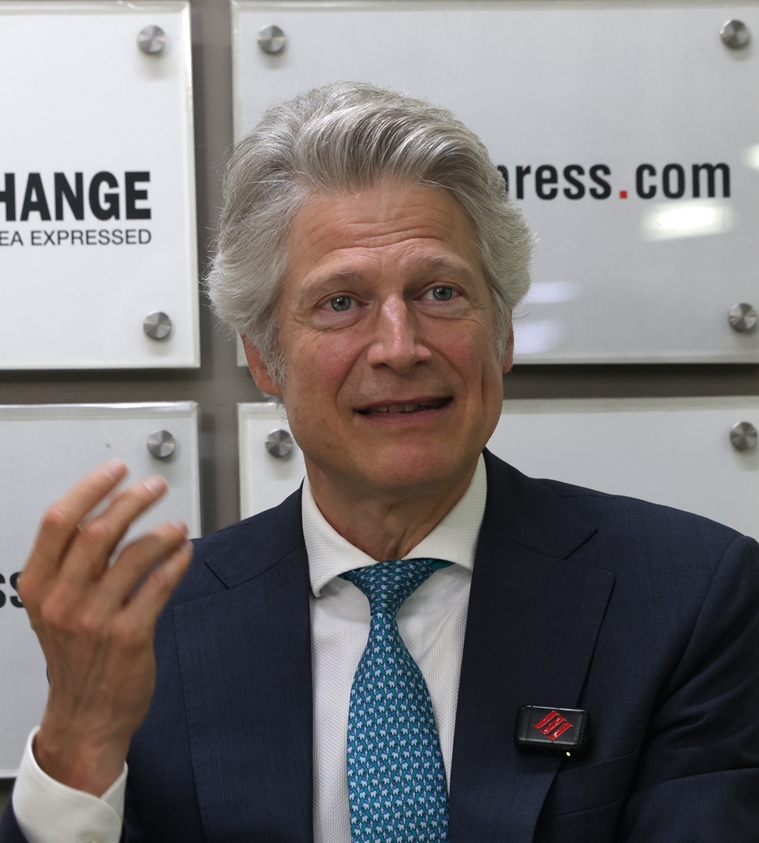 German Ambassador Jasper Wieck. (Photo: Renuka Puri)
Shubhajit Roy: Through India-Germany economic relationship after the FTA, what is the market access India will get?
Normally when such a trade deal is signed, people look at the tangibles, like cars, airplanes, refrigerators, but if you took a broader view and look at the entire supply chain, you realise you need a lot of components. For instance, India has developed an impressive car component subsidiary industry. If a European car manufacturer has components delivered from India because you produce them at a lower price, our cars in Europe get cheaper. And if car producers in India say this is a high-tech device that we would like to have from Germany and you don’t have to pay the tariffs any longer, then your economy, the competitiveness of your companies and your consumers will all benefit as well.
It’s also important to understand that big companies like BASF, Bayer, Siemens and Bosch need the FTA less because they go ‘local for local’; they produce in India. But the famous German Mittelstand — small and medium enterprises with up to 200 workers — cannot establish global subsidiaries and need this agreement because they realistically will not go local. And of course, vice versa, India also has enterprises that cannot simply open a production site in Germany. They simply want export.
On Israel-Palestine | The German government is criticised from both sides, for being too pro-Israeli and the Israeli government criticises us for being too critical about what they are doing. We are not blind on either side, we have both eyes open
Aakash Joshi: With the rise of the AfD and its sort of nativist anti-migrant policy and the political pressure it faces, if this movement continues to rise, how do you see it playing out?
Story continues below this ad
It’s important to see how our society and also our migration policy has evolved over the years. In 2015, we had huge pressure from crisis regions, particularly from Syria. There were times when our authorities were no longer in full control over the flux of people coming into our country and that was the moment for a populist party like AfD to jump in. They told our people that the ruling government had lost control. Till today, they benefit from that moment of mass movement in 2015. But this has little to do with our today’s migration and mobility policy towards India, which is about inviting skilled labour that our companies and even our public service system need urgently. So, there’s a broad consensus among all the parties that we need talented Indian people who are willing to make their living in Germany and, in general, it works very well.
Aakash Joshi: How much does economic and political upheaval in major EU members affect Germany, which is arguably the real leader of the EU?
In general, I see protests — as long as they are peaceful and happen within the legal framework — positively because they are an expression of our free society and that people can take to the streets, if they are not satisfied. In Germany, we have a long tradition of people raising their voice, now it’s Gen Z. That’s what makes our societies different from authoritarian countries, where protests are suppressed. I would not want to live in that kind of a society. It can lead to grave mistakes by the ruling class because they don’t accept any criticism.
In Germany, you switch on (the radio station) Deutschlandfunk which by the way is funded by the State and even for someone like the Federal Chancellor, it’s a perfect way of knowing how political or legislative initiatives by the government are discussed in society. It is important that we all engage in necessary political debate, but at the same time violence or exploitation of political issues has no place in democracies.
Story continues below this ad
Vandita Mishra: But don’t protests point to the inability of institutions to listen to the younger generation. What do you think governments should do when Gen Z takes to the street?
As the German ambassador to India, I’m not here to give recommendations. I assume that the voices of the younger generation are heard. When I compare Germany of the 1950s with the Germany of today, I think it has evolved tremendously socially, also because the civil society has brought up ever new initiatives. Political parties and non-governmental organisations have actively participated in shaping policy and that’s what we need.
India too, has evolved over the decades. India today is a modern, digitalised country that at the same time has retained its traditions. It is an economic powerhouse, with a voice that is heard worldwide. All this doesn’t come from nothing. It’s people that have struggled, initiated and implemented reforms, that have taken to the street, if need be, held discussions and seminars to bring up new ideas continuously. So, what I am saying is you can trust your very vibrant and agile civil society, which, by the way, has worldwide renown for being animated and spirited.
Saptarshi Basak: Part of Germany’s economic roles are being attributed to China’s rise, because China has displaced Germany in manufacturing, engineering, electronics. Is there is a regret retrospectively in German circles about this?
Story continues below this ad
Well, it depends on who you ask in Germany. I would say that German companies have benefited from engaging with China. By producing in China, our supply chains have been cost effective and the consumer has benefitted as well. But we also had to learn our lessons and had to become more vocal with regard to reciprocity in investment opportunities and fairness in trade. Our economy had become too dependent on China. We now have investment screening mechanisms in place and encourage companies to diversify. This also explains the rising importance of India to German business and the FTA between India and the EU is, among other things, a manifestation of our approach to diversify.
Saptarshi Basak: In the case of Palestine, how does Germany see the requirements for a two-state solution?
One very essential requirement for sustainable peace in the Middle East is that there be a viable entity in Palestine. For the time being this is not the case. We spend a lot of money on humanitarian assistance, particularly to Palestinians in Gaza. Before any formal recognition of Palestine there are many questions to be looked at, and I think for the people in these areas it is much more important that we help them survive in there every day life than that we grant them any formal status which is for the time being just on paper. And, of course, Israel and the security of its people are an important part of the equation. We want to have Israel on board with any political solution. For historic reasons that are well known we have a very special relationship with Israel.
Shubhajit Roy: You talk about your special relationship with Israel, but critics argue that your commitment is to Israel and its people, not to the Netanyahu government. Do you agree with that perception?
Well, the German government is criticised from both sides, which is always a good sign. We are criticised that we are too pro-Israeli and the Israeli government criticises us for being too critical about what they are doing. So somehow, we are on middle ground. We are not blind on either side, we have both eyes open.
Devyani Onial: Given the history, do you now see a generational change, with the public speaking up more for Palestine?
When I was at university, we had similar debates among us students. The situation in West Asia is very complex, and it has always been a debated issue in our society, as in many other societies. So, I don’t think that it has tremendously changed, perhaps those who stand up for the rights of Palestine or for the two-state solution have become more vocal, but at the same time we have strong defenders of Israel. Perhaps, the topic is more on our agenda than in the past but the debates are very much the same.
KioskNews shows a cleaned-up reading view extracted from the publisher’s page — the original always lives on their site, not ours.