Mumbai air is turning toxic: Why is civic body holding back construction ban?
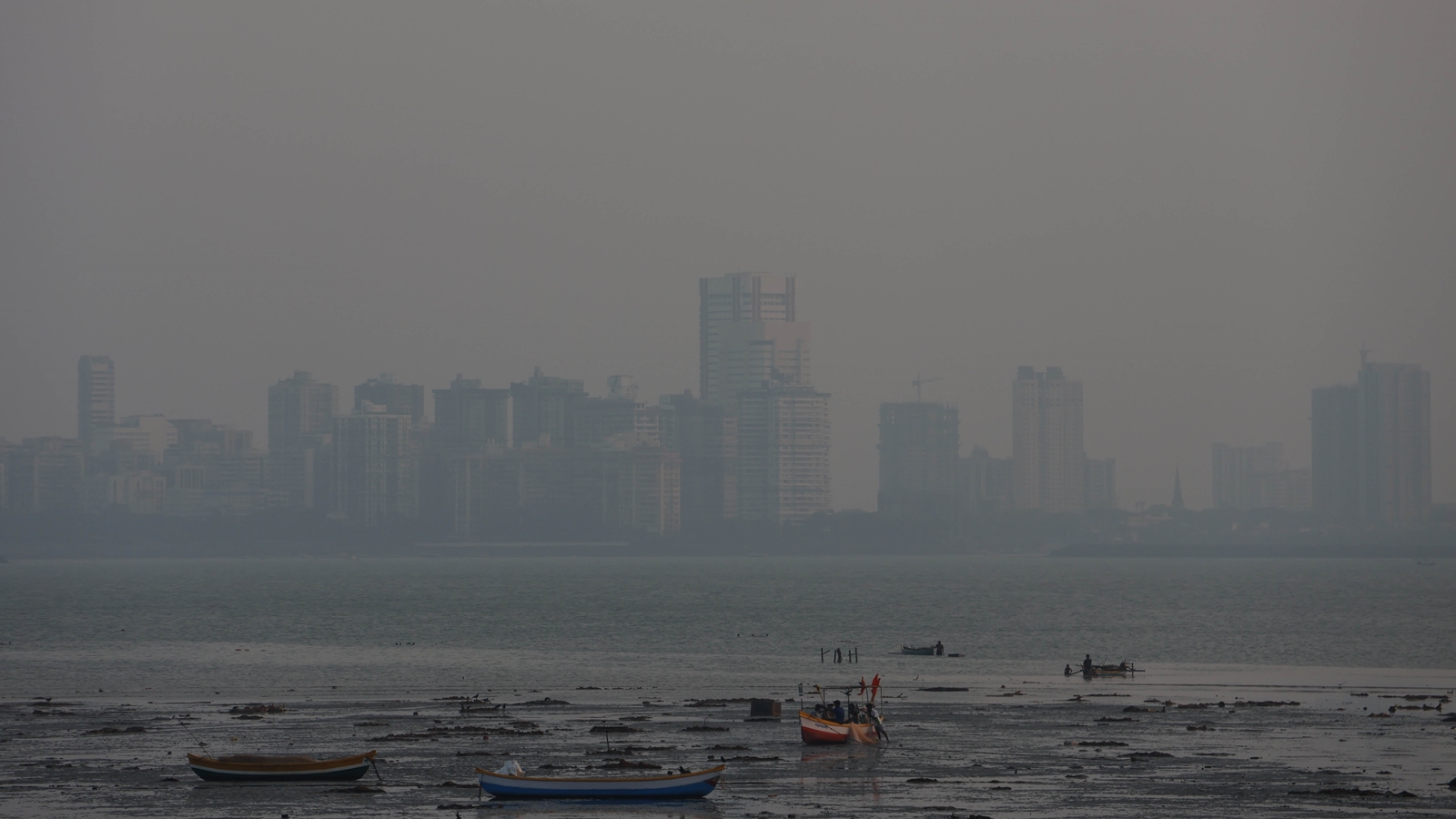
As Mumbai continues to grapple with deteriorating air quality, Central Pollution Control Board (CPCB) records show that several pockets of the city have recorded Air Quality Index (AQI) readings above 200 for three or more consecutive days on multiple occasions this month.
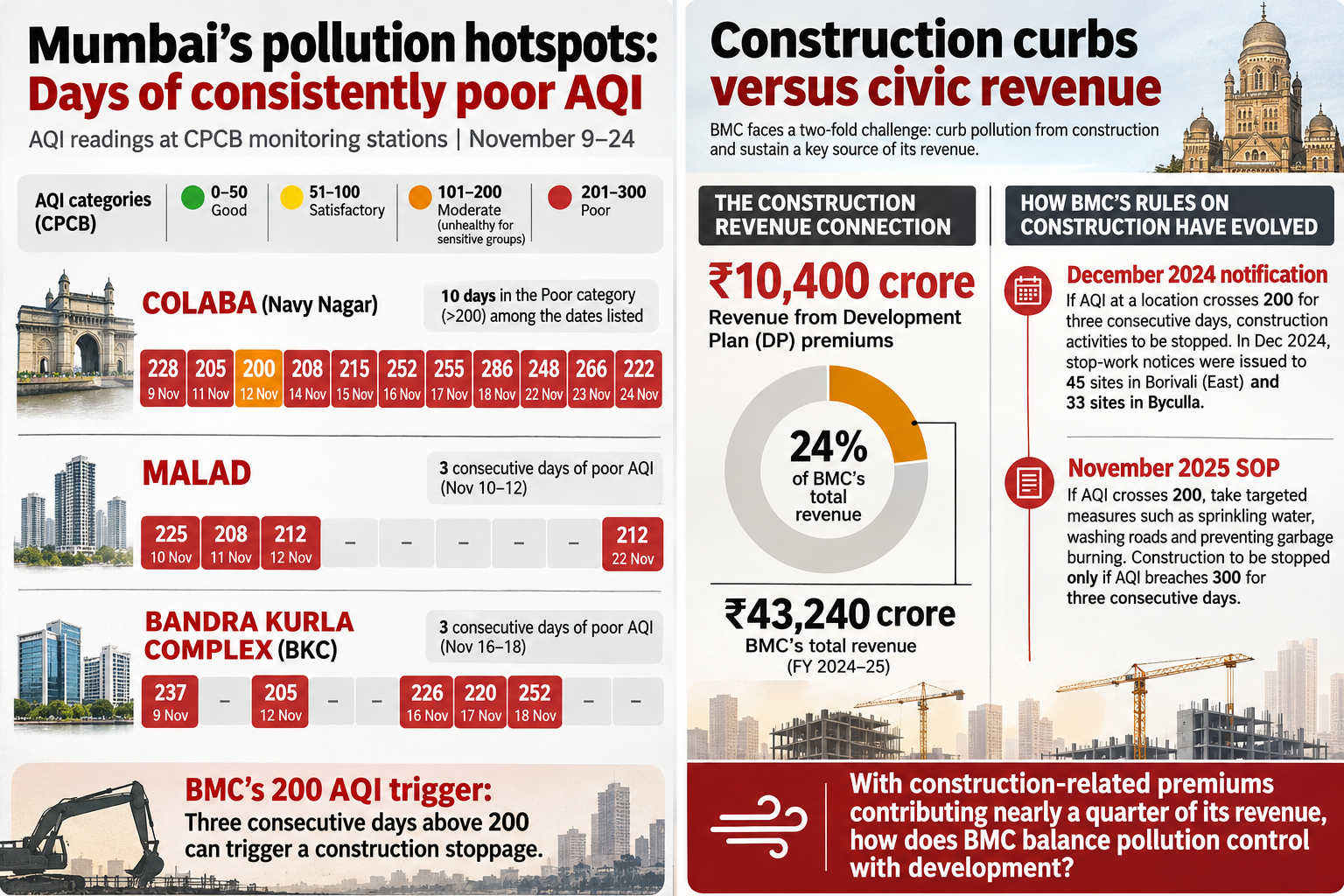
Under a December 2024 notification, the Brihanmumbai Municipal Corporation (BMC) had stipulated that construction activities would be stopped in locations where AQI readings remained above 200 for three consecutive days. The provision was part of the civic body’s Graded Response Action Plan (GRAP).
According to the CPCB’s classification, an AQI reading of 0-50 is considered Good, 51-100 Satisfactory, 101-200 Moderate, 201-300 Poor, 301-400 Very Poor and 401-500 Severe.
In December 2024, the BMC had issued stop-work notices to 45 construction sites in Borivali East and 33 in Byculla, ordering an immediate halt to construction activities after the respective areas recorded AQI readings above 200 for three consecutive days.
The BMC’s Mumbai Air Pollution Mitigation Plan (MAPMP), released in 2023, had identified construction dust as one of the primary contributors to air pollution in the city.
However, the civic body has yet to initiate similar action this year, despite multiple locations recording consecutive days of poor AQI. According to the CPCB dashboard, the monitoring station at Navy Nagar in Colaba recorded readings above 200 for three consecutive days between November 22 and 24, at 248, 266 and 222, respectively.
“The BMC rules state that action will be taken only after observing the 24-hour average readings for three consecutive days. Tuesday is the third day and, after observing the readings tomorrow, we will consider taking action,” Avinash Dhakane, additional municipal commissioner, told The Indian Express on Tuesday.
Story continues below this ad
This is, however, not the first instance this month of Colaba recording consecutive days of poor air quality. Between November 14 and 18, the monitoring station recorded readings in the poor category for five consecutive days, at 208, 215, 252, 255 and 286, respectively. Between November 7 and 24, Colaba recorded poor AQI for 11 days.
“Colaba’s Navy Nagar is a defence area and some construction work is underway there. Our officials, along with those from the Maharashtra Pollution Control Board (MPCB), had informed the authorities concerned about the situation and asked them to immediately control the activities. Now that AQI readings are consistently deteriorating, we will have to take action,” Dhakane said.
CPCB data also shows that Colaba is not the only location to have recorded poor AQI for three consecutive days. Between November 10 and 12, Malad recorded readings of 225, 208 and 212, respectively. The readings subsequently improved before rising to 212 again on November 22.
Similarly, the monitoring station at Bandra Kurla Complex (BKC) recorded poor AQI for three consecutive days between November 16 and 18, at 226, 220 and 252, respectively. The location had also recorded poor readings of 237 on November 9 and 205 on November 12.
Story continues below this ad
However, a separate set of standard operating procedures (SOPs) issued by the BMC in November 2025 stipulates that construction activities should be stopped only if AQI readings in an area remain above 300 for three consecutive days. Under these SOPs, readings above 200 call for targeted interventions such as water sprinkling, road washing and preventing activities such as garbage burning. Construction activities are to be stopped only if air quality deteriorates further.
“AQI is not influenced solely by human activities; meteorological factors also play a role. Mumbai currently has thousands of government, private development and infrastructure projects underway. Therefore, stopping all activities immediately after AQI crosses 200 would be arbitrary,” another civic official told The Indian Express.
For the BMC, development fees and premiums are the second-largest source of revenue. These are statutory charges levied on private developers and government agencies undertaking redevelopment and construction projects in Mumbai. In some cases, concessions are extended to government agencies.
In the previous financial year, the BMC generated Rs 10,400 crore through development premiums, accounting for 24 per cent of its total revenue of Rs 43,240 crore.
Mumbai needs a model to study AQI
Story continues below this ad
Environmental experts, however, said that stopping construction activities alone does not constitute a definitive strategy to curb air pollution.
Speaking to The Indian Express, Abhishek Chakraborty, environmental engineer and professor at IIT Bombay, said that halting construction could bring down pollution levels, but there was no conclusive evidence to establish whether any improvement was actually attributable to reduced construction activity or changing meteorological conditions.
“We need data-backed, evidence-based interventions rather than ad hoc decisions. Local emission sources are also responsible for pollution. It is not just construction activity, but vehicular emissions and several other sources that need to be addressed. There needs to be a scientific understanding of what is driving pollution and whether the measures being implemented are actually working,” Chakraborty said.
He added that pollution in a city like Mumbai was heterogeneous, with several factors, including human activities and meteorological conditions, influencing air quality.
KioskNews shows a cleaned-up reading view extracted from the publisher’s page — the original always lives on their site, not ours.