China launches Shenzhou-24 carrying first Pakistani astronaut to space station
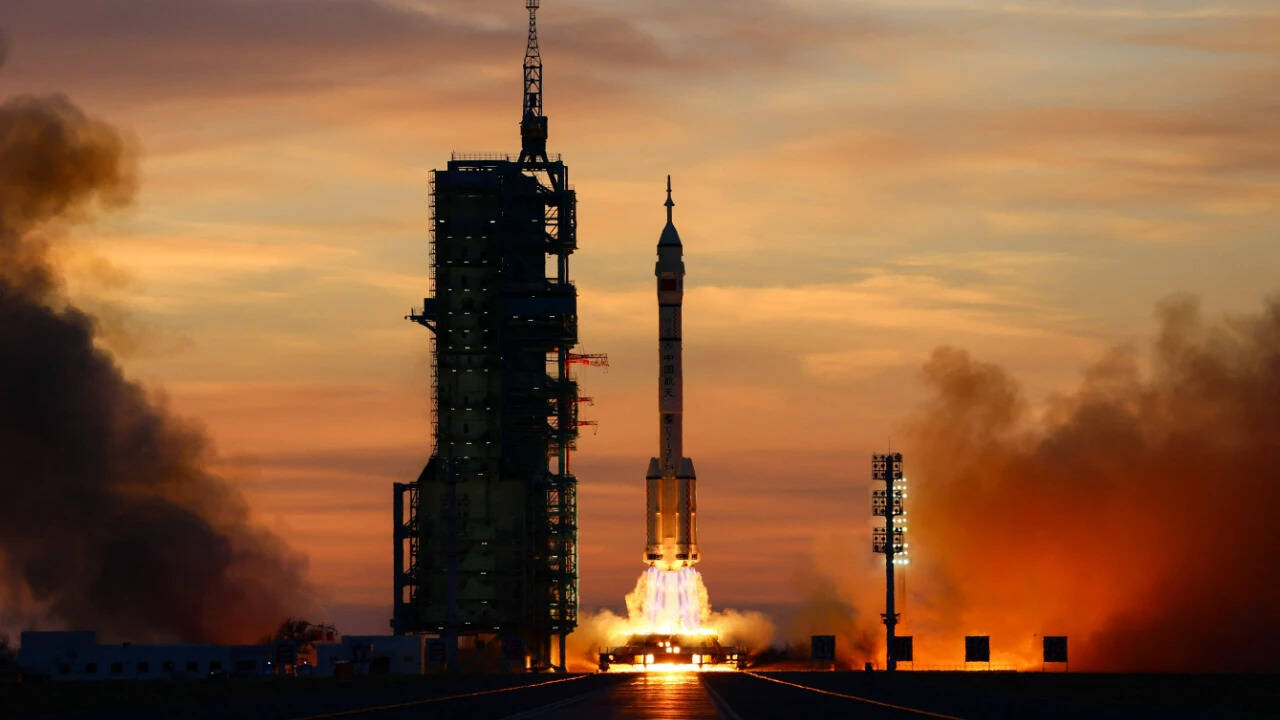
A Long March 2F Y24 rocket carrying the Shenzhou-24 spacecraft with Chinese astronauts Tang Hongbo, Wu Yi and Pakistani astronaut Muhammad Zeeshan Ali, blasts off to China's Tiangong space station
China on Wednesday successfully launched its Shenzhou-24 spacecraft carrying three astronauts, including Pakistani national Muhammad Zeeshan Ali, marking the first time a foreign astronaut has travelled aboard a Chinese mission to its Tiangong space station.The spacecraft blasted off from the Jiuquan Satellite Launch Center in northwestern China, carrying Ali, 40, alongside Chinese astronauts Tang Hongbo, 51, and Wu Yi, 39. The mission marks the first joint spaceflight involving Chinese and foreign astronauts in the history of China's crewed space programme.Ali, a former Pakistan Air Force pilot, will serve as a payload specialist during the mission. He is expected to conduct scientific experiments and technology tests alongside the Chinese crew before returning to Earth aboard the Shenzhou-23 spacecraft, according to Chinese state media.Speaking ahead of the launch, Ali described the mission as the beginning of a broader journey in space exploration and cooperation between the two countries.“It's like my daily training. Day after day, reaching new heights,” he said in Mandarin.In English, he said the mission “is not a finish line” but a long path, expressing hope that future cooperation would expand from individual astronauts travelling together to multiple joint missions and eventually journeys to the Moon, Mars and beyond.
“To every child who’s watching while I’m in orbit: Look up at the sky and remember that I am up there with your dreams," he said.
More than 90 experiments planned
The three-member crew will conduct more than 90 scientific experiments and technology tests during the mission, China's official Xinhua news agency reported.According to state broadcaster CCTV, Ali will undertake four scientific projects covering biotechnology and materials science.
One of the experiments will involve photosynthetic microorganisms, including cyanobacteria.Ali's mission will be relatively short, and he is scheduled to return to Earth aboard the Shenzhou-23 spacecraft, CCTV reported.For Tang, the mission will mark his third visit to the Tiangong space station, making him the first Chinese astronaut to travel there three times. Wu and Ali will be undertaking their first spaceflights.Tang said differences in language, culture and psychology had made preparations for the mission more challenging, but both teams had worked to overcome them.“The labels and operating instructions aboard the spacecraft and space station are all in Chinese, and the Pakistani astronaut began training with virtually no foundation of the language,” he said, adding that he and Wu had also stepped up their English studies.
China-Pakistan space cooperation
The mission is part of a space cooperation agreement signed by China and Pakistan in February 2025. It marks a new phase in the two countries' growing partnership in space exploration and technology.Their cooperation has already included Chinese-launched Pakistani satellites, a joint satellite-navigation system and plans for a Pakistani-built lunar rover to fly aboard China's Chang'e mission around 2028.Pakistani Prime Minister Shehbaz Sharif extended his wishes to the astronauts ahead of the launch, describing the mission as a milestone in bilateral relations.“Tomorrow, Pakistan will look to the skies with anticipation, pride and deep gratitude,” he wrote on X.Praising Chinese President Xi Jinping, Sharif said his “visionary leadership and steadfast commitment to Pakistan-China friendship have taken our All-Weather Strategic Cooperative Partnership to unprecedented heights.”
He also credited Pakistani scientists, the armed forces and national institutions for their contributions to the country's space programme.“Pakistan-China friendship is surpassing the heights of the Himalayas in its journey to outer space,” he said.
China targets crewed Moon landing by 2030
China's space programme has expanded rapidly as Beijing seeks to strengthen its position in space exploration and compete with the United States.The country is preparing for its first crewed lunar landing by 2030, while NASA is targeting 2028 for its next astronaut landing on the Moon.Since Yuri Gagarin's first human spaceflight in 1961, citizens of around 50 countries have travelled to space. However, only three countries, Russia, the United States and China, have developed the capability to launch their own crewed spacecraft.
KioskNews shows a cleaned-up reading view extracted from the publisher’s page — the original always lives on their site, not ours.