The object, the color and the line
Kaohsiung hosts Michael Craig-Martin’s first major solo exhibition in Taiwan
By Shane O’Reilly / Contributing reporter


A leading figure in British contemporary art, Michael Craig-Martin makes his Taiwanese debut with this major solo exhibition at the Kaohsiung Museum of Fine Arts (高雄市立美術館).
For more than 60 years, Craig-Martin has subverted and reinvented the typical conventions of object, color and line.
He has challenged the spectator to reconsider our world of everyday components, provoking deep philosophical questions about human perception, consumerism, and material awareness.
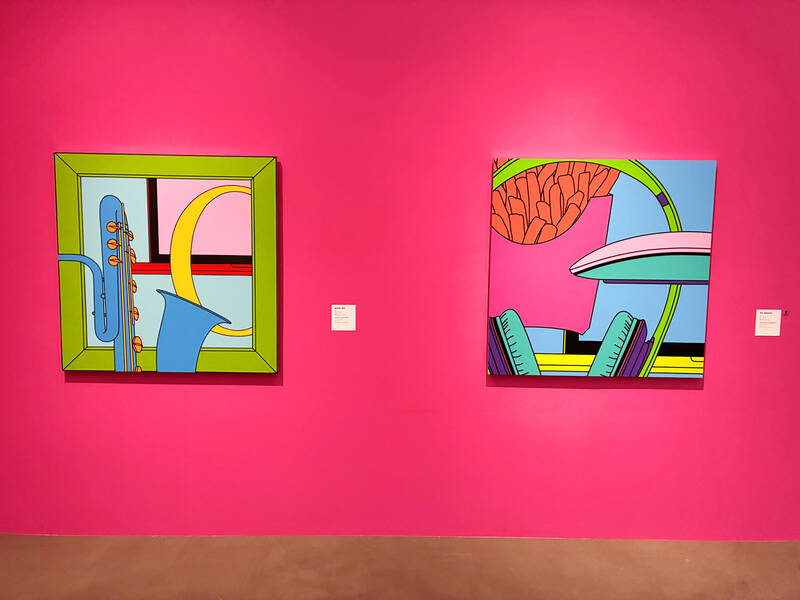
Michael Craig-Martin’s Saxophone (green frame), 2026, and Untitled (chips and headphones), 2023, showcase the duality of the everyday.
Photo: Shane O’Reilly
With over 70 artworks, closely co-curated with the museum’s in-house team, Michael Craig-Martin: The Language of the Everyday presents a comprehensive retrospective of the artist’s work with a specific emphasis on his defining later-stage career.
THE ARTIST
Born in Dublin, Ireland, in 1941, Michael Craig-Martin studied art in Paris and Yale before moving to London in 1969, where he lives to this day.
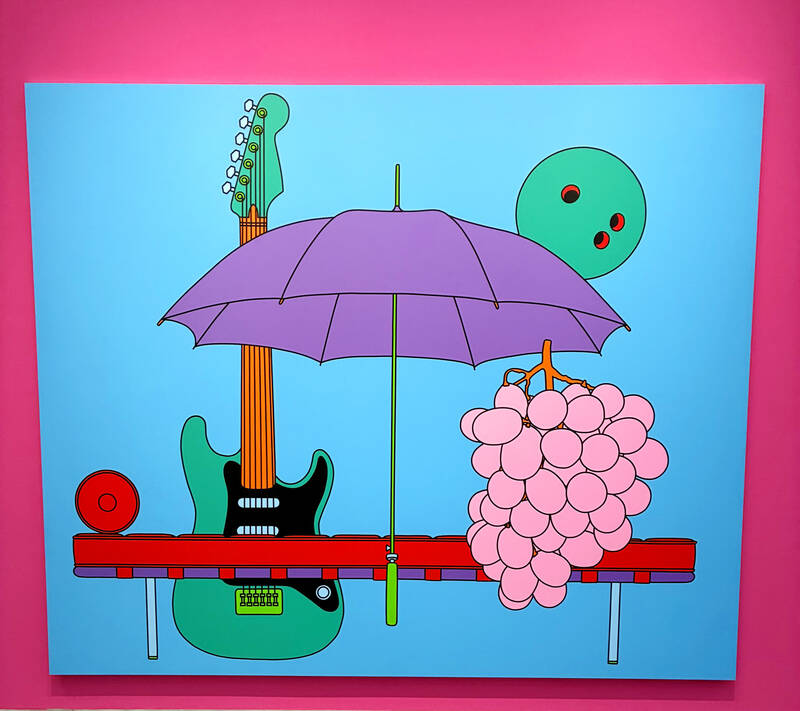
Michael Craig-Martin’s Interior (with daybed), 2021, exemplifying the beauty of random assemblage.Photo: Shane O’Reilly
Photo: Shane O’Reilly
Initial iterations of his work focused on minimalism and box-like structures that played with dimensions of geometric design.
This culminated in his inclusion in two seminal 1972 exhibitions at the Hayward and Tate galleries, positioning him at the forefront of Britain’s emerging new wave of conceptual artists.
His seminal conceptual piece An Oak Tree followed, premiering in 1974.
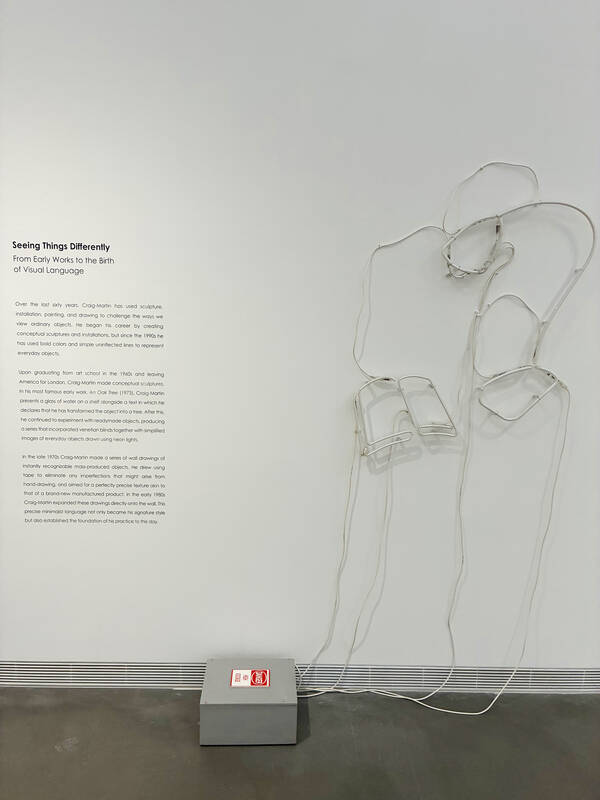
First impressions; the introductory text and Michael Craig-Martin’s Reading Light (1975).
Photo: Shane O’Reilly
Perhaps influenced by Patrick Caulfield’s bold, heavily outlined symmetrical conceptualism, Craig-Martin became enamored with exposing everyday items as nakedly as possible.
He began creating large-format sketches of these rather prosaic household items and outlining them in fine black crepe tape, which retained the flat, minimalist focus he’d envisioned.
By the mid-to-late 1990s, however, his discovery of digital vector graphics would lead his work in a new direction, influencing the likes of Julian Opie, Damien Hirst and Gary Hume.
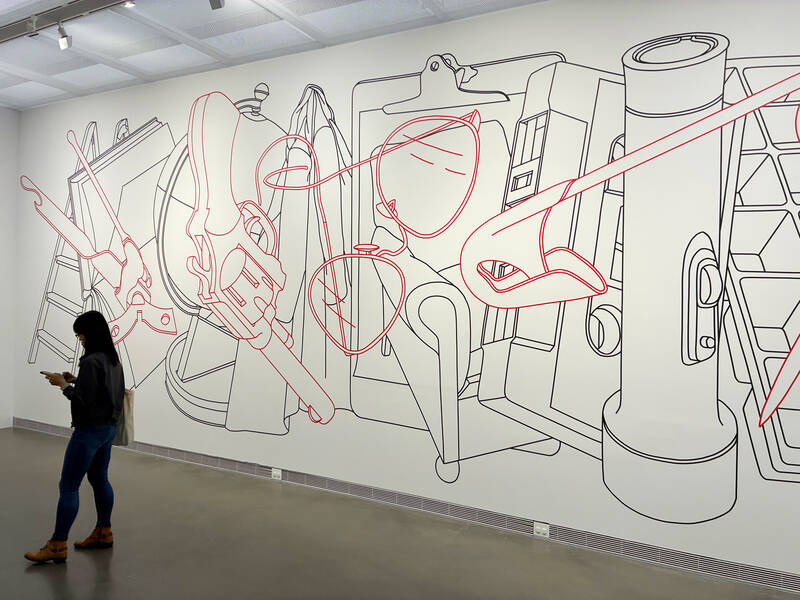
The majestic scale of Michael Craig-Martin’s Modern Dance (1981).
Photo: Shane O’Reilly
This new process relied on an entirely black surface, onto which he projected his vector drawing. Tape was applied exactly along the blueprint lines, then four-inch paint rollers were used to apply the color.
He used a limited range of acrylic paint with only six to ten colors per artwork, flushing his works with plenty of turquoise, aqua, pinks, purples, cadmium yellow, saturated reds, and bright greens.
Once dry, removal of the tape unveiled his brightly rendered objects.
THE EXHIBITION
Technically designated across three main gallery spaces, the interior layout is partitioned into several smaller, distinct thematic sections, creating a larger, more labyrinthine environment which was very welcome.
Vertical and horizontal works nested comfortably next to one another, beginning with the conceptually brilliant An Oak Tree, asking us to see beyond a simple glass of water.
The centrally placed Formica Box (1968) follows, and, thankfully, only two pieces of his Venetian Blinds series, which retain a place and purpose, but hardly inspire.
The evolutionary flow continued from sparsely colored blueprints to the boldest fully realized frames, with 1981’s stark trichromatic Modern Dance sitting somewhere in between; 45 years old, retaining all its mesmeric impact.
There was a noticeable lack of his 1990s works, but as most were site-specific temporary constructs, it is an unavoidable concession rather than an oversight.
Presence without physicality, the artist once demanded, and so it goes as the exhibition moved into the 21st century.
Electric neons came alive across giant crowded canvases of flat overlaid articles from 2002’s Inhale/Exhale to the monstrous splendor of 2010’s Untitled (painting) and 2016’s Space II.
A series of square-framed paintings focused on singular consumer goods from cassettes, lightbulbs and ashtrays to the present-day modernity of iPhones, laptops, and designer trainers.
It was a shame Craig-Martin’s lurid reworking of Seurat’s Bathers at Asnieres appeared as a limited-edition print Seurat (green), rather than either of its original large-scale 2004 paintings, both privately owned.
But the digital installation Cosmos (2024) was magnificent. Developed jointly with a video animator and composer, it was a dazzling kaleidoscopic dance of more than 400 of the artist’s drawings, accompanied by a stirring soundscape.
The exhibition concluded outside with four of Craig-Martin’s luminescent, powder-coated steel sculptures, including the iconic Headphone (blue), 2022, and 2021’s High Hell (red).
Taiwan often struggles to attract major solo exhibitions by international stars, but this garish, glaring show was a successful romp through a career defined by ingenuity, adaptation, and relentless creativity.
For your information
Exhibition notes:
What: Michael Craig-Martin: The Language of the Everyday Where: The Kaohsiung Museum of Fine Arts, 80, Meishuguan Rd, Kaohsiung City (高雄市美術館路80號) When: Until March 7 Admission: NT$380 On the Net (English and Chinese) www.kmfa.gov.tw
KioskNews shows a cleaned-up reading view extracted from the publisher’s page — the original always lives on their site, not ours.