Bank loan write-offs: 10-year tally at Rs 18 lakh crore; FY26 sees 8.2% dip
Signalling a moderation in the volume of bad loans being removed from bank balance sheets, the amount of loans written off by Indian banks declined by 8.2% to Rs 1.44 lakh crore in FY26, from Rs 1.57 lakh crore in FY25 and Rs 1.70 lakh crore in FY24, according to Reserve Bank of India (RBI) data.
Over the 10-year period, however, banks have written off a staggering Rs 18.08 lakh crore in loans. These write-offs have helped lenders reduce their reported non-performing assets (NPAs), even as questions linger over the recovery of public money lent to defaulting borrowers.
On a positive note, write-offs have declined steadily since FY24, after peaking at Rs 2.39 lakh crore in FY19.
The scale of the write-offs, disclosed in a response by the RBI to a Right to Information (RTI) query, sheds light on the banking system’s handling of bad loans, the opacity surrounding defaulters and the effectiveness of recovery mechanisms.
The cumulative write-offs by scheduled commercial banks (SCBs) stood at Rs 18,07,812 crore between financial years (FY) 2016-17 and 2025-26, according to data provided by the RBI in response to an RTI request filed by The Indian Express. The massive write-offs reveal the scale of bad loans removed from banks’ balance sheets, lowering reported NPAs without extinguishing the underlying liabilities of borrowers.
The figures show that write-offs peaked at Rs 2.39 lakh crore in 2018-19 and remained above Rs 2 lakh crore in each of the next two financial years. They subsequently fluctuated, before declining to Rs 1.44 lakh crore in 2025-26 as against Rs 1.57 lakh crore in 2024-25. But the reduction in annual write-offs does not establish that the underlying problem of bad loans has disappeared.
As a result of huge write-offs, gross NPAs of banks declined to Rs 3.86 lakh crore (1.73% of advances) in FY26 from Rs 4.32 lakh crore in the previous year. This is a decline of 63% from Rs 10.40 lakh crore NPAs (11.18% of advances) in FY18, the peak of the NPA problem in the banking sector.
Story continues below this ad
Public sector banks lead cumulative write-offs
State Bank of India (SBI), the country’s largest lender, led the list of banks with the highest cumulative write-offs. It wrote off Rs 303,160 crore over the 10-year period between 2016-17 and 2025-26, followed by Punjab National Bank (PNB) at Rs 1,31,170 crore and Bank of Baroda at Rs 114,701 crore, RBI data showed.
Union Bank of India wrote off Rs 113,112 crore, while Canara Bank wrote off Rs 103,949 crore. The five public sector lenders together accounted for Rs 766,093 crore in write-offs, underscoring the exposure of government-owned banks to the bad-loan problem.
The top 10 banks alone wrote off Rs 11.73 lakh crore during the 10-year period, according to the RBI data. The list also includes private sector lenders ICICI Bank, Axis Bank and HDFC Bank, along with Bank of India and Indian Overseas Bank. Their combined write-offs stood at Rs 11,73,070 crore, or approximately 65 per cent of the total write-offs of Rs 18,07,812 crore across scheduled commercial banks.
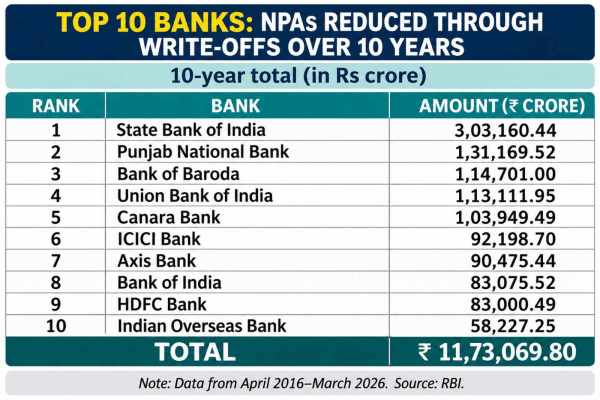 The top 10 banks alone wrote off Rs 11.73 lakh crore during the 10-year period, according to the RBI data.
Public sector banks accounted for nearly 63% of the overall write-off exercise, according to the information provided. The concentration of such large sums in a relatively small group of lenders raises uncomfortable questions about lending decisions, risk assessment, accountability and the consequences faced by borrowers who default on substantial loans.
Story continues below this ad
The annual data shows the extent of the exercise. Banks wrote off Rs 1.08 lakh crore in 2016-17, Rs 1.62 lakh crore in 2017-18 and Rs 2.39 lakh crore in 2018-19. The figure remained high at Rs 2.34 lakh crore in 2019-20 and Rs 2.03 lakh crore in 2020-21. In 2025-26, the total across all scheduled commercial banks stood at Rs 1.44 lakh crore, compared with Rs 1.57 lakh crore in 2024-25.
The distinction is crucial: a fall in annual write-offs does not, by itself, indicate improved recovery or a proportionate reduction in fresh defaults. “Technical write-offs by Indian banks are inequitable and should be stopped… Small loans are rarely written off, most of them are big loans,” said a former RBI Deputy Governor.
A loan becomes an NPA when repayment of principal or interest remains overdue for 90 days. Once the account is classified as an NPA, banks must make provisions against potential losses. As provisions accumulate and the likelihood of recovery diminishes, lenders may write off the outstanding amount in accordance with their policies.
Banks had recovered only around 13-15% of loans written off over the preceding five years, amounting to Rs 1.32 lakh crore. In July 2023, recoveries from written-off loans stood at Rs 30,104 crore in 2020-21, Rs 33,534 crore in 2021-22 and Rs 45,548 crore in 2022-23. These figures underline why recovery performance, rather than the accounting treatment alone, must be central to any assessment of the write-off exercise.
Story continues below this ad
What are write-offs?
Write-offs by banks are purely an accounting entry where an on-balance-sheet item moves into off-balance-sheet items and is parked in what is known as ‘Advances Under Collection’.
Specialised teams follow up for recovery thereafter. The borrower’s liability to repay or the bank’s right to recover is not diminished in any manner. This is purely a balance-sheet management exercise.
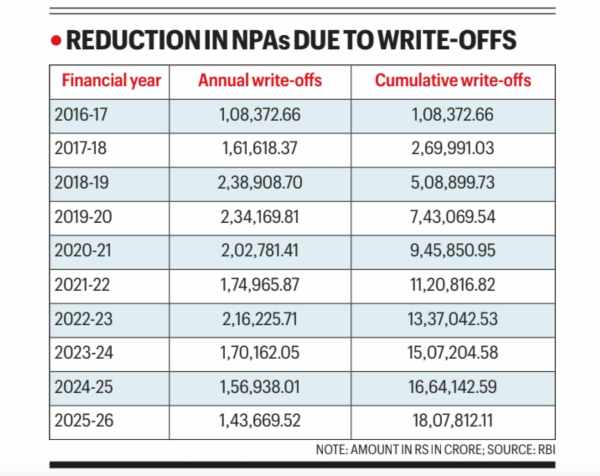 Banks wrote off Rs 1.08 lakh crore in 2016-17, Rs 1.62 lakh crore in 2017-18 and Rs 2.39 lakh crore in 2018-19.
A write-off does not automatically extinguish the borrower’s liability. Banks are expected to continue recovery proceedings, including through legal channels and other mechanisms available to them. The central bank has described technical write-offs as an accounting exercise intended to clean up balance sheets and improve tax efficiency.
One of the most troubling aspects of the exercise is the absence of publicly available borrower-wise details in the information cited. While the cumulative figures establish the enormous scale of write-offs, they do not identify the individual borrowers whose unpaid loans account for the amounts involved.
KioskNews shows a cleaned-up reading view extracted from the publisher’s page — the original always lives on their site, not ours.