Pat Cummins can end sandpaper saga with full disclosure of what players knew – not what they didn’t | Geoff Lemon

In March 2018, Steve Smith was handed a shit sandwich by Cricket Australia. Smith had helped in its preparation, as captain of an Australia team whose ball tampering experiments on their tour of South Africa had got out of control, but it was always questionable that CA limited the blame to Smith, David Warner and Cameron Bancroft. Usman Khawaja’s recent revelations have added context that Smith adamantly took the fall to spare others. It is not in truth good leadership to perpetuate a lie, but Smith would reasonably have believed that his first job was to protect his men. Sometimes, you just have to tuck in.
Eight-and-a-half years later, current Test captain Pat Cummins has been handed a shit sandwich of his own. This one is in the form of Khawaja’s book, detailing the 2018 team’s widespread acceptance of ball tampering. Khawaja got to enjoy his full playing career before this reveal, which has denied the same luxury to active players Cummins, Smith, Mitchell Marsh, Mitchell Starc, Josh Hazlewood and Nathan Lyon. That doesn’t make Khawaja’s actions wrong. It’s a miracle the stitched-up version of events lasted this long. From day one, nobody involved had the courage to simply speak the whole truth. That’s the sole reason this saga continues.
Cummins wasn’t a major player in the 2018 drama: the junior corner of the bowling quartet, recently back from six years of injury. But as the leader now, he has to lead. He has a technique as captain to brush off unwelcome questions: a broad smile and a shake of the head, a few words of non-engagement with the premise, stifling the query before it draws breath. He used this on Australia’s recent return to South Africa, asked whether their previous visit held untold secrets. “It’s obviously a long time ago. All the investigations, everything was done back then. Answered every question a million times … all I can say is as a group we’ve moved on.”
Players moving on is irrelevant, not when they retain a duty to a public with a justified interest in the behaviour of their national team. Not when Khawaja asserts that getting reverse swing by any means was a team-wide policy driven from the coaches down, and that sandpaper featured openly in experiments and conversations in the dressing rooms of at least two Tests. Warner quickly backed Khawaja’s version, as has one of the tour’s bowlers in Chadd Sayers, while an as-yet unnamed squad member made similar confirmations to Cricinfo. That makes four.
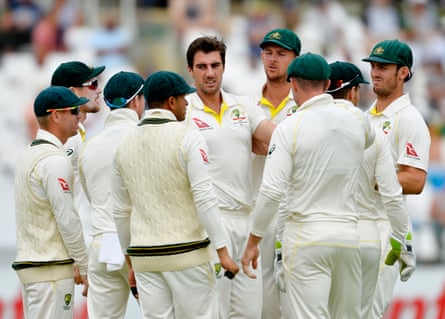
Another quartet, the bowling four of Cummins, Starc, Hazlewood and Lyon, are drawing focus given their 2021 statement denying knowledge of the rumbled plan to sandpaper the ball in Cape Town. This week Starc reiterated his denial about the third Test, while under further questioning added a denial about sandpaper knowledge in the second.
Perhaps all of this is an interpretation issue, where information is congruent but appears contradictory. From the Khawaja or Warner lens, tampering was for the team’s gain, and everyone knew that some form of it happened, thus it was a team act. Other players by contrast might believe that a background awareness of shenanigans, or some overheard hyperbole in the rooms, does not make them complicit in a specific escalation, especially not such a blatant and clownish one as mid-session whipping out a bright yellow carpentry aid. Even a team with a formalised tampering policy wouldn’t require 15 players to sit in a lunchtime circle and get collectively granular. Players who didn’t tick off that colossally stupid call would have some claim to leave blame to those who did. There is room for both realities to be true enough, animated by the vested interests of those who believe them.
But if it is a perspective clash, the players denying involvement need to explain theirs. What they didn’t know is no longer relevant; what they did know is. What did they think was happening in their team? If they didn’t hear conversations about sandpaper, what conversations do they remember? Did meetings feature coaches exhorting them to get the ball swinging, and what did they understand this to mean? How did they think teammates carried out those directions? When the ball reversed all day in Port Elizabeth, with even Marsh bending it, what did they think was happening? What questions did they ask, or choose not to ask? Could they have been unaware of its condition? Or unaware of how its condition came about? Was this lack of awareness cultivated or incidental?
Not many people believe their denials anyway, and without detail, none will. Acknowledging the broader presence of ball tampering in that era might improve that. More fudging will not. It has been the source of all of this trouble since day one, when Smith and Bancroft lied in their press conference about using bat tape rather than sandpaper, a fruitless attempt to deflate the seriousness by a whisker. CA cited this lie as a factor in their punishment while following the same impulse to minimise, fixing the formal investigation’s scope so its findings would implicate only three players during one match, and avoid looking at everything else.
after newsletter promotion
Now, despite full turnover at the top since that sham, CA carries on backing their old review, dead-batting the need to finally get things in the open. “I don’t think there’s anything that can be gained from it,” said CEO Todd Greenberg while living the counterfactual, inhabiting a world that could have been better for all involved. He cites conflicting accounts as a reason that scrutiny is pointless, rather than an essential way to let the public make up their own minds.
Since the beginning, nobody in this story has spoken plainly. A land of abstraction, obfuscation, passive tense. The team’s coach at the time, Darren Lehmann, on ABC Radio last week: so many words, so little said. Starc this week: “we weren’t aware of things being taken on the field, that’s where I’ll leave it,” also leaving vacant fields for conjecture about what he was aware of. There is Warner on Khawaja’s account: “It’s 100% accurate,” without ever naming what “it” is. Khawaja himself started strong with “It was all of us,” then became tongue-tied when asked to specify who that implicates. Everyone is staring in the mirror, clutching a candle, afraid of who will appear if they speak a name.
This is why Cummins has to do it, once and for good. Ball tampering is not high on the ranking of mortal sins. Refusing to confront this shabby episode is the only reason it still has such ferocious life. The Australian captain can put an end to that with full disclosure, whatever that looks like, about the former team environment and how its members made the choices they made. Life won’t be fun for a few weeks. Motives will be dissected and insults levied, as Khawaja knows. But there is no more need for bans or punishment. That stuff is done. There is just a need for transparency, for the willingness to suffer through an unpleasant experience in order to take everyone somewhere better. That’s what leaders are supposed to do. Tuck in.
KioskNews shows a cleaned-up reading view extracted from the publisher’s page — the original always lives on their site, not ours.