What my father Bruce taught me, and why I’ll always stare at fish
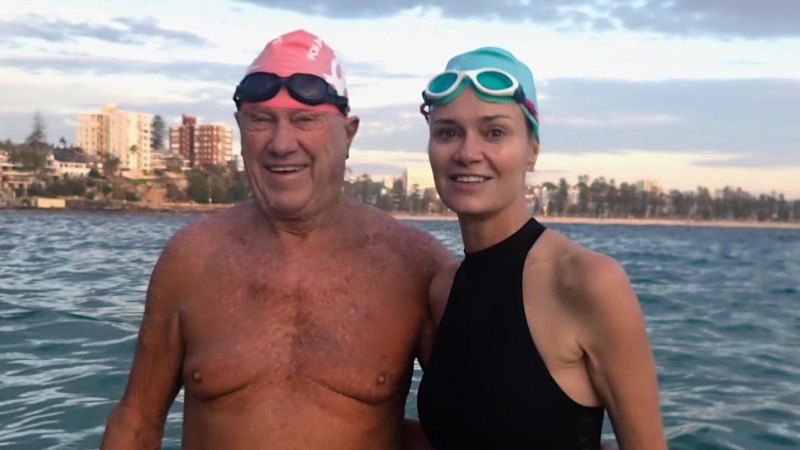
Last week I returned to the University of Sydney to accept an honorary doctorate. It was wonderful to be back at a place that shaped my life and the lives of my family; where I’d spent the best part of a decade studying arts, and some law, and then diving into history to write a PhD that took a ridiculously long time and caused clumps of my hair to fall out. History, like careers, like human lives, never operates in a straight line. It gets knocked out of shape by events, like all of us, like the human heart.
On that day my heart was particularly dented because that place was also where my father, alongside my mother, studied arts in the ’60s. He went on to live a big life of public service, humanity and adventure. He died suddenly, before I was due to speak at the university, and I thought about not going. But I was there because he would have wanted me there, along with my family – mainly because he loved attention and fancy hats and would have been horrified at the prospect of my forgoing either on his account.
Dad always said Mum was the great scholar, not him. Which may be fair. But he was a great human. And he paid attention, especially to the things that aren’t written down, that aren’t on the syllabus.
He paid attention to people, and to the ocean.
He taught me to push forward in the surf, to enter the ocean every day no matter your mood or workload, no matter the colour of the skies, the size of the waves (within reason), to dive in and just try, to give it a crack.
When you find people who believe in you, don’t take them for granted. Keep them by your side.
I’ve worked most of my life as a journalist but history is the first great love of my life. History has sneaked me into the best places, like a friend who knows the bouncer (hang on to those people, too, by the way).
History has taken me to secret archives in Windsor Castle, diaries hidden in attics in Scotland, a job in New York, a fellowship in Boston, and a career in journalism.
Journalism and history are closely related; the former is the messy first draft of the latter. Neither of them is ever perfect. Both require constant revision, vigilance, revisitation. And both require attention. Most importantly, attention to detail. Accuracy is everything for journalists. And for historians, for whom the challenge is not just to notice and record what’s there but also what’s missing.
The key is observation. Intense, slow observation.
One of my favourite historians, David McCullough, has four words pinned above his computer in his writing shack in Martha’s Vineyard: “Look at the fish”. This comes from Louis Agassiz, the 19th-century Harvard naturalist, who would give every new student the same test. He’d pluck a smelly fish out of a jar and tell them to just look at it. Many stared at it for days. One of them wrote that after several days of despair he realised what he had not seen, and what was unique. Excitedly, he said to Agassiz, “It has paired organs, one on either side!”
“Great, that’s right, you’ve got it!” said the teacher.
“OK,” said the student, “what now?” Agassiz said: “Look at the fish.” Some spent months doing this.
The reason I love this story is because it underlines the power of true attention. Keep looking and you will see things others haven’t. Keep looking to ensure your eyes don’t deceive you. Don’t be freaked out if you notice something that others haven’t. This is where the study of history requires courage. And it’s even more important in an era of AI – a vaulting technology that is better and faster than any of us here at synthesising and charting every single thing that’s ever been noticed and recorded by humans. But noticing things that haven’t been noticed? Seeing gaps and wondering about them? That takes deep and meticulous human observation.
I felt all the apprehension you could possibly imagine when I decided to write a biography of Queen Victoria, even though she was one of the most examined women in history.
I kept staring at the fish. And I found absences, assumptions, mistakes others had made. I found a tiny scrawl in the margins of a diary of Victoria’s doctor that described a flirtation game where she and her handsome Scottish ghillie, a man she clearly loved, played hide and seek, alternately lifting his kilt then her skirt. The headline in the Scottish newspapers once I’d published my book was “Queen Victoria and servant ‘exposed’ themselves to each other”!
I saw – in Victoria’s handwriting – the secret instructions she gave her doctor for her burial. Her wish that a photograph of Albert and a lock of her own hair be placed in her right hand. And in her left, a photograph of John Brown and a lock of his hair – as well as his mother’s wedding ring, which he had given her. She then instructed her doctor to cover that hand in gauze to conceal it from her family.
As a researcher, finding details like this gives you full-body chills.
Find the things that give you chills – and don’t let go of them.
They do exist, outside the inertia of screens.
And don’t underestimate the joy of full immersion in another world, another life or century.
When I was writing the biography of Queen Victoria I went to her holiday house on the Isle of Wight. It was on my second trip, as I was walking through the yellow living room, slightly dusty from having seen Bruce Springsteen at a music festival the night before, that a guard whispered to me: “Have another look at that painting. Give it a really good look.” So, I stared and stared and stared at it – a portrait of three women lying on the grass under a parasol – and then suddenly I saw it: the outline of a man’s back under the skirt of the woman in the middle, and two extra shoes poking out.
The man was hidden and the woman had a particularly dreamy look on her face.
And this was the first painting Victoria gave Albert, which tells us a lot.
Attention is our greatest commodity now, one that tech platforms seek to suck from us daily.
Fight for yours. Hold it tight. It’s a great weapon.
Your attention is worth something. It’s worth everything, actually. Human attention is the building block of just about everything that is valuable in our shifting lives.
Without sustained and very particular human attention in a discipline that is not my own, for instance, I wouldn’t be here today. My surgeon – Associate Professor Dr Cherry Koh, a colorectal surgeon from the Royal Prince Alfred Hospital, has conducted three of four massive operations to remove cancer from my abdomen over the past 11 years. Think of the attention to detail she must possess.
My last surgery was 19 hours long. In this case I guess I was the fish. I marvel at her work and her skills.
So, on that visit to Sydney University last week, I had one piece of advice for the students to whom I spoke: pay attention. Know the value of that attention. Deploy it wisely. Notice each other, notice the world, notice the appetites, desires and blind spots of your own mind. Ask yourself constantly, who and what has my attention? Is it worth it? Is my attention going to places that reward the investment? Am I harvesting knowledge? Awe? Insight? Is it useful? Attention is the magical, quicksilver asset of our age.
But most of all – look at the fish, just as my dear Dad used to do.
This is an edited version of a speech given by Julia Baird at the University of Sydney.
Get a weekly wrap of views that will challenge, champion and inform your own. Sign up for our Opinion newsletter.
KioskNews shows a cleaned-up reading view extracted from the publisher’s page — the original always lives on their site, not ours.