Vietnam's top leader departs for 33rd APEC Economic Leaders' Week, bilateral engagements in China
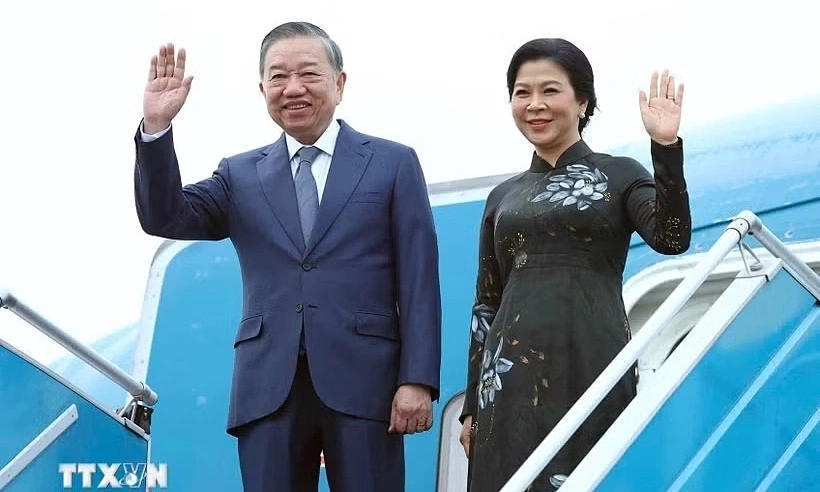
General Secretary of the Communist Party of Vietnam Central Committee and President To Lam and his spouse Ngo Phuong Ly leave Hanoi on Nov. 17, 2026. Photo by VNA
Vietnam's Party General Secretary and President To Lam, his spouse Ngo Phuong Ly and a high-ranking Vietnamese delegation left Hanoi on Tuesday for the 33rd Asia-Pacific Economic Cooperation (APEC) Economic Leaders' Week in Shenzhen and bilateral engagements in China from Nov. 17 to 20.
The working trip is made at the invitation of General Secretary of the Communist Party of China Central Committee and President of China Xi Jinping and his spouse.
The delegation includes Politburo Members and Secretaries of the Party Central Committee: Nguyen Duy Ngoc, Chairman of the Party Central Committee's Commission for Organization; Tran Sy Thanh, Chairman of the Party Central Committee's Commission for Inspection; Trinh Van Quyet, Chairman of the Party Central Committee's Commission for Publicity.
Other Politburo Members are Pham Gia Tuc, Standing Deputy Prime Minister and Chairman of the APEC 2027 National Committee; Gen. Luong Tam Quang, Minister of Public Security; and Le Hoai Trung, Minister of Foreign Affairs.The delegation also comprises Party Central Committee Members Nguyen Hai Ninh, Chief of the Party Central Committee Office; Ngo Van Tuan, Minister of Finance; Le Manh Hung, Minister of Industry and Trade; Tran Hong Minh, Minister of Construction; Lam Thi Phuong Thanh, Minister of Culture, Sports and Tourism; Vu Hai Quan, Minister of Science and Technology; and Hoang Minh Son, Minister of Education and Training.
To An Xo, Assistant to the Party General Secretary and President, and Head of the Party General Secretary's Office; and Pham Thanh Binh, Vietnamese Ambassador to China also join the delegation.
Established in 1989, APEC has cemented its role as the premier regional economic cooperation forum, pioneering trade and investment liberalization across the Asia-Pacific and globally. The organization remains a key driver of regional economic growth, peace, and stability.
Since joining the forum in 1998, Vietnam has consistently championed open regionalism alongside trade and investment liberalization. The country's major contributions include advancing the Busan Roadmap toward the Bogor Goals via the 2006 Hanoi Action Plan, driving the forum's post-2020 strategy, and hosting the establishment of the APEC Vision Group in Da Nang in 2017.
KioskNews shows a cleaned-up reading view extracted from the publisher’s page — the original always lives on their site, not ours.