Hong Kong’s planned renovation body may be liable for poor oversight: minister
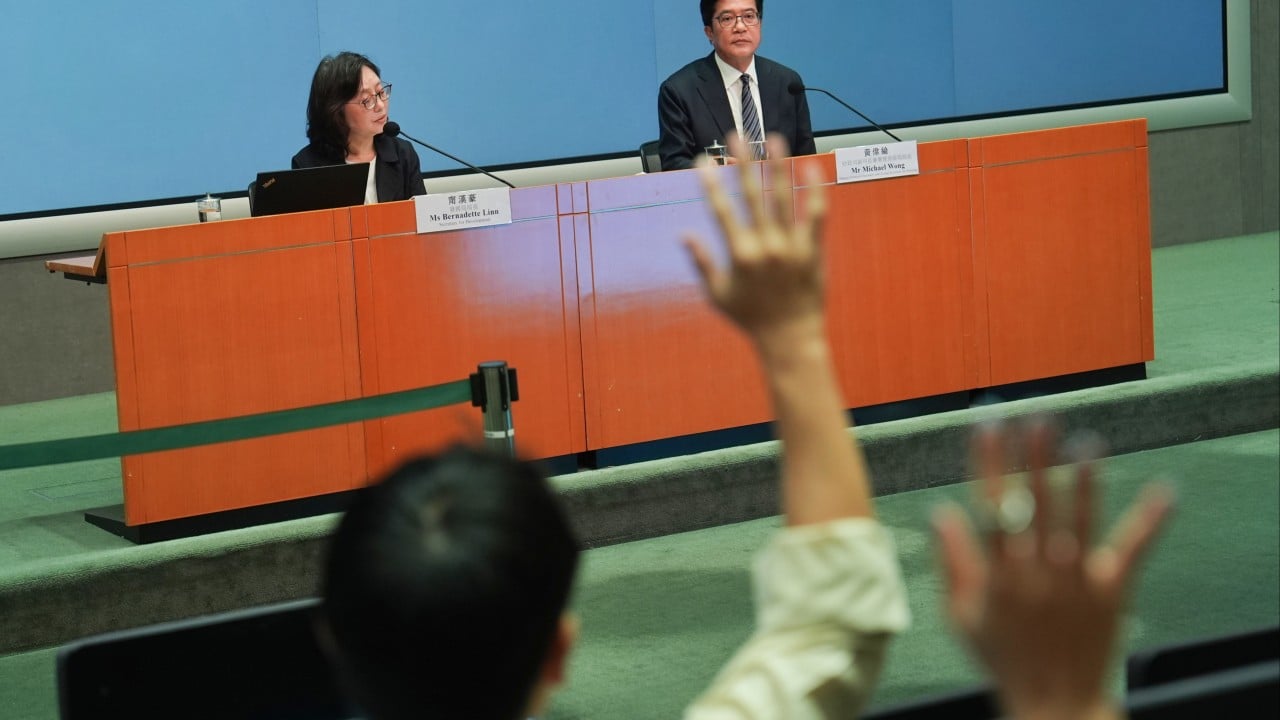
Hong Kong’s planned renovation monitoring body could be held liable for poor oversight when recommending and keeping tabs on consultants and contractors, Secretary for Development Bernadette Linn Hon-ho has warned, as officials detailed broader reforms to curb malpractice during major building repairs.
Deputy Financial Secretary Michael Wong Wai-lun on Friday also gave assurances that a new department overseeing major renovation projects would adopt a fresh approach and provide training, despite being staffed by personnel from the Housing Bureau’s Independent Checking Unit (ICU) – the agency with the biggest responsibility for the city’s deadliest fire in Tai Po.
The officials’ remarks followed a second public apology from the ministers implicated in the inferno, with authorities vowing to have enforcement agencies sit in “high-risk” owners committee meetings and criminalise bid-rigging by next April.
Wong said he hoped a raft of reforms proposed by the government could help build a healthy environment for effective building renovations.
“Previously, our system relied on trust in the professionals … Today, we have found a group of black sheep among the professionals from the incidents. We need to adjust and strike a balance,” he said.
“In the future, we will leverage the professionals’ technical skills and knowledge, but we need robust regulation.”
As part of an overhaul, the government proposed setting up a body, known as the Building Maintenance Support and Services Council, to recommend qualified professionals and contractors. Buildings Department will also supervise some procedures.
Under the operation, the council will assign inspection consultants to owners and monitor the inspection process. The department will conduct surprise checks and review the inspection report submitted by the consultant. The report has to be approved by the department.
The council will recommend up to three contenders for each supervision consultant and contractor tender exercise, and handle declarations of interest from professionals, companies and the management committees of the owners’ corporations.
Owners must appoint consultants and contractors from the three recommendations to receive government subsidies for renovation works.
Currently, building maintenance projects enjoy a simplified approval process. But under the new regime, professionals must submit detailed documents, including building plans and a supervision proposal, to apply for a maintenance work permit.
During renovations, the council will request regular progress reports from the supervision consultant and provide independent advice to owners if the renovation requires higher costs or the work scope changes significantly.
The supervision consultant has to submit a report to the department every six months, while the department will inspect sites with major maintenance at least once every six months.
The department will also conduct random checks on the project completion reports.

But development chief Linn noted the council’s services would not be free as homeowners had the “primary responsibility” for building maintenance. She estimated that the renovation would cost several thousand Hong Kong dollars for each household, up from a few hundred.
Asked if the council would be held accountable in case issues arise, Linn said it was not a straightforward answer, as violation of the contractual provision would be dealt with between owners, professionals and contractors.
But she said the council could be liable, given its role in overseeing the performance of consultants and contractors.
“In case the council is being lax in its monitoring duty, the council will have a role and liability,” she said.
The council would have civil liabilities under the service contract if it overlooked crucial matters when recommending certain consultants or contractors, she explained.
While the council will be a company owned by the government, rather than a statutory body, Linn said its staff would still be penalised in case of misconduct, such as dismissal.
Authorities also planned to increase penalties for professionals. For instance, the offence of carrying out inspections or works that cause injury or damage will be increased from a HK$1 million (US$127,450) fine and three years’ imprisonment to HK$10 million and five years behind bars.
Wong, who also serves as the acting housing minister, detailed how the ICU would be replaced with the Public Housing Building Control Section next month, with the ICU’s roughly 300 staff being transferred to the section.
Questioned if the restructuring would just be a “cosmetic reform”, Wong brushes aside concerns.
According to Wong, the control section will operate based on work projects, rather than the current regulatory teams, to handle major maintenance works at individual estates.
He said it would also step up communication with the Buildings Department, which oversees works at private properties, from once a year to at least once a quarter, adding that staff training would be provided to increase their awareness.
“We think these changes will help improve our future services significantly,” he said.
Vincent Ho Kui-yip, chairman of the Hong Kong Institute of Surveyors’ Task Force on Building Repair, Maintenance, Alteration and Addition, said the council should have an internal mechanism to monitor staff performance to ease public concerns.
He added that the council would also collaborate with enforcement agencies to vet contractors and consultants before allowing them to join tenders.
Ho believed that the mechanism would at least filter out most bad actors and monitor industry players to prevent misconduct.
Ho is a candidate for the Election Committee Subsector Ordinary Elections 2026. A full list of candidates can be viewed here.
KioskNews shows a cleaned-up reading view extracted from the publisher’s page — the original always lives on their site, not ours.