After Trump: Vance, Rubio and the Democrats’ Road to 2028
Donald Trump's succession now turns on a difficult question: can his political movement survive without his name on the ballot? The Democratic victory in the November 3 midterms adds urgency to that debate. Vice President JD Vance and Secretary of State Marco Rubio offer different routes forward, while Democrats face their own contest over who can turn congressional gains into a return to the White House in 2028.
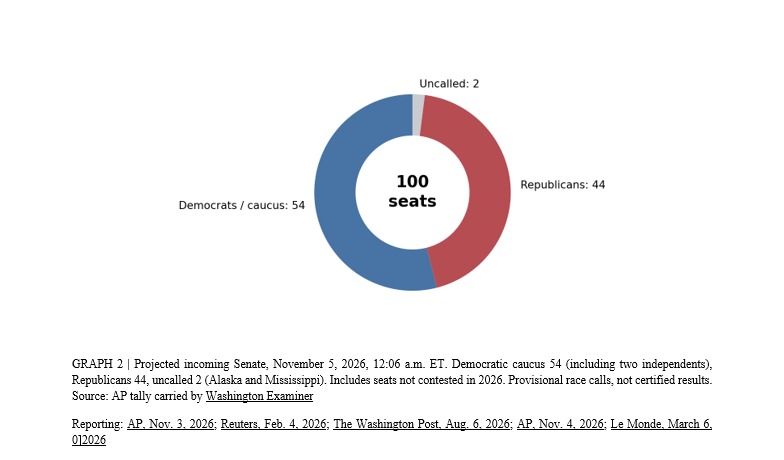
The Associated Press reports that Democrats won control of both chambers of Congress. Its Senate tally, carried by the Washington Examiner on November 5, put the Democratic caucus at 54 seats, Republicans at 44, with Alaska and Mississippi uncalled. Those are projections for the incoming Congress, including seats not contested this year, rather than a change in today's membership. A congressional majority creates opportunities to investigate the administration and constrain its agenda; it does not settle the next presidential election.
The 22nd Amendment bars anyone from being elected president more than twice. For Republicans, the succession therefore involves preserving Trump's coalition while finding a candidate able to broaden it. The vice presidency gives Vance visibility and proximity to the party's leader. Rubio brings experience from the Senate, his 2016 presidential campaign and his role directing American diplomacy.
Trump's signals favor Vance without establishing an irrevocable choice. The Washington Post's August 6 report described private encouragement for Vance, with Trump's choice unsettled. Reuters reported on February 4 that Trump declined publicly to choose between the two and praised a possible joint ticket. Private remarks, public flattery and a formal endorsement carry different political weight. Treating them as interchangeable would overstate how far the succession has advanced.
The ideological distinction is clearest in foreign policy. Vance's political identity draws on nationalist populism and skepticism about prolonged overseas commitments. Rubio's record places greater emphasis on confronting American adversaries and sustaining US influence abroad. Their service under the same president limits how neatly those traditions translate into opposing policies. Vance's anti-interventionist reputation, in particular, should not be confused with independence from the administration's decisions.
Nor does a single ranking of which man is more radical explain the choice. Vance's appeal rests on an assertive challenge to political and cultural elites; Rubio combines conservative politics with a more conventional diplomatic background. Both have accommodated themselves to Trump's leadership. The practical question is which combination of economic policy, immigration enforcement and international engagement can hold Republican voters together while recovering support beyond the party's core.
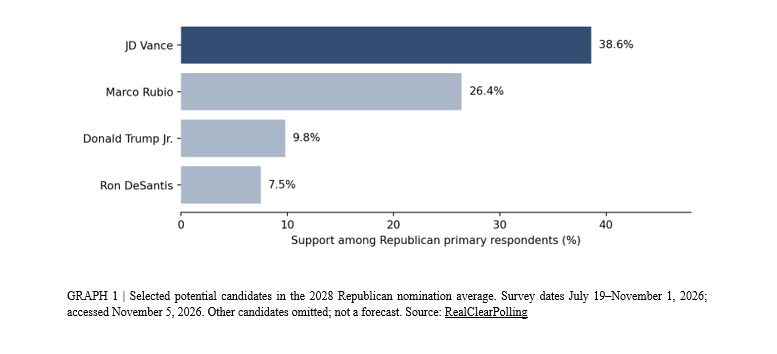
Early polling offers evidence of an advantage, not a nomination. RealClearPolling's average for surveys conducted July 19 – November 1, 2026, lists Vance at 38.6% and Rubio at 26.4%. Its table also includes an AtlasIntel poll showing Rubio ahead. Different questionnaires, candidate lists and respondent groups can produce divergent results. These figures concern hypothetical Republican nomination preferences, not a head-to-head general election or a forecast of who will become president.
For Democrats, congressional success supplies a platform but leaves the leadership argument open. Kamala Harris, Gavin Newsom and Pete Buttigieg are among the potential contenders discussed in current reporting. Their political strengths suggest different routes to recovery, rather than an agreed formula. The party must determine whether its gains reflect durable support for a governing program or a temporary coalition united chiefly by opposition to Trump.
Harris offers national recognition and relationships built during her vice presidency and 2024 campaign. Another run would also require persuading Democrats that she can overcome the weaknesses exposed by that defeat. Newsom offers executive experience in California and a confrontational approach to Trump, but would have to convince voters elsewhere that his state's record answers their concerns. Buttigieg brings experience as transportation secretary and a reputation for explaining policy, while facing the challenge of building a broader electoral coalition.
The competition extends beyond those three. Governors and progressive figures could challenge familiar national names, pressing Democrats over affordability, public services and the balance between institutional reform and electoral persuasion. A credible comeback requires an account of how government would improve daily life. Opposition to the president can mobilize voters, but presidential candidates must also earn confidence in their own judgment.
For both parties, 2028 will test the difference between inheriting an organization and winning a country. Trump's blessing could help determine the Republican nominee; it cannot guarantee victory. Democratic congressional gains strengthen the opposition's position, but choosing its next leader will require a separate argument about competence, priorities and the voters still to be won.
Ultimately, the question of who is more radical depends on the political dimension being examined. Vance represents a deeper ideological break with traditional Republicanism, embracing nationalist populism and challenging the party’s longstanding internationalist orientation. Rubio, by contrast, remains closer to the Republican establishment, although his historically more interventionist foreign policy reflects a willingness to pursue a confrontational approach abroad. Their differences illustrate two distinct directions for the post-Trump Republican Party: one centered on ideological transformation at home, the other on a more assertive projection of American power overseas. The real question is not simply who is more radical, but which vision will define the Republican Party after Trump.
KioskNews shows a cleaned-up reading view extracted from the publisher’s page — the original always lives on their site, not ours.