Why is Nvidia king of the AI chip hill, and how soon can rivals catch up?
SINGAPORE - Once known for primarily supplying the video game industry, US chipmaker Nvidia’s pivot to meet the unrelenting demands of artificial intelligence has made it indispensable to the global economy.
However, its dominance is now being tested following the resignation of its chief executive Jensen Huang, triggered by revelations of extramarital affairs, including with a businesswoman suspected by US intelligence of being a Chinese spy.
The affair has intensified scrutiny of Megaspeed where Alice Huang was a former executive. The American authorities have been looking into whether the Singapore-based company aided in bypassing US export controls, specifically examining if chips were being unlawfully rerouted or smuggled into China.
These developments in a post-Jensen Huang era may spell trouble for South-east Asia’s AI infrastructure build-out, with experts expecting data centre operators in the region to face stricter checks on purchases of advanced American chips.
The Straits Times examines Nvidia’s central role in the AI industry and other viable AI chip alternatives.
Q: What are Nvidia’s key products?
The firm is known for its high-performance compute chips, which power modern tasks such as AI chatbot assistants that can do deep research and code, autonomous vehicles, and delivery robots.
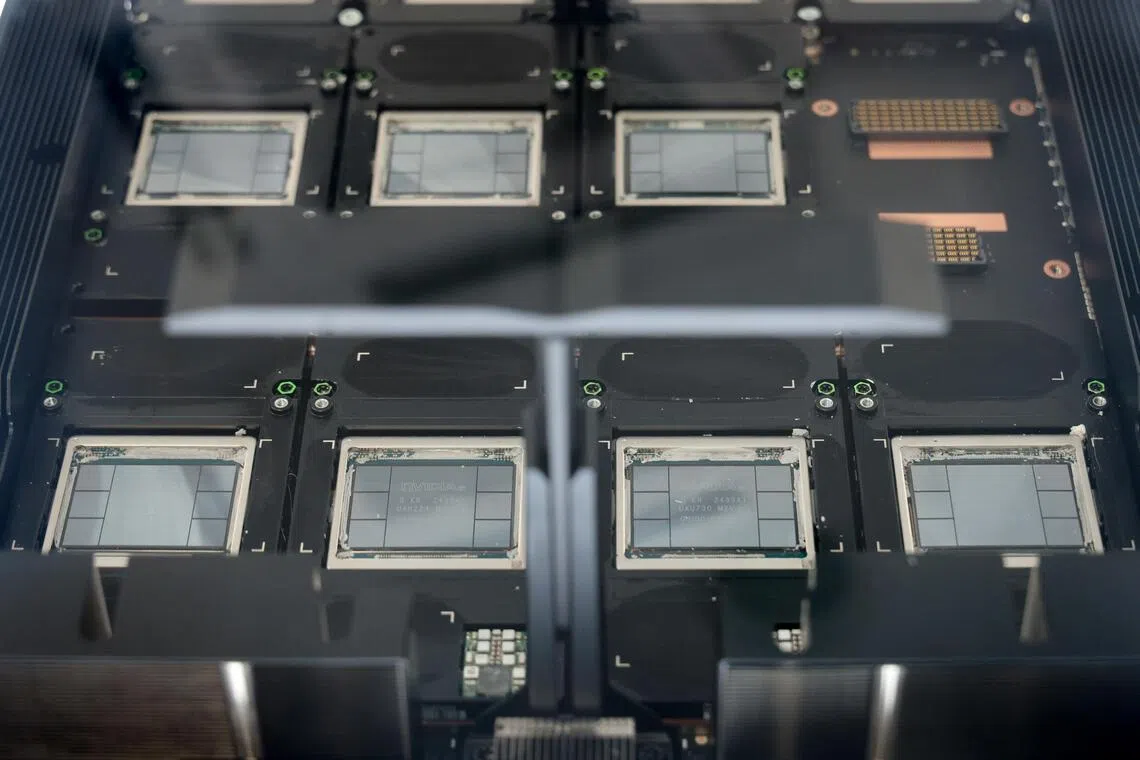
Nvidia is traditionally known for designing Graphics Processing Units (GPUs) that deliver optimal graphics for video games and multimedia design. The same technology has grown to become the bedrock of data centres, running massive amounts of calculations simultaneously to train and run AI models.
Among its most advanced chips are the Blackwell and Rubin GPUs, which the US authorities have banned from being exported to China, citing security concerns due to the potential for military use.
Earlier in September, the chipmaker set foot into the personal computer market with its new RTX Spark Superchip, allowing users to run large AI models and high-end games on laptops.
Q: How does Nvidia dominate the global market?
The firm dominates the global market for high-end chips in data centres for training AI models and inference work, with industry estimates putting its share at around 80 per cent.
In Singapore, Nvidia’s chips are used for AI training by companies such as telco Singtel, government agency HTX, and data centre operator Equinix.
Singapore’s national research supercomputer also has the country’s largest cluster of advanced GPUs from Nvidia, which allows it to have more computing power than 120,000 high-end AI laptops combined. This power helps more than 9,000 public researchers from universities, research institutes, and government agencies build complex AI models and shorten experimentation time.
Nvidia’s industry dominance stems from its comprehensive AI chipset portfolio that powers a wide range of applications, said Su Lian Jye, chief analyst for tech research firm Omdia.
These include data centres, high-end PCs, predictive medical machines, humanoid robots and self-driving cars.
Its popular proprietary CUDA platform, a toolkit of pre-written AI software, removes the need to code complex functions from scratch, said Su.
A firm that builds AI products on CUDA will have its entire codebase tied to Nvidia - making it a hassle to switch to hardware released by rivals even if they might be cheaper or faster.
More than 1,500 Nvidia H200 GPUs power the Aspire 2B, Singapore’s latest national research supercomputer, located within Nanyang Technological University.
ST PHOTO: JASON QUAH
The company’s support for the open-source community also democratises access to its software tools and services for AI engineers and users, building a large user base familiar with Nvidia’s tools and solutions.
Q: Who are Nvidia’s main competitors, and how do they compare?
For high performance data centre GPUs and consumer graphic cards, its key competitors include Advanced Micro Devices (AMD) and Intel.
Chinese chip suppliers such as Huawei Technologies and Cambricon Technologies primarily serve the Chinese market for AI chips, fueled by US export controls on advanced AI chips from rivals such as Nvidia.
Huawei is key to China’s push for self-sufficiency in critical tech, in the face of US export control restrictions. It is reportedly accelerating the debut of its next-generation chips in 2027 by several months, as part of its goal to compete on a global stage. The goal is for Huawei’s flagship Ascend 960DT chip to operate every single AI model in China and beyond, said a company official in September.
As part of the country’s push for self-reliance, Chinese AI lab DeepSeek is also planning to deploy at least 160,000 950DT chips at a data centre it is buliding in Inner Mongolia to operate its models. The two companies will also be working together to develop programming tools optimised for Huawei’s Ascend chips.
Huawei is reportedly also exploring foreign markets, such as Malaysia and Egypt.
Hyperscalers, or firms that rent out compute power and server space, such as Amazon Web Services, Google, and Microsoft have also developed their own in-house chipsets. These are often engineered to perform specific tasks, including AI training, in a cheap and energy-efficient manner.
Each competitor has sought to differentiate itself in its own way, by offering chips with better inference speed and bandwidth, larger memory, ultra-low latency, or better on-device performance, said Omdia’s Su.
Most recently in November, Google released its latest variants of tensor processing units, which help develop and run AI software. They work to allow models to access a wider range of information when tackling queries and encrypt sensitive data at a chip level, making it ideal for confidential work in regulated sectors such as finance and healthcare.
Q: What is the timeline for Nvidia’s competitors to catch up?
Any catch-up by Nvidia’s rivals will take years, and is more likely to result in partial market erosion than a full catch-up, said Galen Zeng, senior research manager at market intelligence firm IDC’s enterprise infrastructure global research domain.
He said that the first to challenge the dominance of Nvidia will be major cloud providers and hyperscalers like Amazon Web Services, Google, and Microsoft.
“Cloud providers’ custom chipsets hold advantages in cost and power efficiency,” said Zeng.
Most enterprises locked into Nvidia’s platform will prefer to stay put, as switching will require an overhaul of systems and processes.
Omdia’s Su said that countries such as China and Korea could make the switch quicker as they actively grow their own AI chipset industry. He added that the Middle East and South-east Asia regions could also make the switch quickly too, as they are wary of being too reliant on a single source, often choosing to adopt both GPU and non-GPU solutions.
“The rest of the world will still favour Nvidia,” said Su.
Q: What is the outlook for Nvidia after Jensen Huang’s resignation?
Analysts are optimistic that the firm’s strategies, commitment to customers, and operations will continue to be honoured.
“Nvidia’s board is unlikely to fix what is not broken,” said Su, adding that Jensen Huang’s resignation will help the company refocus on its daily operations, and ensure that deals and partnerships are executed as planned.
Capacity across manufacturing, advanced packaging and high-bandwidth memory is highly specialised and committed well in advance, said Chris Hampsen, senior vice-president of global supply chain consultancy Proxima.
“I’d expect continuity rather than disruption,” said Hampsen. "Innovation is the work of large engineering teams, software ecosystem, and long-standing supplier partnerships, and those still remain in place despite leadership transitions.”
Omdia’s Su expects Nvidia to continue to fight for democratised access to GPUs for all and support the open-source community. He added that the US administration will ultimately decide on the availability of advanced models such as the H200.
KioskNews shows a cleaned-up reading view extracted from the publisher’s page — the original always lives on their site, not ours.