Supply disruptions bite as factory activity grows
Reuters, LONDON and TOKYO


Global manufacturing activity remained solid last month, but factories are increasingly showing strain from rising energy costs while supply-chain disruptions squeezed margins, surveys showed yesterday.
The data point to growing pain for export-led economies as prolonged conflict in the Middle East keeps fuel and food prices high, hitting consumption and business confidence.
S&P Global’s eurozone manufacturing purchasing managers’ index (PMI) eased to 52.7 from 52.9 in September — which was the highest reading since May 2022 — but was above a preliminary estimate of 52.4. Readings above 50.0 indicate growth in activity.
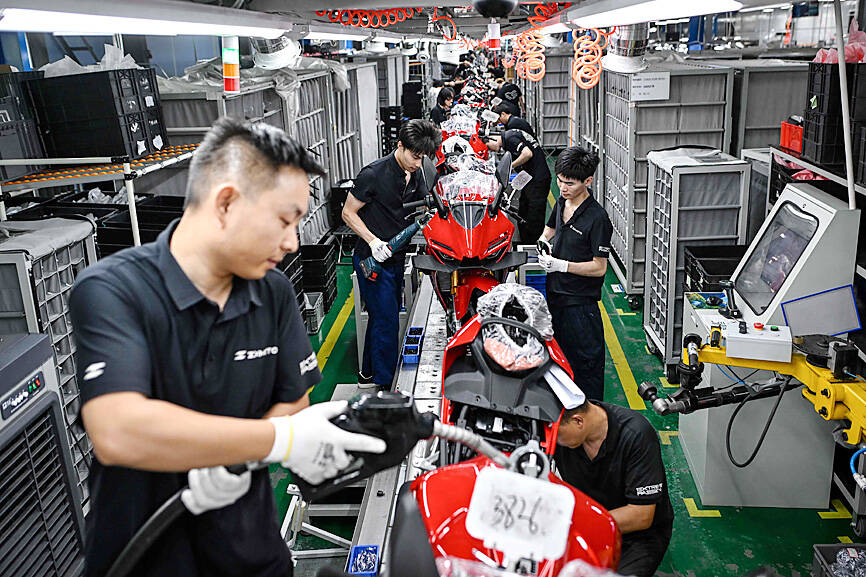
Workers assemble motorcycles at the ZXMoto factory in Chongqing, southwestern China, on July 20. ZXMoto was founded just two years ago, but already rivals leading manufacturers such as Europe’s Ducati and Japanese giants Yamaha and Honda with a bike retailing for a fraction of their prices.
Photo: AFP
This suggests manufacturers are holding up despite tariffs, conflicts and surging energy costs, but rising input prices add to pressure on the European Central Bank to raise interest rates again.
“October’s final manufacturing PMIs confirmed the resilience of the eurozone’s industrial sector,” Oxford Economics lead economist Leo Barincou said. “Meanwhile, price pressures continue to intensify as robust demand meets constrained supply, with eurozone input prices rising at their fastest pace since May and output prices also increasing rapidly, reinforcing our view inflationary pressures will remain elevated over the coming months.”
Germany’s manufacturing industry expanded solidly last month but France’s slipped back into contraction. British manufacturers started the final quarter of this year with the strongest output growth in more than two years, S&P Global said.
Factory activity across Asia continued to expand last month but growth slowed in China, Japan, South Korea and Taiwan, S&P Global surveys showed, indicating the drag from the US-Israeli war with Iran might be offsetting robust global demand for chips and artificial intelligence (AI)-related goods.
“Strong chip and AI demand had masked soft spots in Asian and global economies. But that’s becoming hard to sustain with the Middle East war dragging on for so long, pushing up fuel and food prices,” Dai-ichi Life Research Institute chief emerging market economist Toru Nishihama said.
“High inflation is hurting Asian consumption. Intensifying price competition from China is also weighing on rival exporters like Japan and South Korea,” he said.
China’s PMI stood at 52.0, just below September’s 52.1, and Japan’s PMI also eased, marking the slowest expansion in seven months as output and new orders lost momentum, while South Korean factory activity grew at the slowest pace in eight months on weaker output and demand.
Taiwan’s PMI continued to show solid growth in activity, albeit slowing down from the previous month; India’s manufacturing growth slowed as domestic demand and hiring weakened, although a surge in export orders helped cushion the blow, S&P Global said.
KioskNews shows a cleaned-up reading view extracted from the publisher’s page — the original always lives on their site, not ours.