Is IMAX 3D a better experience than 2D? Here's what to know


Nyul/Getty Images
I have seen movies in both IMAX 2D and IMAX 3D, and I still wouldn't say that 3D is the automatic upgrade. When a movie gives all that added depth something to do, it can be much more immersive. I felt that again when I recently watched Spider-Man: Brand New Day in IMAX 3D. The extra depth was appropriate for a film that was all about speed, height, and objects constantly whizzing through the frame. But I also found the image to be darker.
This time, there was another adjustment to deal with. I recently began wearing prescription glasses, which meant I had to put the IMAX 3D pair on top of them. It worked, but there was a learning curve, and it's hard to forget that you're wearing one pair of glasses on top of another for a couple of hours. None of that spoiled the experience for me, but it did confirm a rule I've been slowly working up to: 3D has to earn the glasses.
There is one simple distinction to clear up first. IMAX and 3D aren't rival formats. An IMAX screening can be either 2D or 3D, while RealD and other systems can deliver 3D in conventional auditoriums. Choosing IMAX 2D can still get you the enormous screen, fantastic sound, and, depending on the movie and theater, an expanded aspect ratio.
What IMAX 3D really brings
Bestravelvideo/Shutterstock
The basic trick behind theatrical 3D is simple. Two slightly different images of the same scene are shown, one for each eye, and the glasses prevent the images from mixing so that your brain can fuse them into a picture that has a sense of depth.
On an IMAX screen, that added depth can be especially effective. The best 3D doesn't shoot objects at your forehead all day long. Rather, it can provide a sense of distance between the foreground objects, characters, and whatever lies beyond them. And when combined with a frame that already takes up a lot of your view, an otherwise normal shot can feel like a space you're looking into, not an image in front of you. That's the aspect of IMAX 3D that I really appreciate. Plus, Spider-Man swinging between skyscrapers makes a good sales pitch for depth.
How good that effect looks also depends on the theater, especially because not all IMAX laser installations are the same. The company's GT Laser system is based on dual projectors, whereas CoLa and XT installations are based on a single projector and are not as bright or sharp as GT Laser. That helps explain why one person's great IMAX 3D experience can sound like another person's blurry one.
The obvious alternative is RealD 3D, which employs the same basic concept of sending different images to each eye. It's not an exact parallel since IMAX is putting the 3D show in a bigger package with its projection systems, auditorium geometry and audio. RealD says its platform is installed on more than 22,000 screens in 72 countries.
Why I would still opt for IMAX 2D at times
DrPilulkin/Shutterstock
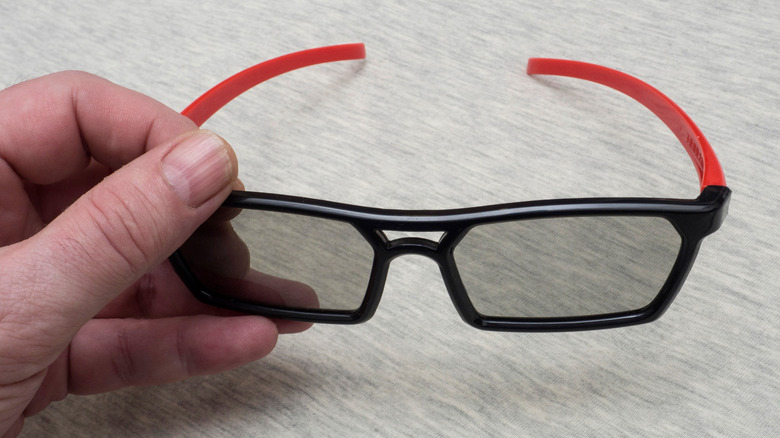
That brightness hit is hardly a new complaint. We were seeing the same tradeoff a decade ago, when our test found that IMAX's laser system could offset some of the brightness lost to 3D and its glasses with its higher light output. At the end of the day, brightness and stereo contrast are also important components of a good 3D presentation. Then there's comfort. IMAX's glasses were manageable over my prescription glasses, but "manageable" is not the kind of endorsement you're looking for when you pay extra for the premium screening. For some viewers, the issue goes beyond simply wearing two pairs of glasses.
In a study of 497 healthy adults, 54.8 percent reported some degree of simulator sickness after viewing a 3D movie, while 14.1 percent reported symptoms after viewing a 2D movie. Stereoscopic viewing discomfort has also been associated with vergence-accommodation conflict, where your eyes converge on the apparent depth of an image while remaining physically focused on the flat screen. The 2013 study did not focus on IMAX in particular, so those rates should not be read as IMAX-specific.
I would still pay for IMAX 3D for the right film, especially if it's known to make good use of depth and is being shown in a good laser auditorium. But when 3D is an afterthought, I'd prefer to take the brighter picture, lose the second pair of glasses, and retain all the other things I love about IMAX. And of course, price can be a deciding factor too. Premium-format charges depend on the theater and membership, but AMC A-List includes IMAX and RealD 3D screenings without an extra premium-format charge.
KioskNews shows a cleaned-up reading view extracted from the publisher’s page — the original always lives on their site, not ours.