Driven out of forests, 56 displaced elephants run into politics in Karnataka
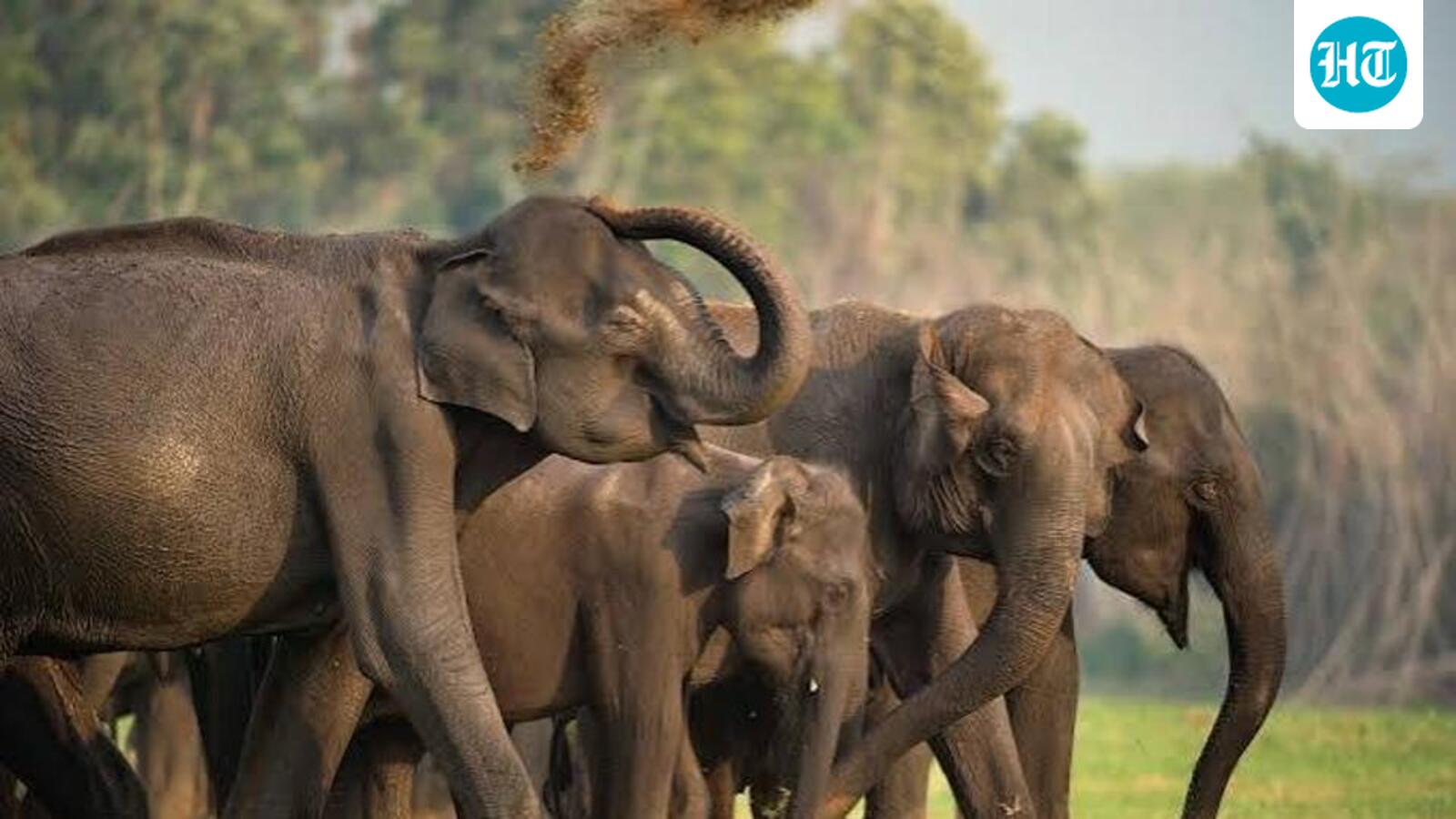
The movement of 56 elephants out of Hassan’s coffee estates in Karnataka has run into a political roadblock, with the forest department temporarily suspending the operation after protests by legislators and residents in neighbouring Chikkamagaluru.
The herd, meanwhile, has scattered across three districts, with 39 elephants in Mudigere, 13 back in Belur and four tuskers moving towards Kodagu as of November 26. For the elephants, finding a safe home is proving almost as difficult as escaping one: forests are fragmented by plantations, roads and fences, while the prospect of moving them elsewhere has run into resistance from communities worried about inheriting the conflict.
The operation, launched after two people were killed in elephant attacks in Belur, began on November 21, following the capture of two tuskers on November 18 and 19. One was shifted to the Mathigodu elephant camp in Nagarahole Tiger Reserve, while the other was released into the wild in Bandipur after being fitted with a radio collar. The forest department then began guiding the remaining 56 elephants from Belur towards the Bhadra forests.
Although the operation has been suspended, officials are continuing to monitor the herd and guide the elephants in Mudigere towards the Tatakola forest area, which adjoins reserve forests. Forest minister Ramalinga Reddy is scheduled to meet legislators from the affected districts on November 30 to discuss the issue.
The dispute has raised a difficult question: moving elephants away from one set of villages may simply shift the risk to another, particularly as the habitats and traditional routes connecting forests become increasingly fragmented.
Political resistance across districts
Hassan district in-charge minister K M Shivalinge Gowda has defended the operation, arguing that Belur has barely 100 acres of forest and cannot provide adequate habitat for the elephants.
However, Congress MLAs Nayana Motamma, T D Rajegowda and H D Thammaiah have opposed moving the herd towards Chikkamagaluru, which also faces frequent human-elephant conflict.
Motamma, who represents Mudigere, submitted her resignation to the Assembly speaker on November 23, protesting against the movement of elephants into her constituency without consulting local elected representatives. She withdrew it after chief minister D K Shivakumar and senior Congress leaders intervened, but continued to demand assurances on public safety.
“I have to answer the people who elected me. I am not answerable merely to the government. If we cannot protect the people who elected us, what is the purpose of holding public office?” she said.
Reddy, meanwhile, said elephants belonged in forests rather than coffee estates and cautioned legislators against politicising the issue.
“These elephants belong to the forest and not to the coffee estates. Do not indulge in politics,” he said.
Fences, roads and shrinking habitats
Research from the Hassan landscape helps explain why moving elephants from one area to another may offer only temporary relief.
A study published in August in the Journal of Wildlife Science, titled Navigating the coffee fields: elephants’ use of habitat mosaics and the impacts of barriers on their spatial use of villages in a fragmented landscape of South India, examined elephant movement across 466 villages spread over approximately 1,180 sq km between 2023 and 2025.
Researchers from the Nature Conservation Foundation mapped 277 solar-powered fences erected around coffee plantations between 2010 and 2025. Together, these fences stretched 382 km and covered approximately 32 sq km, nearly 5% of the study area.
Nearly 20% of the identified refuge habitat fragments shared a boundary with a solar fence, while another 30% had fences within 300 metres.
“The proximity of fences to habitat refugia limited elephants’ access to resources, pushing them into new areas,” the researchers found.
The study also identified the expansion of National Highway 75 from two lanes to four as a barrier to elephant movement. Elephant activity hotspots recorded on both sides of the highway in 2023 shifted predominantly to its northern side in 2024 and remained concentrated there in 2025. The researchers linked the shift to the highway expansion, completed in 2023.
They recommended protecting refuge habitats, redesigning fences to allow elephant movement, discouraging new fencing near natural forests and constructing highway overpasses or underpasses at critical crossing points.
Corridors exist, connectivity doesn’t
Karnataka has nine identified elephant corridors, but the Union government had reported securing only two through private land purchases, according to a Rajya Sabha reply in March 2023.
The state acquired 25.37 acres for the Edayahalli-Doddasampige corridor in 2017 and another 16.30 acres at Muddahalli for the Chamarajanagar-Talamalai corridor in 2021-22.
The Karnataka Economic Survey 2025-26 estimated the state’s elephant population at 6,395, based on the 2023 assessment. It also reported that the state had installed 428 km of railway barricades, 1,360.87 km of solar fencing and 1,775.41 km of elephant-proof trenches to reduce human-elephant conflict.
While these barriers can protect farms and settlements, their placement can also restrict elephants’ access to habitats and traditional movement routes.
Joseph Hoover, president of the United Conservation Movement and a former member of the Karnataka State Wildlife Board, said the conflict was being viewed too narrowly.
“We are blaming elephants for a crisis largely created by human intervention. Their habitats have been fragmented, food sources depleted and traditional corridors blocked. When elephants are forced out of forests into agricultural land, we cannot treat them as the problem. We have to address what drove them there,” he said.
“Capturing elephants and driving them back into forests will only provide temporary relief. Unless we restore habitats and protect corridors, we will continue to see more human deaths and more elephant deaths,” he added.
The human cost of conflict
For farmers in Hassan, the conflict has also meant repeated crop losses. Union government data show that the district recorded 4,285 cases of crop damage by elephants in 2022-23, for which ₹2.97 crore was paid in compensation.
The number of cases fell to 3,641 in 2023-24, but compensation rose to ₹4.07 crore. In 2024-25, the district recorded 3,015 cases, with ₹3.80 crore paid in compensation.
The same data recorded 24 human deaths in elephant attacks in Hassan between 2020-21 and 2024-25.
For the forest department, the immediate challenge is to manage the 56 elephants dispersed across Belur, Mudigere and towards Kodagu without exposing more communities to danger.
The November 30 meeting may resolve the immediate political dispute, but not the underlying conflict. Driven out of one landscape because of the threat they pose to people, the elephants face resistance in another. Shrinking habitats, plantations, roads and fences lie at the heart of the problem. Relocating the herd may shift the conflict, but will not address its causes.
KioskNews shows a cleaned-up reading view extracted from the publisher’s page — the original always lives on their site, not ours.