Friars turn to modern technology to repair 13th century basilica
Sergio Fusetti went as far as humanly possible after a pair of powerful earthquakes cratered part of the roof of the Basilica of Saint Francis of Assisi. Yet, almost three decades have passed, and Fusetti has been unable to figure out where more than 80,000 fragments of the 13th century church belong.
"This is impossible," he said in Italian. "Only artificial intelligence can help us here."
And that's exactly what's happening. A team of art historians and software engineers has joined forces with the Franciscan friars to try to finish the restoration — this time with the help of digital wizardry and AI.
Earthquakes and the Basilica of Saint Francis of Assisi
The Basilica of Saint Francis of Assisi, constructed in the hills of Umbria in central Italy, is the resting place of one of Christianity's most beloved saints. Francis, sometimes called the original hippie, rejected his family's wealth for a life of poverty. Medieval masters, including Cimabue, Pietro Lorenzetti, Simone Martini and Giotto, lined up at the basilica to paint beautiful scenes of Francis' life.
The basilica has endured more than 20 earthquakes in the years since it was constructed, according to Fusetti, who has worked to restore art at the church since the 1970s. Two of the quakes hit one after the other in 1997.
Four people were killed by falling rubble, and Fusetti was hospitalized with injuries he suffered during the second quake.
Friar Guiulio Cesareo, who was a student at the church at the time, is still scared of earthquakes. He remembers seeing a stone archway in the church shaking during the 1997 quakes.
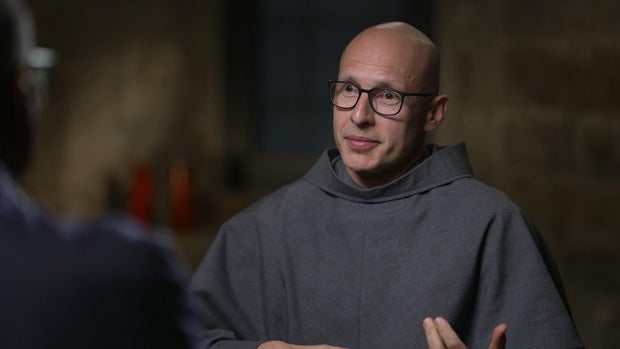
"I am always terrified," he said. "If I have the impression that there is something shaking, maybe it's just the wind, immediately I feel, you know, sort of cold coming from inside. The damage was a shock for the Italian country."
Using 21st century technology to restore a 13th century home
Restorers painstakingly repaired frescos and art treasures at the basilica. Yet some frescos are still pockmarked, some walls still bare.
Friars are now working with Haltadefinizione, a technology company specializing in ultra-high-definition photography. Chief Technology Officer Giovanni Borelli is leading the project to create a digital twin of the basilica. The camera he and his team use is no ordinary piece of equipment; it can capture details the human eye cannot.
"You can see all the smallest details of the work of art, the strokes of the painting, of the brush. You can see everything in great detail," he said.
Borelli's team is using cameras, drones and lasers to take hundreds of thousands of photos. They'll stitch them together to make the highest-resolution 3D blueprint of a building ever made.
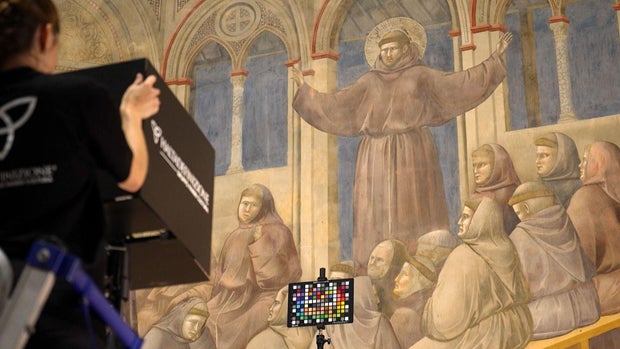
With it, restorers will have an exact reconstruction road map if the area is struck by an earthquake again.
The basilica's digital twin will be complete next year and will be available to the public.
Borelli's team of computer experts is also planning to use AI to fit together some of the missing pieces in the church and to tackle other problems.
"Like cracks in the paintings, discoloration — layers of paint, lifting. That kind of analysis done by hand and with the eyes of a physical person would require years to just do one round of the whole building," he said. "With AI, minutes."
Expanding access while preserving history
Borelli also wants to make the art more accessible. The technology he's using at the basilica has also been used to capture the remains of a thermal bath built by a Roman emperor. A laser scanner captured details of rooms with 30-foot ceilings and delicate mosaics. The cameras revealed hidden chambers and passageways that had been forgotten by history.
Virtual reality technology is also being used to allow users to step inside Italy's past.
"When I founded one of the companies that built this kind of technologies, I was a software engineer – pretty new to the art world," Borelli said. "The main question that I was focused on is a kind of philosophical one: How good can the digital representation of a physical object be? What is missing?"
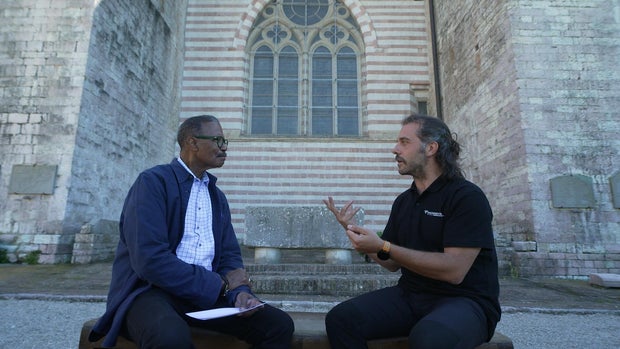
While Borelli acknowledges that virtual reality technology can't duplicate the emotional impact of standing in front of a piece of history or work of art, he sees it as a valuable tool.
"You can run, let your fantasy run wild," Borelli said.
Friar Cesareo sees all the technology as a tool toward a specific goal: sharing the "treasure of faith and beauty."
"Technology helps us to go farther away, to reach more people than we could before," he said. "And in a more efficient way."
In:
Friars turn to AI for restoration of the Basilica of Saint Francis | 60 Minutes
KioskNews shows a cleaned-up reading view extracted from the publisher’s page — the original always lives on their site, not ours.