Is 3D printing safe to do in your bedroom or home office?
Even PLA releases particles and gases. Here's what that means for your bedroom, desk and home-office setup.
Pressmaster/Shutterstock
A 3D printer can be placed on your bedside table. That does not mean that it is a good place to run one. Each print can take hours, and sitting next to the printer means breathing in air that may contain its emissions.
Even common PLA filament emits airborne particles and gases when heated. That means that overnight bedroom printing isn't a good idea, and a home office requires a bit more planning than a corner of the desk. When considering whether a 3D printer is worth buying, space is as important as what you want to print.
Even PLA isn't emission-free
Vedran Crnjac/Shutterstock
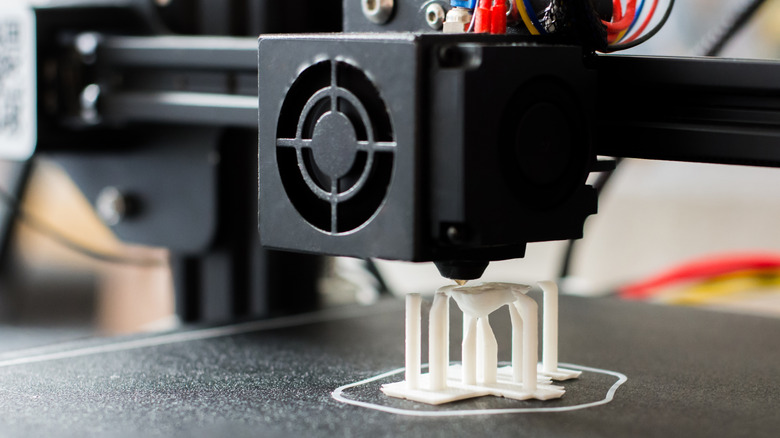
A printer can alter the air in a room without smoke being visible. According to the EPA, filament printers emit ultrafine particles that can reach deep into the respiratory system, as well as volatile organic compounds (VOCs). Some of those gases can be harmful when inhaled.
PLA is usually recommended as a safer option, and it can produce fewer particles than ABS. ABS was found to emit more particles than conventional PLA in a 2026 test of 17 commercial filaments, with emissions differing between brands. The picture can also change due to nozzle temperature and additives. While switching to PLA helps, it's not a get-out-of-jail-free card to spend all day by a running machine.
Human airway cells have also been exposed to emissions from PLA and ABS printers, and changes associated with inflammation and cellular stress have been observed. The tests were conducted in a laboratory, however. They did not determine what long-term exposure at home does to people, nor did they establish a safe level of exposure for a bedroom.
There are other issues with resin printers (those that use liquid resin instead of filament). The National Institute for Occupational Safety and Health (NIOSH) warns that uncured resin may lead to skin reactions or asthma. Additional exposure risks may occur during washing and curing of prints, particularly with the use of solvents.
Where should you actually put a 3D printer?
A separate room or workshop with ventilation that exhausts outdoors is better than a bedroom. A garage can be used as well, provided it's properly ventilated and humidity and temperature fluctuations won't ruin your prints. Keeping the machine away from your desk reduces the time spent right beside it, but distance alone doesn't replace ventilation.
For a home-office setup, an enclosure with exhaust ducted outside can capture emissions closer to the source, while an open window alone may draw in fresh air without reliably removing the particles and gases emitted by the printer. NIOSH suggests that emissions should be captured close to the printer and that time spent near it should be minimized while it's operating.
Filters have limits. HEPA filters are designed to capture particles, and activated carbon can filter some VOCs if there is sufficient carbon. Neither can make a poorly ventilated room automatically safe, and proper enclosures, ducting and replacement filters all increase costs.
For occasional printing, a local printing service might make more sense if there's no suitable place for a printer. NIOSH also recommends keeping printers away from flammable materials and having fire detection in printing areas.
KioskNews shows a cleaned-up reading view extracted from the publisher’s page — the original always lives on their site, not ours.