British ‘heirs of slavery’ group support reparations
Caribbean nations campaigning for slavery reparations have won support from an unexpected source — the descendants of some of Britain’s most prominent families to have benefited from the slave trade.
As prime ministers, courtiers and aristocrats, the Gladstone, Lascelles and Trevelyan families were at the heart of the governing elite down the decades.
They accumulated significant wealth from slavery through the ownership of plantations in the West Indies and South America.
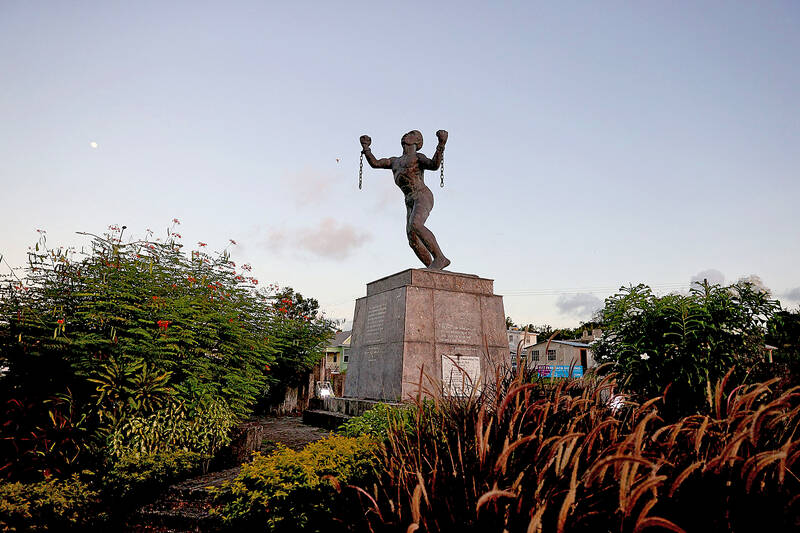
The Emancipation Statue in Bridgetown, Barbados, is pictured on Nov. 16, 2021.
Photo: Getty Images via AFP
Laura Trevelyan, a former BBC journalist, said she had been unaware of her family’s involvement until hearing about an archive listing compensation payments to plantation owners triggered by the British parliament’s abolition of slavery in 1833.
“I was clueless,” she said. “I looked at the database and saw this small island in the eastern Caribbean called Grenada that various members of the Trevelyan family had claimed compensation for the loss of what was termed their property.”
The revelation spurred Trevelyan, who made a public apology in Grenada in 2023, to cofound the Heirs of Slavery group which supports “reparative justice.”
With other members of her family, she has paid voluntary personal reparations of about £100,000 (US$133,744) earmarked for educational projects.
“Everybody I met, I asked them: ‘Should I apologize for what my ancestors did and do you think that I personally should pay reparations?’ and the answer came back a resounding ‘yes,’” she said.
Cofounder Charlie Gladstone, a direct descendant of reforming former British prime minister William Gladstone whose father John was one of the largest slave owners in the British West Indies, followed suit by making a public apology in Guyana in 2023.
Another group member is aristocrat David Lascelles, the Earl of Harewood, whose family has close links to the royal family.
A portrait of the actor David Harewood hangs at the family’s stately home, Harewood House in northern England, after it was discovered that his ancestors had worked on Lascelles family sugar plantations in Barbados.
The British government last month reiterated its rejection of calls for slavery reparations.
Modern British royals have expressed remorse, but like the government, have not issued an official apology.
The issue is likely to be raised during a Caribbean tour by King Charles III which begins tomorrow when he travels to the Bahamas, then Guyana, and Antigua and Barbuda where he is to address the Commonwealth Heads of Government meeting.
A Buckingham Palace spokesman said the king would acknowledge the “darkest days” of colonial rule and slavery during the trip.
Ahead of the visit, Guyanese President Irfaan Ali said his country would continue to champion the reparation issue “because slavery was the worst indignity to humankind.”
He called for a “mature” discussion on an apology and reparations, pointing to differing measures from debt relief, to finance for education and healthcare, and even climate adaptation.
The Reparations Commission of the Caribbean Community (CARICOM) has called for “monetary compensation” alongside debt cancelation and a full apology as part of its 10-point plan.
Meanwhile, the British Privy Council — the final court of appeal for UK overseas territories — is to next year hear a petition for slavery reparations filed by Jamaica.
The petition asks the court to rule on whether the capture, transport and enslavement of Africans in Jamaica was ever legal under English law, and whether the UK owes the people of Jamaica a “reparatory remedy.”
However, not all families who benefited from slavery have agreed with the Heirs group approach.
CARICOM Reparations Commission chairman Hilary Beckles has repeatedly spoken out about ex-Conservative Party lawmaker and UK landowner Richard Drax, 68, whose ancestors established Drax Hall Estate in Barbados in the mid-17th century.
Beckles has estimated up to 30,000 slaves died at Drax plantations in Barbados and Jamaica over 200 years.
Drax has remained staunchly opposed to reparations. He has said that while the role his ancestors played in the slave trade was “deeply, deeply regrettable... No-one can be held responsible today for what happened many hundreds of years ago.”
The Draxes are unique in that “they’re the only family that still owns a plantation that was set up in the beginning,” said Paul Lashmar, author of Drax of Drax Hall: How One British Family Got Rich (and Stayed Rich) from Sugar and Slavery.
However, he said it was increasingly difficult to see how Drax’s position could prevail.
“If you are very wealthy, and a lot of your wealth comes from those years, then it’s not something you can wash your hands of,” he said.
KioskNews shows a cleaned-up reading view extracted from the publisher’s page — the original always lives on their site, not ours.