650,000 flood-hit households still await relief funds
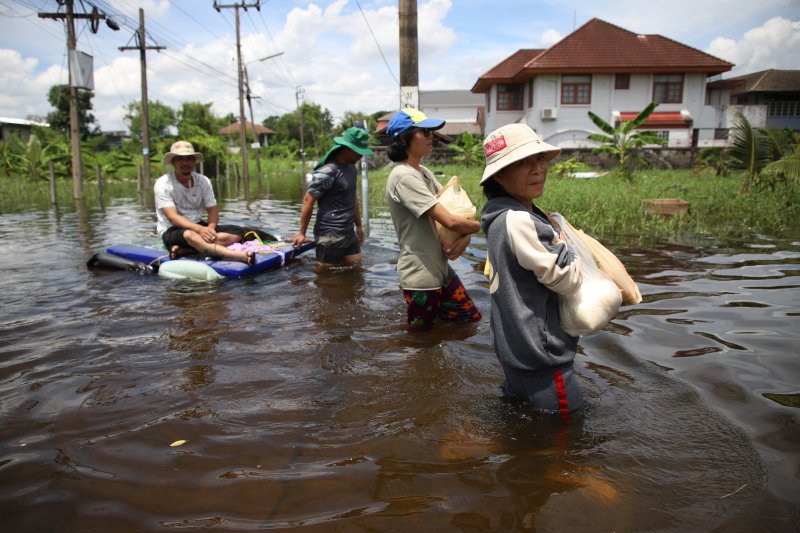
Two months after the floods, 25% relief applications are still waiting on compensation.
More than 650,000 households nationwide are still waiting for flood compensation, with applicants facing lengthy procedures, delays and uncertainty over when payments will arrive.
As of Nov 26, authorities had successfully transferred money to 1,887,124 of 2,537,683 applicant households or 74.4%.
Bangkok accounted for 43.4% of nationwide applications, with more than 1.1 million households seeking assistance. Of these applications, 342,349 had yet to receive succesful payments.
Five provinces such as Trang, Bueng Kan, Yasothon, Loei and Sakon Nakhon recorded no successful transfer despite receiving a combined 498 applications. Lop Buri and Phuket reported payment rates of just 10,6% and 20.1%, repectively.
The figures reflect the difficulties faced by flood victims navigating a compensation system involving multiple agencies, documentation requirements and damage assessments.
Onpriya Chawaburanaphithak, 23, who lives in Ramkhamhaeng, Bangkok, told the Bangkok Post on Nov 17 that she received 9,000 baht in initial relief after her home was inundated. Her sister submitted the application through the government's Tang Rat app on Oct 2 and the payment arrived on Oct 11.
However, a separate application through the Claim Bangkok system, submitted on Oct 4, for additional compensation of up to 45,000 baht remained pending.
Officials from the district's civil engineering department visited Onpriya’s home about two to three weeks after the application to assess the damage. Around five to six officials inspected the property, asking about floodwater levels and damage.
Ms Onpriya said she initially expected damaged furniture and electrical appliances, including a refrigerator and sofa, to be included in the assessment. However, officials indicated these items might not be covered, with the assessment focusing instead on physical damage to the house, such as swollen walls and damaged floor tiles.
Although her application status had changed to pending payment following the inspection, she said she had not been informed how much she would receive.
"The day I waded through the floodwater to get into my house was the most gruelling day of my life" she said.
She said she was concerned that once the water receded, she would no longer be able to prove that her house had been flooded, prompting her to find a way to enter the property while it was still flooding.
Asst Prof Kanrawee Wichaipa, a disaster relief specialist at Srinakharinwirot University’s Faculty of Social Sciences, told the Bangkok Post that requiring photos is a major flaw, as it forces victims to gather evidence during an active emergency. Other countries use broader methods to verify damage: the US relies on satellite imagery, aerial photos, and government flood data, while Japan sends officials to inspect heavily damaged properties instead of relying solely on resident photos.
Having already spent much of the initial 9,000 baht payment on necessities, Ms Onpriya said she was now relying on the additional compensation to cover the remaining damage.
"If I were to pay for all the repairs upfront, only to receive a reimbursement of just 10,000 baht or even less, it might not really be worth the cost of the repairs. In that case, it would probably make more sense to just wait until the floods happen again next year, and then carry out all the repairs at once. That way the repair costs might actually be worth it," she said, sarcastically.
Apasorn Prasongkit, 24, who lives in Lam Sam Kaeo in Pathum Thani province, said flood relief procedures differ significantly from those in Bangkok, despite her neighbourhood being only a road away from the capital.
"Bangkok had already dried up. If you crossed just one road into Bangkok, it was dry, but my side was still flooded. But I wasn't in Bangkok," she said.
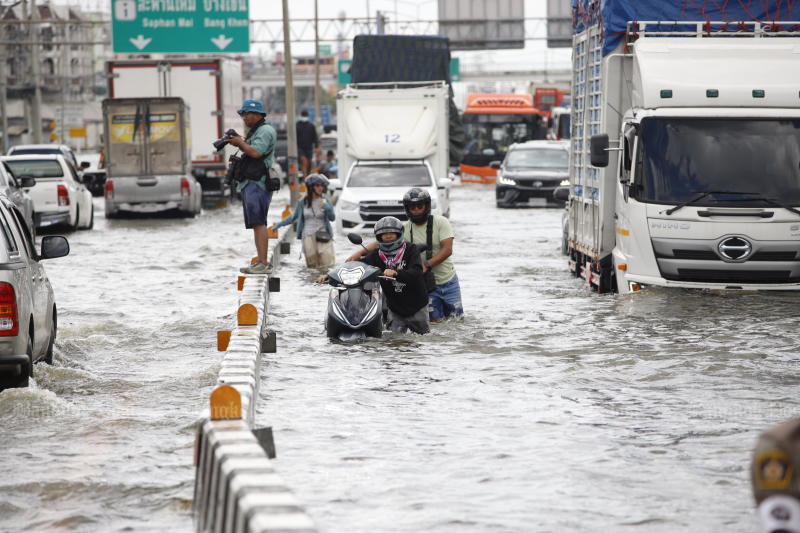
Motorists struggle to drive through an inundated road in Pathum Thani province on Sept 29, 2026. (Photo: Pattarapong Chatpattarasill)
Ms Apasorn said she initially submitted her application to the wrong local authority.
After being notified that the application was submitted to the wrong jurisdiction, she rushed to correct the documents and she prepared around 10 pages of paper work before going to the municipality, where hundreds of people were waiting in queues.
She knew that local officials were trying to assist residents, but she still questioned why applicants could not complete the process online and why information about application status was scattered across different platforms.
"If the process could be completed through the Tang Rat app alone, I think people would be less confused," she said.
Relief money is not compensation
Asst Prof Kanrawee said delays were not necessarily the result of individual officials' failures, but reflected weaknesses in how the system was designed. Particularly, its reliance on post-disaster evidence and requiring victims to prove they had suffered damage.
The 9,000-baht payment is intended as emergency relief rather than compensation for the full value of losses, she said. Under the government's regulations on emergency advances, assistance is intended to provide immediate support rather than restore damaged homes and belongings in full.
She said similar principles applied internationally, with the US Federal Emergency Management Agency (Fema) providing assistance for basic needs rather than acting as insurance, while Japan has a separate framework for livelihood recovery assistance.
However, the effectiveness of emergency relief depends heavily on how quickly it reaches victims.
"Around 9,000 baht in the first week can buy food, pay for transport and buy drinking water. But what can 9,000 baht do two months later?" Asst Prof Kanrawee questioned.
Why payments are delayed
The relief system is designed to prevent wrongful payments rather than prioritise getting money to victims quickly, Asst Prof Kanrawee pointed.
Applications must pass through several stages, including local authorities’ damage assessment, submissions to the Department of Disaster Prevention and Mitigation (DDPM), cabinet budget approval and transfers through state banks. Each stage can become a bottleneck.
She identified five keys factors behind the delays, including the floods occurring at the end of fiscal year, exhausted initial relief funding, and a much higher number of applications than the original budget could allocate. The extensive verification process also slowed payments, as officials sought to avoid mistakes that could expose them to accountability.
Fragmented information systems across government agencies further complicated applications, leading to confusion and duplicate submissions, while incorrect recipient payment details caused some transfers to fail.
She warned that delays could also lead to more stringent scrutiny, potentially excluding vulnerable people whose documents or evidence were incomplete.
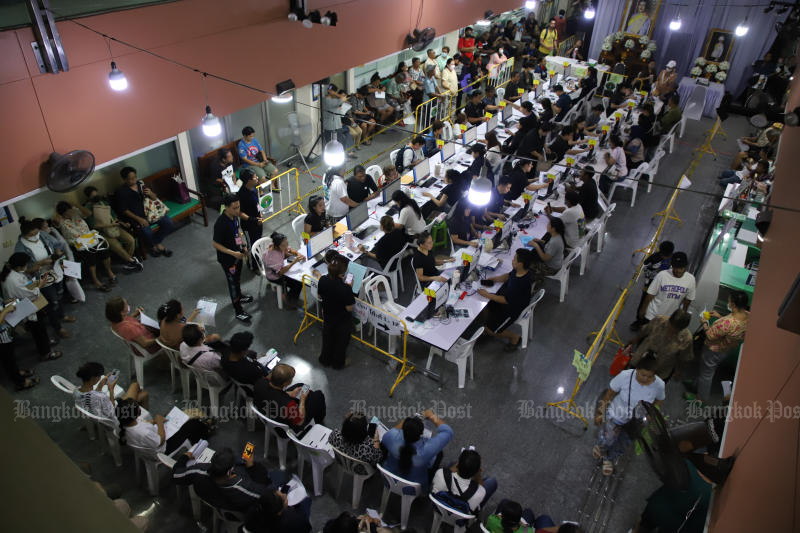
Residents wait to submit flood compensation claims at Sai Mai District Office in Bangkok in October 2026. More staff were deployed to ease overcrowding. (Photo: Varuth Hirunyatheb)
The national disaster insurance system could help address delays by shifting from securing funding after disasters to preparing funds in advance.
Under the new system, households affected by floods would receive an initial 10,000 baht, with coverage of up to 100,000 baht depending on damage, and payments targeted within 15 days after complete documentation is submitted.
Ultimately, disaster relief should not be measured only by how much the government pays, but by whether the money reaches people when they need it, she said.
"An effective insurance system must begin with trust in the people, with the state taking responsibility for proving who has been affected, rather than making citizens prove it themselves," she added.
KioskNews shows a cleaned-up reading view extracted from the publisher’s page — the original always lives on their site, not ours.