‘Soft resistance’ is the ‘most malicious’ threat to nat. security in Hong Kong – security chief

Hong Kong’s security chief has named “soft resistance” the “most malicious” threat to national security in the city.
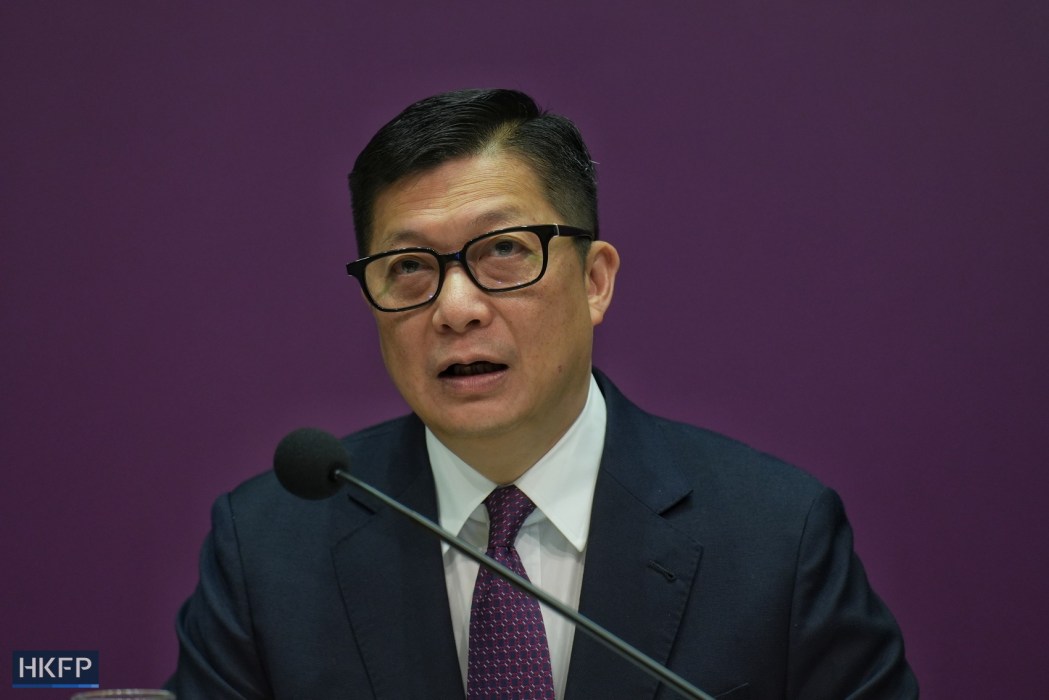
“The evil of soft resistance lies in the fact that you may not know it is evil,” Secretary for Security Chris Tang said in an interview with Commercial Radio on Monday. “You may even think it is [coming from] a good person.”
Reiterating language introduced by the government last year, Tang listed “four great national security risks” in Hong Kong. These include interference by foreign forces, domestic terrorist activities, fugitives continuing to spread “Hong Kong independence ideology,” and “soft resistance.”
Among the four, Tang said, “soft resistance” is the “most malicious” since its dangers are not as clear as the others’.

“If it is not illegal, first consider its intentions,” Tang added. “If it is illegal, action should of course be taken.”
Tang did not elaborate or provide any examples.
‘Undercurrents’
The term “soft resistance” was first mentioned in 2021 in a speech by Luo Huining, then-director of Beijing’s liaison office in Hong Kong. Since then, Hong Kong officials have cited “soft resistance” as a threat to national security, although they have not provided a clear definition of the term.
After Luo’s speech, pro-establishment commentator Lau Siu-kai told HK01 that soft resistance focused on ideological work that was difficult to address in law, including “disseminating disinformation, creating panic, maliciously attacking the SAR government and the central authorities and distorting the Basic Law.”
In his radio appearance, the security chief said that the “four great threats to national security” continue to operate primarily in the “undercurrents” of society.
At a passing-out parade last week, national security police chief Andrew Kan told new recruits to the force that “national security challenges have become more invisible,” cautioning them to stay on guard against “external forces,” “soft resistance,” and “ideological infiltration.”
“Oftentimes,” Kan said, “hidden dangers lurk in every corner of our communities.”
Beijing inserted national security legislation directly into Hong Kong’s mini-constitution in June 2020 following a year of pro-democracy protests and unrest. It criminalised subversion, secession, collusion with foreign forces and terrorist acts – broadly defined to include disruption to transport and other infrastructure. The move gave police sweeping new powers and led to hundreds of arrests amid new legal precedents, while dozens of civil society groups disappeared. The authorities say it restored stability and peace to the city, rejecting criticism from trade partners, the UN and NGOs.
Safeguard press freedom; keep HKFP free for all readers by supporting our team
Support HKFP | Policies & Ethics | Error/typo? | Contact | Newsletter | Transparency & Annual Report | Apps
Make a one-off donation.


Founded in 2015, Hong Kong Free Press is an impartial, non-profit, award-winning English-language newspaper. Run by journalists, backed by readers and 100% independent, HKFP is governed by a public Code of Ethics. If there are uncertainties relating to safety or security, we may use an "HKFP Staff" byline. More on our Ethics & Policies.
KioskNews shows a cleaned-up reading view extracted from the publisher’s page — the original always lives on their site, not ours.