Watch – Why Johannesburg’s inner city has been without power for weeks
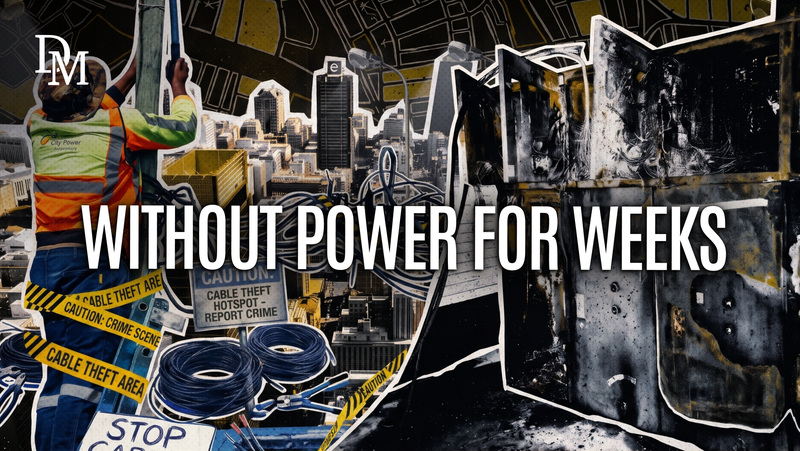
For weeks, parts of Johannesburg's inner city have been without electricity. On 16 October, City Power took property owners underground at Central Substation to show them stolen cables, the entry points used by thieves, and a 1980s feeder board that caught fire and exploded on 14 October. This video explains why repairs have taken so long, how theft continues despite armed guards, and what the outages are costing residents and property owners, with vacancy rates in affected buildings rising from about 3% to 20%. Daily Maverick’s Anna Cox explains.
Reporting by: Anna Cox
Filmed by: Malibongwe Tyilo
Edited by: Joel Seboa
Produced by: Emilie Gambade
Creative input by: Malibongwe Tyilo
Sub-edited by: Ian Wolstenholme
Support journalism that protects democracy. Become a Maverick Insider.
For many weeks, large parts of Johannesburg's inner city have been without electricity. Property owners have been paying for diesel and emergency water. Tenants have been moving out. And residents have been running out of patience.
On 16 October, City Power took a group of property owners underground, into Central Substation, to show them what its repair teams are up against.
They were shown stolen cables, old and broken equipment, and the routes thieves use to get in, through walls and tunnels.
They also saw the old feeder board, the equipment that sends power out to the surrounding area, which had been damaged by fire and an explosion.
One of the people on that tour was Angela Rivers, who heads the Johannesburg Property Owners and Managers Association.
Her organisation had spent weeks criticising City Power following numerous complaints by its members. But she came out with a different view.
She told me that, having seen first-hand how thieves were breaking in, she now believed City Power's account of the theft and vandalism. And she said she was more hopeful than before she went underground.
So why has fixing Central taken so long?
The feeder board there dates back to the 1980s. City Power had planned to keep it running while a new one was built and installed. But the old board failed first.
On the evening of 14 October, during an attempt to restore power, it caught fire and exploded, and could no longer be repaired. By 17 October, City Power said about 80% of the protection cables had been laid and testing of key equipment was under way.
It set an estimated restoration date of 20 October, provided repairs, testing and safety checks were completed.
Rivers said the delegation was told the new feeder board had been installed, and that power would come back in stages.
Then there is the security problem. Central Substation is now under 24-hour armed guard. Even so, City Power told the delegation that thieves were still trying to break in around midnight, while repair teams were working.
In parts of the rebuilt network, it has replaced copper cables with aluminium, to make them less attractive to steal.
City Power says its inner-city underground network runs through about 14 kilometres of cable tunnels, with multiple access points.
It is working with the police, the Hawks and private security companies, and it has approached the Defence Ministry for help. There has been no confirmation that soldiers have been deployed.
Central is not the only repair job. City Power replaced six kilometres of cable between Selby Substation and Kazerne, but when teams tried to restore supply on the night of 16 October, the cable failed. The utility blamed vandalism.
At Fort Substation, there was better news. All 17 cables damaged in a fire on 12 October were repaired, and power was restored to Hillbrow, Braamfontein, Berea, parts of the CBD and the Constitutional Court.
But the restoration followed days of disruption. In Braamfontein, a local church said students preparing for exams could not charge their computers or get online, and food was spoiling.
The economic cost has been mounting.
Earlier in October, Rivers told me that vacancy rates among affected property owners had risen from about 3% to 20%.
One building lost 20 tenants in a single month. Some property owners have spent millions of rands on diesel, generators and water.
Some have even been providing gas stoves and freezers in the basements for their tenants to assist them. Caretakers and owners are often threatened because tenants believe it is their fault.
And it is not only the inner city. In Rosettenville, Bez Valley and Malvern, residents have burned tyres in protest. In Kensington, residents say they have had numerous outages in five months, some lasting seven days week.
Their ward councillor, Neuren Pietersen, says repairs and changes to the grid often go unrecorded, so teams can spend days just finding a fault.
And he says the reporting systems are so poorly coordinated that faults can be marked as fixed while homes are still in the dark. One estate manager in the area says about 60 tenants have moved out in four months.
The property owners' association has a full round-table with senior City Power officials scheduled for 27 October.
City Power has acknowledged the hardship these outages have caused. It says the planned work is meant to make the network more reliable, and to shorten repair times when faults occur. DM
KioskNews shows a cleaned-up reading view extracted from the publisher’s page — the original always lives on their site, not ours.